Quipazine
 | |
| Clinical data | |
|---|---|
| Other names | 2-(1-Piperazinyl)quinoline; 2-Piperazinoquinoline; 1-(2-Quinolinyl)piperazine |
| Drug class | Non-selective serotonin receptor agonist; Serotonin reuptake inhibitor; Emetic; Serotonergic psychedelic; Hallucinogen |
| ATC code |
|
| Identifiers | |
IUPAC name
| |
| CAS Number | |
| PubChem CID | |
| IUPHAR/BPS | |
| ChemSpider | |
| UNII | |
| ChEMBL | |
| CompTox Dashboard (EPA) | |
| ECHA InfoCard | 100.164.885 |
| Chemical and physical data | |
| Formula | C13H15N3 |
| Molar mass | 213.284 g·mol−1 |
| 3D model (JSmol) | |
SMILES
| |
InChI
| |
| (verify) | |


Quipazine, also known as 1-(2-quinolinyl)piperazine, is a serotonergic drug of the arylpiperazine family and an analogue of 1-(2-pyridinyl)piperazine which is used in scientific research.[1][2][3][4][5] It was first described in the 1960s and was originally intended as an antidepressant but was never developed or marketed for medical use.[1][6][4]
Pharmacology
Pharmacodynamics
| Target | Affinity (Ki, nM) |
|---|---|
| 5-HT1A | 230–>10,000 |
| 5-HT1B | 1,000 |
| 5-HT1D | 1,000–3,720 |
| 5-HT1E | ND |
| 5-HT1F | ND |
| 5-HT2A | 59–2,780 |
| 5-HT2B | 49–178 |
| 5-HT2C | 54–339 |
| 5-HT3 | 2.0–4.0 (Ki) 1.0 (EC50) |
| 5-HT4 | >10,000 (guinea pig) |
| 5-HT5A | >10,000 (mouse) |
| 5-HT6 | 3,600 |
| 5-HT7 | 3,033 |
| α1 | >10,000 (rat) |
| α2 | 5,000 (rat) |
| β1 | 5,600 |
| β2 | 2,900 (rat) |
| D1 | >10,000 |
| D2 | >10,000 |
| D2-like | 3,920 (rat) |
| mACh | >10,000 (rat) |
| SERT | 30 |
| NET | ND |
| DAT | ND |
| Notes: The smaller the value, the more avidly the drug binds to the site. All proteins are human unless otherwise specified. Refs: [7][8] | |
Quipazine is a serotonin 5-HT3 receptor agonist and to a lesser extent a serotonin 5-HT2A receptor agonist, ligand of the serotonin 5-HT2B and 5-HT2C receptors, and serotonin reuptake inhibitor.[1][2][7][8] Activation of the serotonin 5-HT3 is implicated in inducing nausea and vomiting as well as anxiety, which has limited the potential clinical usefulness of quipazine.[1][2][3]
Quipazine produces a head-twitch response and other psychedelic-consistent effects in animal studies including in mice, rats, and monkeys.[1][3][9][10][11] These effects appear to be mediated by activation of the serotonin 5-HT2A receptor, as they are blocked by serotonin 5-HT2A receptor antagonists like ketanserin.[1][3][11] The head twitches induced by quipazine are potentiated by the monoamine oxidase inhibitor (MAOI) pargyline.[11][12] Based on this, it has been suggested that quipazine may act as a serotonin releasing agent and that it may induce the head twitch response by a dual action of serotonin 5-HT2A receptor agonism and induction of serotonin release.[11][12]
Quipazine did not produce psychedelic effects in humans up to a dose of 25 mg, which was the highest dose tested due to serotonin 5-HT3 receptor-mediated side effects of nausea and gastrointestinal discomfort.[13][3] Alexander Shulgin has anecdotally claimed that a fully effective psychedelic dose could be reached by blocking serotonin 5-HT3 receptors using the serotonin 5-HT3 receptor antagonist ondansetron.[3][14]
Quipazine can produce tachycardia, including positive chronotropic and positive inotropic effects, through activation of the serotonin 5-HT3 receptor.[2]
Although quipazine does not generalize to dextroamphetamine in drug discrimination tests of dextroamphetamine-trained rodents, dextroamphetamine and cathinone have been found to partially generalize to quipazine in assays of quipazine-trained rodents.[15][16] In relation to this, it has been suggested that quipazine might possess some dopaminergic activity, as the discriminative stimulus properties of amphetamine appear to be mediated by dopamine signaling.[15][16] Relatedly, quipazine has been said to act as a dopamine receptor agonist in addition to serotonin receptor agonist.[11] Conversely however, the generalization may be due to serotonergic activities of amphetamine and cathinone.[17] Fenfluramine has been found to fully generalize to quipazine, but levofenfluramine, in contrast to quipazine, did not generalize to dextroamphetamine.[15][10]
Chemistry
Quipazine is a substituted piperazine and quinoline.[4] It is structurally related to 6-nitroquipazine and 1-(1-naphthyl)piperazine.[4]
Synthesis
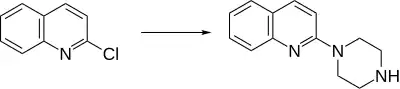
It is synthesized by reacting 2-chloroquinoline with piperazine.
See also
References
- 1 2 3 4 5 6 Glennon RA, Dukat M (2 May 2023). "Quipazine: Classical hallucinogen? Novel psychedelic?". Australian Journal of Chemistry. 76 (5): 288–298. doi:10.1071/CH22256. ISSN 0004-9425.
- 1 2 3 4 Cappelli A, Butini S, Brizzi A, Gemma S, Valenti S, Giuliani G, et al. (2010). "The interactions of the 5-HT3 receptor with quipazine-like arylpiperazine ligands: the journey track at the end of the first decade of the third millennium". Curr Top Med Chem. 10 (5): 504–526. doi:10.2174/156802610791111560. PMID 20166948.
- 1 2 3 4 5 6 de la Fuente Revenga M, Shah UH, Nassehi N, Jaster AM, Hemanth P, Sierra S, et al. (March 2021). "Psychedelic-like Properties of Quipazine and Its Structural Analogues in Mice". ACS Chem Neurosci. 12 (5): 831–844. doi:10.1021/acschemneuro.0c00291. PMC 7933111. PMID 33400504.
- 1 2 3 4 Elks J (2014). The Dictionary of Drugs: Chemical Data: Chemical Data, Structures and Bibliographies. Springer US. p. 987. ISBN 978-1-4757-2085-3. Retrieved 10 December 2024.
- ↑ Morton IK, Hall JM (2012). Concise Dictionary of Pharmacological Agents: Properties and Synonyms. Springer Netherlands. p. 244. ISBN 978-94-011-4439-1. Retrieved 10 December 2024.
- ↑ Rodríguez R, Pardo EG (1971). "Quipazine, a new type of antidepressant agent". Psychopharmacologia. 21 (1): 89–100. doi:10.1007/BF00404000. PMID 5567294.
- 1 2 "PDSP Database". UNC (in Zulu). Retrieved 4 December 2024.
- 1 2 Liu T. "BindingDB BDBM50014407 2-(piperazin-1-yl)quinoline::2-Piperazin-1-yl-quinoline::2-Piperazin-1-yl-quinoline (Quipazine)::2-Piperazin-1-yl-quinoline(Quipazine)::CHEMBL18772::QUIPAZINE". BindingDB. Retrieved 4 December 2024.
- ↑ Glennon RA (1996). "Classical Hallucinogens". Pharmacological Aspects of Drug Dependence. Handbook of Experimental Pharmacology. Vol. 118. Berlin, Heidelberg: Springer Berlin Heidelberg. pp. 343–371. doi:10.1007/978-3-642-60963-3_10. ISBN 978-3-642-64631-7.
- 1 2 Glennon RA (1988). "Site-Selective Serotonin Agonists as Discriminative Stimuli". Transduction Mechanisms of Drug Stimuli. Vol. 4. Berlin, Heidelberg: Springer Berlin Heidelberg. pp. 15–31. doi:10.1007/978-3-642-73223-2_2. ISBN 978-3-642-73225-6. PMID 3293039.
{{cite book}}:|journal=ignored (help) - 1 2 3 4 5 Nakagawasai O, Arai Y, Satoh SE, Satoh N, Neda M, Hozumi M, et al. (January 2004). "Monoamine oxidase and head-twitch response in mice. Mechanisms of alpha-methylated substrate derivatives". Neurotoxicology. 25 (1–2): 223–232. Bibcode:2004NeuTx..25..223N. doi:10.1016/S0161-813X(03)00101-3. PMID 14697897.
- 1 2 Malick JB, Doren E, Barnett A (March 1977). "Quipazine-induced head-twitch in mice". Pharmacol Biochem Behav. 6 (3): 325–329. doi:10.1016/0091-3057(77)90032-6. PMID 140381.
- ↑ Winter JC (1994). "The stimulus effects of serotonergic hallucinogens in animals". NIDA Research Monograph. 146: 157–182. PMID 8742798.
- ↑ Halberstadt AL, Geyer MA (2016). "Effect of Hallucinogens on Unconditioned Behavior". Behavioral Neurobiology of Psychedelic Drugs. Current Topics in Behavioral Neurosciences. Vol. 36. pp. 159–199. doi:10.1007/7854_2016_466. ISBN 978-3-662-55878-2. PMC 5787039. PMID 28224459.
- 1 2 3 Young R, Glennon RA (1986). "Discriminative stimulus properties of amphetamine and structurally related phenalkylamines". Med Res Rev. 6 (1): 99–130. doi:10.1002/med.2610060105. PMID 3512936.
- 1 2 Glennon RA, Rosecrans JA (1981). "Speculations on the mechanism of action of hallucinogenic indolealkylamines". Neurosci Biobehav Rev. 5 (2): 197–207. doi:10.1016/0149-7634(81)90002-6. PMID 7022271.
- ↑ Goudie AJ (September 1985). "Comparative effects of cathinone and amphetamine on fixed-interval operant responding: a rate-dependency analysis". Pharmacol Biochem Behav. 23 (3): 355–365. doi:10.1016/0091-3057(85)90006-1. PMID 4048231.
- ↑ DE 2006638, Rodriguez R, issued 1970 Chem. Abstr., 73: 98987g (1970).