Asymbescaline
 | |
 | |
| Names | |
|---|---|
| Preferred IUPAC name
2-(3,4-Diethoxy-5-methoxyphenyl)ethan-1-amine | |
| Other names
3,4-Diethoxy-5-methoxyphenethylamine | |
| Identifiers | |
CAS Number |
|
3D model (JSmol) |
|
| ChEMBL | |
| ChemSpider | |
PubChem CID |
|
| UNII | |
CompTox Dashboard (EPA) |
|
InChI
| |
SMILES
| |
| Properties | |
Chemical formula |
C13H21NO3 |
| Molar mass | 239.315 g·mol−1 |
Except where otherwise noted, data are given for materials in their standard state (at 25 °C [77 °F], 100 kPa).
Infobox references | |


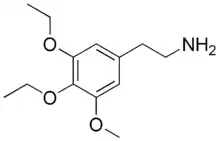
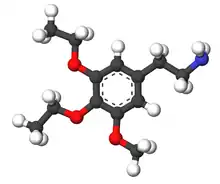
Asymbescaline (3,4-diethoxy-5-methoxyphenethylamine) is a lesser-known psychedelic drug. It is a homolog of mescaline. Asymbescaline was first synthesized by Alexander Shulgin. In his book PiHKAL, the dosage range is listed as 200–280 mg, and the duration listed as 10–15 hours.[1] Asymbescaline produces few to no effects.[1] Very little data exists about the pharmacological properties, metabolism, and toxicity of asymbescaline.
See also
External links
References
This article is issued from Wikipedia. The text is licensed under Creative Commons - Attribution - Sharealike. Additional terms may apply for the media files.