Lower Dir District
Lower Dir District
ضلع دیر زیریں ښکته دير ولسوالۍ | |
|---|---|
District of Khyber Pakhtunkhwa | |
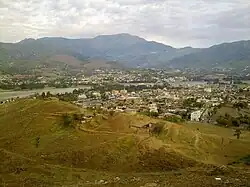 Timergara, the district headquarters | |
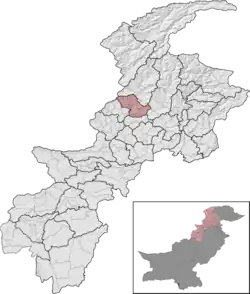 Lower Dir District (red) in Khyber Pakhtunkhwa | |
| Coordinates: 34°51′N 71°51′E / 34.850°N 71.850°E | |
| Country |  Pakistan Pakistan |
| Province |  Khyber Pakhtunkhwa Khyber Pakhtunkhwa |
| Division | Malakand |
| Headquarters | Timergara |
| Government | |
| • Type | District Administration |
| • Deputy Commissioner | Muhammad Fawad (BPS-20 PCS) |
| • District Police Officer | Ikramullah Khan (BPS-18 PSP) |
| Area | |
• Total | 1,583 km2 (611 sq mi) |
| Population (2023)[1] | |
• Total | 1,650,183 |
| • Density | 1,000/km2 (2,700/sq mi) |
| • Urban | 47,855 (2.90%) |
| • Rural | 1,602,327 |
| Literacy | |
| • Literacy rate |
|
| Time zone | PST |
| Number of Tehsils | 5 |
| Website | dirlower |
Lower Dir District (Pashto: ښکته دير ولسوالۍ, Urdu: ضلع دیر زیریں) is a district in the Khyber Pakhtunkhwa province of Pakistan.[3] Timergara is the district's headquarters and largest city.[3] The Lower Dir district was formed in 1996, when Dir District was divided into Upper Dir and Lower Dir districts.[3] On 22 January 2023, both Lower Dir and Upper Dir districts were further bifurcated to create a new Central Dir District.[4] Lower Dir is famous for its beautiful snow-capped mountains, valleys, and pleasant weather. The primary industry in Lower Dir is tourism, which is now rapidly growing.
Lower Dir district borders with Swat District to the east, Afghanistan to the west, Upper Dir to the north and Malakand and Bajaur District to the south.
History
At the time of independence of Pakistan, Dir was a princely state ruled by Nawab Shah Jehan Khan. Dir was merged with Pakistan in 1969, declared a district in 1970, and split into Upper and Lower Dir in 1996.[3]
Education
- The University of Malakand is a public university located in Chakdara.
- The University of Dir is a newly established university located in Timergara.
Demographics
| Year | Pop. | ±% p.a. |
|---|---|---|
| 1972 | 277,481 | — |
| 1981 | 404,844 | +4.29% |
| 1998 | 717,649 | +3.42% |
| 2017 | 1,436,082 | +3.72% |
| 2023 | 1,650,183 | +2.34% |
| Sources:[5][1] | ||
As of the 2023 census, Lower Dir district has 202,836 households and a population of 1,650,183. The district has a sex ratio of 97.24 males to 100 females and a literacy rate of 57.36%: 72.57% for males and 43.16% for females. 542,074 (32.88% of the surveyed population) are under 10 years of age. 47,860 (2.90%) live in urban areas.[1] 4,439 (0.27%) people in the district were from religious minorities, mainly Christians.[6] Pashto was the predominant language, spoken by 99.54% of the population.[7]
Administration
National Assembly
NA-6 (Lower Dir-I) and NA-7 (Lower Dir-II) are constituencies of the National Assembly of Pakistan from Lower Dir district. These areas were formerly part of NA-34 (Lower Dir) constituency from 1977 to 2018. The delimitation in 2018 split Lower Dir into two separate constituencies, NA-6 (Lower Dir-I) and NA-7 (Lower Dir-II).
NA-34 constituency (2002-2018)
| Member of National Assembly | Party Affiliation | Year |
|---|---|---|
| Qazi Hussain Ahmad | Muttahida Majlis-e-Amal | 2002 |
| Maulana Ahmad Ghafoor Ghawas | Muttahida Majlis-e-Amal | 2003 |
| Malak Azmat Khan | Pakistan Peoples Party | 2008 |
| Shahib Zada Muhammad Yaqub | Jamaat-e-Islami Pakistan | 2013 |
Since 2018: NA-6 (Lower Dir-I) and NA-7 (Lower Dir-II)
| Member of National Assembly | Party Affiliation | Constituency | Year |
|---|---|---|---|
| Mehboob Shah | PTI | NA-6 (Lower Dir-I) | 2018 |
| Muhammad Bashir Khan | PTI | NA-7 (Lower Dir-II) | 2018 |
Provincial Assembly
| Member of Provincial Assembly | Party Affiliation | Constituency | Year |
|---|---|---|---|
| Muhammad Azam Khan | Pakistan Tehreek-e-Insaf | PK-13 (Lower Dir-I) | 2018 |
| Humayun Khan | Pakistan Tehreek-e-Insaf | PK-14 (Lower Dir-II) | 2018 |
| Shafi ullah | Pakistan Tehreek-e-Insaf | PK-15 (Lower Dir-III) | 2018 |
| Bahdur Khan | Awami National Party | PK-16 (Lower Dir-IV) | 2018 |
| Liaqat Ali Khan | Pakistan Tehreek-e-Insaf | PK-17 (Lower Dir-V) | 2018 |
Sub-divisions
- Adenzai Tehsil
- Balambat Tehsil
- Khall Tehsil
- Lal Qilla Tehsil
- Munda Tehsil
- Samar Bagh Tehsil
- Timergara Tehsil
Notable people
- Nawabzada Shahabuddin Khan, Former Ruler of Lower Dir[8][9]
- Siraj ul Haq, politician
- Muhammad Bashir Khan, politician
- Jehan Alam Khan, President / Head of World Yousafzai Jirga ( WYJ )
- Naseem Shah, cricketer
- Zahid Khan, Ex-Senator
- Abaseen Yousafzai, Pashto poet
Gallery
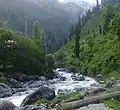 Maidan Valley, Lower Dir
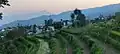 Lajbouk, Lower Dir
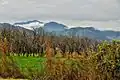 Chakdara, Lower Dir
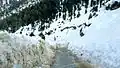 Kalpani Top, Lower Dir
See also
- Constituency NA-6 (Lower Dir-I)
- Constituency NA-7 (Lower Dir-II)
- Education in Lower Dir District
- Upper Dir District
References
- 1 2 3 "7th Population and Housing Census - Detailed Results: Table 1" (PDF). www.pbscensus.gov.pk. Pakistan Bureau of Statistics.
- ↑ "Literacy rate, enrolments, and out-of-school population by sex and rural/urban, CENSUS-2023, KPK" (PDF).
- 1 2 3 4 "About District". Khyber Pakhtunkhwa: Deputy Commissioner Dir Lower.
- ↑ "KP gets another district". Dunya News. 2023-01-18. Retrieved 2024-07-14.
- ↑ "Population by administrative units 1951-1998" (PDF). Pakistan Bureau of Statistics.
- ↑ "7th Population and Housing Census - Detailed Results: Table 9" (PDF). Pakistan Bureau of Statistics.
- ↑ "7th Population and Housing Census - Detailed Results: Table 11" (PDF). Pakistan Bureau of Statistics.
- ↑ "Tribe seeks ban on sale, purchase of shared land". www.thenews.com.pk.
- ↑ High Court, Peshawar (17 November 2016). "Judgment Sheet In The Peshawar High Court - The Government Of Khyber Pakhtunkhwa & Others Vs. Nawabzada Muhammad Shahabuddin Through Lrs & Others" (PDF). Retrieved 18 January 2024.
https://senate.gov.pk/en/profile.php?uid=804
https://www.thenews.com.pk/print/1276499-yousafzai-jirga-chief-vows-to-work-for-pakhtuns-unity
External links
- Khyber-Pakhtunkhwa Government website section on Lower Dir
- Khyber-Pakhtunkhwa news website section on Lower Dir
Provincial capital: Peshawar | ||
| Bannu |  | |
| Dera Ismail Khan | ||
| Hazara |
| |
| Kohat | ||
| Malakand | ||
| Mardan | ||
| Peshawar | ||
| Former |
| |
Administrative divisions of Lower Dir District | ||
|---|---|---|
| Tehsils | Union Councils | |
| Adenzai |
| |
| Balambat |
| |
| Lal Qilla |
| |
| Munda |
| |
| Samar Bagh |
| |
| Timergara |
| |