45

There is clearly a prefix in names like McDonald, McChrystal, O’Brian, O’Neal.

What does this Mc- and O- prefix signify? It looks like Donald, Chrystal, Brian, Neal are perfectly fine names on their own, so why is there a prefix before it?

tchrist
  • 134,759
Midhat
  • 2,811
  • 2
    You forgot to mention another prefix for names, that is "Fitz" as in Fitzgerald. It also means "son of" and it clearly shows noble French Norman ancestry. – Paola Sep 14 '12 at 19:54
  • 3
    @Paola: "fitz" can be derived from Norman French, true, but that does not mean someone with a surname in Fitz- necessarily has Norman, French, or noble ancestry. – Marthaª Nov 01 '12 at 13:21
  • 2
    @Marthaª Fitz was used for bastard-names, so FitzRoy was a natural son of the king. There are also various sorts of FitzWhatevers, like FitzWilliam or FitzCharles or FitzClarence — all originally “illegitimate” children, but sometimes not forever staying that way. – tchrist Dec 07 '14 at 23:56

3 Answers3

49

Mc is an abbreviation of Gaelic Mac, "son".

The standard way to form a name using a simple patronymic byname for men is:

    <single given name> mac <father's given name (in genitive case & sometimes lenited)>

which means

    <given name> son <of father's given name>

For example, Donnchadh who is the son of Fearchar mac Domhnaill would be:

    Donnchadh mac Fearchair

which means

    Donnchadh son of Fearchar

O' is the Anglicized way to write Ó "male descendant of".

The standard way to form a name using an Irish clan affiliation byname for men is:

   
&lt;single given name&gt; &Oacute; &lt;eponymous clan ancestor's name (in genitive case)&gt;<br><br>

which means


&lt;given name&gt; male descendant &lt;of eponymous clan ancestor&gt;<br><br>

For example, Donnchadh who is the son of Fearchar Ó Conchobhair would be:


Donnchadh &Oacute; Conchobhair<br><br>

which means


Donnchadh male descendant of Conchobhar</blockquote>

Two common misconceptions are (1) that Mac means "son of" — it actually means just "son", and the "of" comes from putting the father's name into the possessive case; and (2) that Mc is Irish while Mac is Scottish (or vice versa) — actually, Mc and Mac are two ways to write the same thing, and both occur in names from both countries. (What is true is that O' is almost exclusively Irish; despite the romantic notions we have of Scottish clans, they didn't use their clan affiliation in their names.)

Edit: as for why the prefix is used even though the prefix-less names look perfectly fine on their own, this is basically Gaelic grammar and thus out of scope for this site. Suffice it to say, some languages are fine with unmarked patronymics — names that identify the bearer's father using the unmodified given name — but Gaelic is not one of them.

Marthaª
  • 32,910
  • Indeed, Mac is the Celtic (Irish Gaelic) equivalent of the son suffix in Germanic languages. There's nothing very special about it. – Noldorin Nov 30 '10 at 16:07
  • 3
    [pet peeve]There's no such language as "Celtic".[/peeve] – Marthaª Nov 30 '10 at 16:11
  • There is nothing special about Mc or Mac, but there is (or was) something special about Ó – Remou Nov 30 '10 at 16:23
  • 1
    "Irish Gaelic" = Irish. Another peeve to pet. – Remou Nov 30 '10 at 17:19
  • @Remou: indeed, most languages don't distinguish inherited surnames from literal ones. – Marthaª Nov 30 '10 at 17:22
  • Interesting. I didn't know existence of such a usage in a language other than Arabic. – mmdemirbas Mar 23 '12 at 11:57
  • You assert a “standard”, but cite no authority. Can someone cite an authority/authorities? – danorton Aug 07 '13 at 14:37
  • @danorton: there is no standard-issuing authority, and there is no reason that there should be one. The site I quoted is simply using "standard" as a synonym of "usual". – Marthaª Aug 07 '13 at 18:09
  • 1
    At least in Irish (not sure about Scottish), ó specifically means ‘grandson’, though in surnames it is better to see it as just a vague ancestral relation (basically anything further removed than ‘son’). And using ‘Gaelic’ on its own to refer to both Irish and Scottish—as well as Manx, by definition—is generally frowned upon in the field. ‘Goidelic’ would be a better term (Brythonic has the same patronymic, of course, but it is (f)ab in Welsh and other forms I don't know off the top of my head in Cornish and Breton). – Janus Bahs Jacquet Feb 12 '14 at 09:10
  • Also note (he says, a year later) that the modern Gaelic languages do frequently employ unmarked patronymics, but as colloquial epithets. The pattern there is <Anglicised first name> <father’s name in the genitive>, so your example person, Donnchadh Ó Conchobhair, son of Fearchar Ó Conchobhair, would colloquially be referred to as Donny Fhearchair, similar to how one might in quaint English refer to him as Old Farquhar’s Donny. – Janus Bahs Jacquet Mar 28 '15 at 18:19
  • 1
    @JanusBahsJacquet: note that putting the father's name in the genitive is a type of marking, so this is still not an example of an unmarked patronymic. It's Fred Johns, not Fred John. – Marthaª Mar 29 '15 at 02:40
13

Mac, is the Gaelic for "son", and O' means "grandson of". It is found mainly in names from family of Irish origin.

See Wikipedia for more information.

Eldroß
  • 4,057
  • 2
    The prefix "Mac" is closely related to Scottish Gaelic as well; see http://en.wikipedia.org/wiki/Scottish_Gaelic_personal_naming_system – Steve Melnikoff Nov 30 '10 at 12:32
  • 3
    Not O', O (Ó Domnhaill) the apostrophe was due to a confusion with the English O' (of). And do not forget Nic, Ní and Uí – Remou Nov 30 '10 at 14:57
  • @Remou Do you happen to know if Nic, , and are seen in modern naming convention, as it is the case with Mac and Ó/O'? – Eldroß Nov 30 '10 at 15:01
  • In Ireland, yes. – Remou Nov 30 '10 at 15:02
  • I'll add to that, just think how strange it would be to say "This is Maria son of Donal" (not quite the right translation, but to that effect) :) – Remou Nov 30 '10 at 15:10
  • @Remou: that's the case if you translate anything literally from other languages. A full Russian name might be "Alexandr Vladimirovich Safronov", but that would mean "Alexandr, son of Vladimir, of the Safron's". – Claudiu Nov 30 '10 at 15:41
  • 4
    @Claudiu: I think you missed the gender mismatch in @Remou's example. – Marthaª Nov 30 '10 at 15:57
  • @Martha: oh hehe.. – Claudiu Nov 30 '10 at 18:25
  • @Eldroß, most of those come from mac and ó to begin with. Mhic and are the genitives of mac and ó, and are used when the full name is in the genitive: Seán Mac Grianna and Seán Ó Grianna in the genitive is Sheáin Mhic Ghrianna and Sheáin Uí Ghrianna. is a shortening of nighean ‘daughter of X’, and nic is a contraction of ní mhic ‘daughter of son of X’. So S.M.G.’s daughter Mary would be Máire Nic Ghrianna, and S.Ó.G.’s would be Máire Ní Ghrianna. When a woman takes her husband’s name, bean (‘wife/woman’) is added: Máire Bean Uí Néill (Mary O’Neill). – Janus Bahs Jacquet Feb 12 '14 at 09:20
0

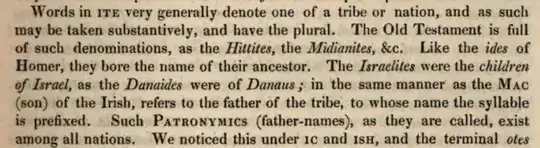
I found the following quote which could be helpful. It is from David Booth's (1766-1846) book: An Analytical Dictionary of the English Language.
enter image description here

"Words in ITE very generally denote one of a tribe or nation, and as such may be taken substantively, and have the plural. The Old Testament is full of such denominations, such as the Hittites, the Midianites, &c. Like the ides of Homer, they bore the name of their ancestor. The Israelites were the children of Israel, as the Danaides were of Danaus ; in the same manner as the MAC (son) of the Irish, refers to the father of the tribe, to whose name the syllable is prefixed. Such PATRONYMICS (father-names), as they are called, exist among all nations."

Page xcvii (or pdf page 113) Source: https://archive.org/details/analyticaldictio00bootuoft