13

I have often read "None of the above" at the end of multiple-choice questions (and I guess this is shorthand for "None of the above items").

Recently, in answering a help center email with my answer on top of the help center’s suggestions, I wrote "none of the below helps me". It struck me as incorrect just after having send it. I guess I should have put "None of the items below".

But it seems to me it is a matter of usage rather than logic : if "the above" is OK, what’s wrong with "the below" ?

tchrist
  • 134,759
Ewan
  • 143
  • 1
    @Edwin: I agree this question should have been covered by either your link, or “the below-identified person”: Term for this style and any style guides regarding. But I don't see anything explaining how it comes about that we all accept *the above* as a valid noun usage, but many if not most of us are at least vaguely discomfited by *the below*. – FumbleFingers May 24 '14 at 11:31
  • 8
    We usually use "the following" instead of "the below" as a counterpart to "the above" (note that "the preceding" is a more exact counterpart to "the following"). – Robusto May 24 '14 at 11:42
  • @Ewan: We just had our European MEPs election a couple of days ago in the UK, for which the list of candidates was so long I bet half the potential UKIP voters got bored and gave up before finding their preferred candidate (it was arranged alphabetically by party, so UKIP came last). I thought I'd be onto a winner if I started the "None of the Above" political party, but I'm now thinking "Sod idiomatic usage preferences! I need to officially register as 'A* None-of-the-Below Party' to have any chance of being noticed before voter apathy sets in!"* – FumbleFingers May 24 '14 at 11:43
  • 1
    Reading's a linear process. Presumably 'the above' has already been read. 'The below' is a mystery. 'See below' works when you don't want to use something as long as 'the information below'. – Wayfaring Stranger May 24 '14 at 11:46
  • 1
    @Robusto: True, but have you any explanation for why usage preferences for the below don't feel exactly "symmetrical" to the above? I realise it is used that way at least sometimes, but I can't deny I find it slightly "weird" even so. And that's only 57 hits for "the below* is a summary", whereas there are apparently 46,600 hits for "the above is a summary"*. – FumbleFingers May 24 '14 at 11:50
  • @Fumble: If I could hazard a guess, I would say it probably has more to do with the writer than the reader. At the time of writing, there is usually nothing "below" on the page, so perhaps it feels like an odd prolepsis. I myself have felt awkward referring to things "below" what I have already written, whereas "the following" seems to more comfortably refer to as-yet unrealized items that may be appended from this point forth. – Robusto May 24 '14 at 12:56
  • @Robusto: It's only just dawned on me that this is one of those relatively unusual contexts where writers may be much more significant than speakers. On the other hand, maybe it's relevant to note that OED's earliest noun sense (above* = a successful, flourishing, or prosperous state)* doesn't necessarily imply a written context. – FumbleFingers May 24 '14 at 13:02
  • I think "the above/below" feel more definite than "the preceding/following", perhaps because of the verbal nature of the latter pair. Because of what Wayfaring Stranger said about linearity, it makes sense to me that the more definite one feels more natural in the case of "above" (you've already read it so you have the definite thing for it to refer to). Whereas, the less definite one, "the following", the temporal nature of which contains a hint at the fact that you don't have the referent yet, feels more natural than "below". – Rupe May 24 '14 at 13:05
  • @Fumble: Well, yes, since speakers rarely make use of a spatial reference; instead, they would view the relationship as temporal. "What did I just tell you?" This is past. "Listen well to what I'm going to tell you." This is future. Nothing spatial about that. – Robusto May 24 '14 at 13:22
  • @Robusto: That's debatable. There, I've said it. My feeling is that *there* is definitely a "spatial" kind of usage there, and I'm inclined to think the first *that* is too. Come to that, "I'll come to* that, if you'll just let me finish"* seems like a pretty clear allusion to the idea that my future discourse will "spatially" move in that direction (if you catch my *drift!* :) – FumbleFingers May 24 '14 at 13:29
  • @FumbleFingers: I never said anything about demonstrative pronouns. There is a "meta" quality to "above" and "below" that does not obtain with respect to demonstrative pronouns. – Robusto May 24 '14 at 17:55
  • @Robusto: Hmm. In speech you might reasonably say "That there* is a list of supporting examples"* with much the same meaning as might be more formally conveyed in the corresponding written context by "The above* is a list..."*. Whatever. I'm just sceptical of the idea that the preference between spatial/temporal figurative usages varies significantly between spoken and written forms. Not because I have any particular knowledge of the issues involved; it just seems odd to me that such a thing might be true. – FumbleFingers May 24 '14 at 18:14
  • Well, now you're just indulging in sophistry—and reaching into rural U.S. dialect to do so. Do people in your country really say "that there" in conversation? – Robusto May 24 '14 at 20:23
  • @Robusto: I wouldn't say the usage is exactly tripping off every Brit's tongue, no. And it's certainly true that when it's just a metaphoric reference to recently spoken words, we'd usually stick to one word or the other rather than both. But in such metaphoric usages I wouldn't particularly class it as either rustic or "American" (just "informal"). But more "literal" usages like "I'll have me some of that there blueberry pie" would definitely evoke "US rustic" (perhaps just "rustic") to me even without the unmistakably American overtones of *me* and *blueberry pie*. – FumbleFingers May 24 '14 at 21:14
  • What about aforementioned? That would surely fit instead of the below. – ce4 Dec 18 '17 at 17:50

3 Answers3

7

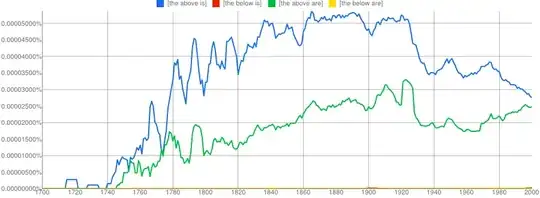
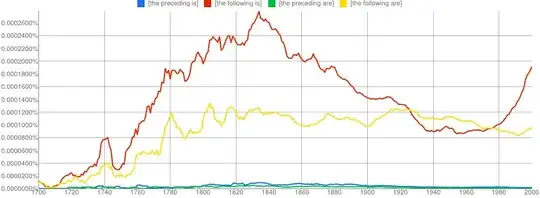
Here are some pretty pictures showing that actual usage is indeed extremely "non-symmetrical"...

From which it seems to me any explanation based on the "linearity" of the reading process isn't likely to cut it, since the above/below and preceding/following preferences are exactly opposite.

I'd also mention that (the full) OED has three subdefinitions for above as a noun usage, the oldest dating back to C14. The first citation for the preceding text sense under consideration here is 1691, and appears to be BrE. The second (1708) is definitely BrE, and nowhere does OED suggest this usage is particularly "American".

On the other hand, OED doesn't explicitly recognise below as a noun usage at all. Here are a few hundred written instances of "the below is a list" to show that every now and then someone is tempted to ignore established preference. But here are 54,200 instances of "the above is a list" showing just how strong that preference is.


TL;DR: I don't know why we accept above/following as noun usages, but we're not so keen on below/preceding. Obviously for current usage it's just that most of us simply reflect a strongly established preference that we can't avoid noticing. But to find the original reason for that choice, you'd have to go back over 600 years (well before Gutenberg invented the printing press).

FumbleFingers
  • 140,184
  • 45
  • 294
  • 517
  • We also prefer 'the house opposite' to 'the opposite house' spatially, whilst 'the opposite conclusion' is mandatory. And 'the opposite' means 'the converse' rather than 'the whatsit opposite'. Oh, and very pretty. – Edwin Ashworth May 24 '14 at 13:50
  • @Edwin: I actually had two or three goes at trying to find the best way of expressing preferences are exactly opposite in the above (sorry 'bout that! :) It's inherently awkward to compare and contrast one pair of opposites with another pair which are opposite to each other, but in the opposite way to the first pair. In the end I just gave up and settled for what you now see. – FumbleFingers May 24 '14 at 14:18
  • I think I write 'the below' with some frequency at work when top posting replies to email. – robertc May 24 '14 at 15:04
  • I’m finding that with almost no exception, all uses of “the below” should either be “this”, “these”, or “the following”. I have also found that most (but not all) postings that contain that phrase require editing because their written English is not good enough. – tchrist Aug 08 '15 at 22:05
  • @tchrist: I'm sure with almost no exception, all uses of “the above” *could* either be “this”, “these”, or “the preceding”. But it does seem usage is asymmetric, in that there's no obvious (to me, at least) reason why we're okay with the above and the following, but we don't like the noun usages the below and the preceding. Not that I particularly object to either of them myself - it's just that I'd almost always choose to use the more common forms. – FumbleFingers Aug 08 '15 at 22:43
  • Consider how you cannot swap in below for any adjective in “Their eager young eyes stared at the stormy grey sea.” Because it cannot substitute for an adjective in syntactic tests such as these without yielding an ungrammatical result, this failure provides strong evidence that below is not an adjective at all. – tchrist Jul 08 '17 at 17:55
3

You are correct! The phrase in common usage is shorthand for:

"None of the {items listed} above"

Common usage has desensitized readers to this shorthand. Because there has been no common usage of the phrase:

"None of the below"

We are still sensitive to it and it sounds odd to us.

2

The arguably adjectival usage (the above / below information) has been discussed in this thread.

The adjective and noun usages of above are given by the Oxford Advanced American Dictionary:

above adjective American [only before noun]

mentioned or printed previously in a letter, book, etc.

Please write to us at the above address.

the above American noun [countable] plural: the above

Please notify us if the above is not correct.

All the above (= the people mentioned) have passed the exam.

M-W has, correspondingly, for below:

3 below noun

something that is below First Known Use of BELOW: 1697

4 below adjective

written or discussed lower on the same page or on a following page First Known Use of BELOW: 1916

I'd add that the region-marker 'American' is unnecessary in the OAAD, and that 'below' is usually used postnominally, at least in the UK. People can fight over whether it's an adjective, adverb, locative, intransitive preposition, unicorn ...