I frequently see statements that refer to something later in the text that use a phrase such as "the below information". Is it more correct instead to say "the information below" (or "the following information")?
Asked
Active
Viewed 5.5e+01k times
37


-
I would assume you also find "the above figure" to be a problem? I personally correct authors constantly in using these terms as adjectives. – way0utwest Dec 10 '10 at 16:11
-
@way0utwest: Yes, I prefer "The frame around my name in the question above is ornate." rather than "the above question." – Dennis Williamson Dec 10 '10 at 16:18
-
11When someone writes "the below information", I surmise that their native language is not English. – GEdgar Nov 17 '11 at 02:50
-
3@GEdgar - Or the writer is trying to sound "businesslike", and they expect "the below information" to help them "synergise the value add". – nnnnnn May 14 '16 at 01:54
-
Intuitively I feel like I can I simply use "the below" (without any further words / nouns). Is it the case? For example, can I write in a email: "let's discuss the below" ? Should I ask another question? – Eugene Lycenok Jun 08 '21 at 07:26
6 Answers
21
As a preposition, "below" would be written after "information" as a stranded preposition. While typically prepositions would precede the noun, stranded prepositions can occur "in interrogative or relative clauses, where the interrogative or relative pronoun that is the preposition's complement is moved to the start".
We see such a stranded preposition in the case of "the information below," and therefore the preposition follows it. By contrast, in the case of "the following information", an adjective is used to describe the noun and therefore may precede it.
In short, "the below information" is not generally accepted to be correct, because "below" is not universally acknowledged as an adjective. Nevertheless, some dictionaries specifically list this as an exception.

Paul Lammertsma
- 2,198
-
1This answer is incorrect. Just as "the following paragraph" is correct, the "the below information" is also correct. – Frantisek Nov 16 '11 at 12:39
-
1Please refer to the discussion under nohat's answer: whether or not this is correct depends completely on whether or not "below" may be used as an adjective. – Paul Lammertsma Nov 16 '11 at 15:08
-
Stating that "the below information is incorrect" is incorrect, therefore your answer is incorrect. – Frantisek Nov 16 '11 at 15:38
-
12Instead of repeating your opinion, a more constructive contribution to this discussion would be demonstrating that "below" is acknowledged as an adjective. – Paul Lammertsma Nov 16 '11 at 16:23
-
I don't see why the burden of proof should be on me. "Below" can be both. The fact that you explained it YOURSELF as a preposition is not my problem. The question should be answered with a general answer, not with a subjective answer containing false assumptions. – Frantisek Nov 16 '11 at 21:14
-
8My answer is based upon the fact that Webster's Unabridged Dictionary, Collins English Dictionary and Wiktionary all only list "below" as a preposition and an adverb. I don't see the need to get so upset about this. – Paul Lammertsma Nov 16 '11 at 22:24
-
It appears that there is simply some difference definitions between dictionaries. "Below" is listed in the American Heritage as an adjective, specifically with this definition. – Paul Lammertsma Nov 16 '11 at 22:30
-
1Whether or not word A is acknowledged as part of speech B by resource C is completely orthogonal to the question of whether or not it is actually used that way in sentence D. In the sentence "I belowed your betweens", neither below nor between is a preposition. – RegDwigнt Nov 16 '11 at 22:49
-
Rimmer, RegDwight: I've revised my answer based upon your comments. – Paul Lammertsma Nov 16 '11 at 23:08
-
2Two points:1- you say "prepositions follow the noun". That is opposite of most understandings of the words in that statement. 2-adjectives can sometimes be placed after what it modifies - 'attorney general'. – Mitch Nov 16 '11 at 23:31
-
@RegDwight: 'Whether or not word A is acknowledged as part of speech B by resource C is completely orthogonal to the question of whether or not it is actually used that way in sentence D.' Yes, but if they're competent descriptivists, whether or not word A is acknowledged as part of speech B by resource C is not completely orthogonal to the question of whether or not it is actually used that way at all. – Edwin Ashworth Apr 10 '13 at 11:11
-
2Prepositions, by their very nature and definition, never follow the noun they modify. ‘Below’ is an adverb in the information below. – Janus Bahs Jacquet Dec 25 '13 at 10:53
-
@JanusBahsJacquet It's my understanding that in the case of "stranded" prepositions, prepositions can follow the noun. – Paul Lammertsma Jun 03 '14 at 15:45
-
1@PaulLammertsma I should have said “directly follow”, I guess. With stranded prepositions, the preposition is removed entirely from its object. Yes, it follows (comes later than) the object; but it doesn’t follow (come immediately after and form a unit with) the object. – Janus Bahs Jacquet Jun 03 '14 at 15:47
-
2@JanusBahsJacquet Here's something to ponder: consider how you cannot swap in below for any adjective in “Their eager young eyes stared at the stormy grey sea.” Because it cannot substitute for an adjective in syntactic tests such as these without yielding an ungrammatical result, I believe that this failure provides strong evidence that below is not an adjective at all. – tchrist Jul 08 '17 at 17:57
-
@tchrist To the extent that below is grammatical at all preceding the noun it relates to, it can grammatically (if somewhat nonsensically) replace stormy just fine to me, as can above. It cannot co-occur with possessive determinatives, so it cannot replace eager. – Janus Bahs Jacquet Jul 08 '17 at 18:03
-
@JanusBahsJacquet Now I wonder whether something can be made of the curious coöccurrence restriction you mention, and perhaps also of the adjective ordering restrictions. – tchrist Jul 08 '17 at 18:13
-
@tchrist I'm not actually sure if that's a grammatical restriction or just a very strong semantic one. Below-mentioned (which is more unequivocally an adjective) is subject to the same restriction (“Their below-mentioned reasons” is impossible for me, at least). – Janus Bahs Jacquet Jul 08 '17 at 18:16
-
@JanusBahsJacquet I believe compound words like above-mentioned work like tool-using and grass-fed do, as well as like skyscraper and can-opener. In all those “aforementioned” :) cases the um non-verb portion which normally follows is reärranged to precede that verb when a compound is formed, so mentioned above, using tools, fed grass, scraping skies, opening cans. Germanic orders these differently from Romance, where you leave the object in the normal place; cf. FR marque-page for bookmark, IT fermacarte for paperweight, ES rascacielos for skyscraper. – tchrist Jul 08 '17 at 18:30
-
@tchrist Yes, there's no doubt that below must follow the verb in the underlying structure in compounds of this type (traditionally called verbale Rektionskomposita). I wasn't implying that below-mentioned has any relevance to ‘the below information’, just that both fall in the adjective slot and both are completely incompatible with possessive determinatives (and perhaps other things as well). – Janus Bahs Jacquet Jul 08 '17 at 18:48
-
1@RiMMER I only ever see non-native English speakers use "below" as an adjective. – Orion Feb 14 '18 at 02:56
20

-
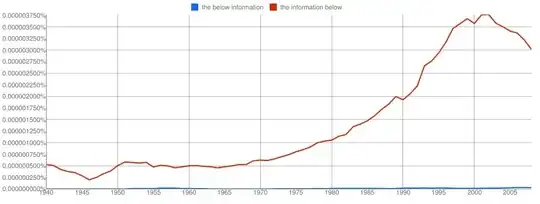
6+1: And adding to the Ngram "the information above" and "the above information" shows that while "above" can go both before and after the noun, "below" can only go after. – Peter Shor Nov 17 '11 at 03:33
-
1I see "the below information" a lot in texts that can be identified as coming from non-native speakers/those that have English as a second-language. E.g in Hindi you would use the word order"Below given information", and it seems this influences the usage by Hindi native speakers (comparable in size to all native English users), of English as a second language . – Anthon Sep 18 '18 at 08:36
14
Merriam-Webster lists a relevant definition:
below (adjective): written or discussed lower on the same page or on a following page
Given this, there is nothing wrong with “the below information”.

nohat
- 68,560
-
I hadn't considered that it could be an adjective. Random House doesn't list it; perhaps this is where the confusion comes from? – Paul Lammertsma Aug 13 '10 at 01:09
-
-
1I want 'below' to be used as an adjective, but I think it is not generally accepted ('bad form'), buit the position is still in question; one can have adjectives (rarely) come after the noun. But I feel that this particular 'below' is more adverbial. The M-W definition doesn't give an example and OED doesn't list an adjectival entry. The related OED entry fro 'beneath' gives the adjective as 'rare' (with a Shakespeare quote). A newspaper editor would fire a writer who tried to use "the below information", whatever ones justification might be. – Mitch Nov 16 '11 at 16:35
-
2@Mitch: I don't like the sound of it myself, but I think that it is becoming / will become more common / acceptable. I don't like the quote verb 'be like', but I'm resigned to its use. That the usage is cited in M-W surely 'legalises' it - absences from other respected dictionaries are not final proofs. Notice that M-W only licenses the domain of written / printed materials. – Edwin Ashworth Apr 10 '13 at 11:08
7
"He lives on the below floor" or "He lives on the floor below"? -- If not grammar, at least usage is against the first mentioned way of saying it.

Kris
- 37,386
-
3The MW sense for the attributive-position adjective (below {adjective}: written or discussed lower on the same page or on a following page) does not sanction domains outside the written / printed page, I'd guess in line with usage. – Edwin Ashworth Apr 10 '13 at 11:02
-
He lives on the below floor means He lives on the floor that we call below. Like, he lives on the top floor or he lives on the ground floor. – Oscar Bravo Mar 04 '19 at 16:05
-1
Usage of the former is often seen in a corporate communication when the author wishes to add a degree of formality or authority to the explanation. For example, 'see data in the below table'. Ironic, really, as instead of adding gravitas it results in the author sounding generic and bland.
Personally, I think it sounds unnatural, and forced, as it is rarely used in speech. You'd never, for example, respond to a query as to where a physical item was in relation to another by saying it 'is on the below shelf'.
One of those phrases used in a corporate context that doesn't exist in real life.


-
I have no recollection of having seen the first usage. The second is common in written communication. – anongoodnurse Jan 24 '14 at 08:41
-
1+1, I would agree, although below
is wrong, in my mind, even though I am seeing it more often in (US English) technical/business/official texts. However, above is more corporate than above - see It's ok to say “the above image” but not “the below image” – Greenonline Jun 13 '17 at 09:33
-3
The fact that the dictionary lists the word 'below' as an adjective doesn't mean it's correct. Dictionaries are a reflection of usage, both correct and incorrect. The reason that the word 'below' may be listed as an adjective reflects the overwhealming incorrect usage of the word. To make proper use of a language, one shoud use forms that have always been deemed correct and not use incorrect forms that have become the norm. Why 'dumb down' our language?

Andy Richard
- 15
-
3This ‘answer’ shows a staggering lack of knowledge of how language actually works. There is no such thing as “forms that have always been deemed correct”. – Janus Bahs Jacquet Dec 25 '13 at 10:51