HOXA13
| HOXA13 | |||||||||||||||||||||||||||||||||||||||||||||||||||
|---|---|---|---|---|---|---|---|---|---|---|---|---|---|---|---|---|---|---|---|---|---|---|---|---|---|---|---|---|---|---|---|---|---|---|---|---|---|---|---|---|---|---|---|---|---|---|---|---|---|---|---|
| |||||||||||||||||||||||||||||||||||||||||||||||||||
| Identifiers | |||||||||||||||||||||||||||||||||||||||||||||||||||
| Aliases | HOXA13, HOX1, HOX1J, homeobox A13 | ||||||||||||||||||||||||||||||||||||||||||||||||||
| External IDs | OMIM: 142959; MGI: 96173; HomoloGene: 73882; GeneCards: HOXA13; OMA:HOXA13 - orthologs | ||||||||||||||||||||||||||||||||||||||||||||||||||
| |||||||||||||||||||||||||||||||||||||||||||||||||||
| |||||||||||||||||||||||||||||||||||||||||||||||||||
| |||||||||||||||||||||||||||||||||||||||||||||||||||
| |||||||||||||||||||||||||||||||||||||||||||||||||||
| |||||||||||||||||||||||||||||||||||||||||||||||||||
| Wikidata | |||||||||||||||||||||||||||||||||||||||||||||||||||
| |||||||||||||||||||||||||||||||||||||||||||||||||||





Homeobox protein Hox-A13 is a protein that in humans is encoded by the HOXA13 gene.[5][6][7]
Function
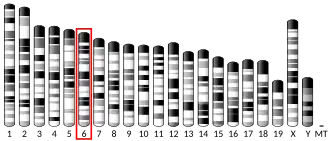
In vertebrates, the genes encoding the class of transcription factors called homeobox genes are found in clusters named A, B, C, and D on four separate chromosomes. Expression of these proteins is spatially and temporally regulated during embryonic development. This gene is part of the A cluster on chromosome 7 and encodes a DNA-binding transcription factor which may regulate gene expression, morphogenesis, and differentiation.[7]
Clinical significance
Expansion of a polyalanine tract in the encoded protein can cause hand-foot-genital syndrome, also known as hand-foot-uterus syndrome.[8] Aberrant expression of HoxA13 gene products in the esophagus, provokes Barrett’s esophagus, a form of metaplasia that is a direct precursor to esophageal cancer.[9]
See also
References
- 1 2 3 GRCh38: Ensembl release 89: ENSG00000106031 – Ensembl, May 2017
- 1 2 3 GRCm38: Ensembl release 89: ENSMUSG00000038203 – Ensembl, May 2017
- ↑ "Human PubMed Reference:". National Center for Biotechnology Information, U.S. National Library of Medicine.
- ↑ "Mouse PubMed Reference:". National Center for Biotechnology Information, U.S. National Library of Medicine.
- ↑ McAlpine PJ, Shows TB (July 1990). "Nomenclature for human homeobox genes". Genomics. 7 (3): 460. doi:10.1016/0888-7543(90)90186-X. PMID 1973146.
- ↑ Scott MP (November 1992). "Vertebrate homeobox gene nomenclature". Cell. 71 (4): 551–553. doi:10.1016/0092-8674(92)90588-4. PMID 1358459. S2CID 13370372.
- 1 2 "Entrez Gene: HOXA13 homeobox A13".
- ↑ Innis JW (2006-07-11). Hand-Foot-Genital Syndrome. NCBI Bookshelf, GeneReviews. University of Washington, Seattle. PMID 20301596.
- ↑ Janmaat VT, Nesteruk K, Spaander MC, Verhaar AP, Yu B, Silva RA, et al. (June 2021). "HOXA13 in etiology and oncogenic potential of Barrett's esophagus". Nature Communications. 12 (1): 3354. Bibcode:2021NatCo..12.3354J. doi:10.1038/s41467-021-23641-8. PMC 8184780. PMID 34099670.
Further reading
- Goodman FR, Scambler PJ (January 2001). "Human HOX gene mutations". Clinical Genetics. 59 (1): 1–11. doi:10.1034/j.1399-0004.2001.590101.x. PMID 11206481. S2CID 38364372.
- Utsch B, Becker K, Brock D, Lentze MJ, Bidlingmaier F, Ludwig M (May 2002). "A novel stable polyalanine [poly(A)] expansion in the HOXA13 gene associated with hand-foot-genital syndrome: proper function of poly(A)-harbouring transcription factors depends on a critical repeat length?". Human Genetics. 110 (5): 488–494. doi:10.1007/s00439-002-0712-8. PMID 12073020. S2CID 22181414.
- Acampora D, D'Esposito M, Faiella A, Pannese M, Migliaccio E, Morelli F, et al. (December 1989). "The human HOX gene family". Nucleic Acids Research. 17 (24): 10385–10402. doi:10.1093/nar/17.24.10385. PMC 335308. PMID 2574852.
- Apiou F, Flagiello D, Cillo C, Malfoy B, Poupon MF, Dutrillaux B (1996). "Fine mapping of human HOX gene clusters". Cytogenetics and Cell Genetics. 73 (1–2): 114–115. doi:10.1159/000134320. PMID 8646877.
- Mortlock DP, Innis JW (February 1997). "Mutation of HOXA13 in hand-foot-genital syndrome". Nature Genetics. 15 (2): 179–180. doi:10.1038/ng0297-179. PMID 9020844. S2CID 24522600.
- Sanger Centre, Washington University Genome Sequencing Center (November 1998). "Toward a complete human genome sequence". Genome Research. 8 (11): 1097–1108. doi:10.1101/gr.8.11.1097. PMID 9847074.
- Post LC, Innis JW (December 1999). "Infertility in adult hypodactyly mice is associated with hypoplasia of distal reproductive structures". Biology of Reproduction. 61 (6): 1402–1408. doi:10.1095/biolreprod61.6.1402. PMID 10569982.
- de Stanchina E, Gabellini D, Norio P, Giacca M, Peverali FA, Riva S, et al. (June 2000). "Selection of homeotic proteins for binding to a human DNA replication origin". Journal of Molecular Biology. 299 (3): 667–680. doi:10.1006/jmbi.2000.3782. PMID 10835276.
- Goodman FR, Bacchelli C, Brady AF, Brueton LA, Fryns JP, Mortlock DP, et al. (July 2000). "Novel HOXA13 mutations and the phenotypic spectrum of hand-foot-genital syndrome". American Journal of Human Genetics. 67 (1): 197–202. doi:10.1086/302961. PMC 1287077. PMID 10839976.
- Zhao Y, Potter SS (August 2001). "Functional specificity of the Hoxa13 homeobox". Development. 128 (16): 3197–3207. doi:10.1242/dev.128.16.3197. PMID 11688568.
- Fujino T, Suzuki A, Ito Y, Ohyashiki K, Hatano Y, Miura I, et al. (February 2002). "Single-translocation and double-chimeric transcripts: detection of NUP98-HOXA9 in myeloid leukemias with HOXA11 or HOXA13 breaks of the chromosomal translocation t(7;11)(p15;p15)". Blood. 99 (4): 1428–1433. doi:10.1182/blood.V99.4.1428. PMID 11830496.
- Kosaki K, Kosaki R, Suzuki T, Yoshihashi H, Takahashi T, Sasaki K, et al. (February 2002). "Complete mutation analysis panel of the 39 human HOX genes". Teratology. 65 (2): 50–62. doi:10.1002/tera.10009. PMID 11857506.
- Innis JW, Goodman FR, Bacchelli C, Williams TM, Mortlock DP, Sateesh P, et al. (May 2002). "A HOXA13 allele with a missense mutation in the homeobox and a dinucleotide deletion in the promoter underlies Guttmacher syndrome". Human Mutation. 19 (5): 573–574. doi:10.1002/humu.9036. hdl:2027.42/35180. PMID 11968094. S2CID 26468280.
- Taketani T, Taki T, Ono R, Kobayashi Y, Ida K, Hayashi Y (August 2002). "The chromosome translocation t(7;11)(p15;p15) in acute myeloid leukemia results in fusion of the NUP98 gene with a HOXA cluster gene, HOXA13, but not HOXA9". Genes, Chromosomes & Cancer. 34 (4): 437–443. doi:10.1002/gcc.10077. PMID 12112533. S2CID 20992707.
- Debeer P, Bacchelli C, Scambler PJ, De Smet L, Fryns JP, Goodman FR (November 2002). "Severe digital abnormalities in a patient heterozygous for both a novel missense mutation in HOXD13 and a polyalanine tract expansion in HOXA13". Journal of Medical Genetics. 39 (11): 852–856. doi:10.1136/jmg.39.11.852. PMC 1735011. PMID 12414828.
External links
- GeneReviews/NCBI/NIH/UW entry on Hand-Foot-Genital Syndrome
- HOXA13+protein,+human at the U.S. National Library of Medicine Medical Subject Headings (MeSH)
This article incorporates text from the United States National Library of Medicine, which is in the public domain.