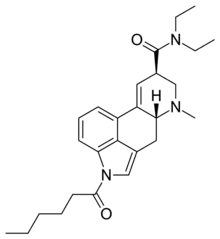
1H-LSD
 | |
| Legal status | |
|---|---|
| Legal status |
|
| Identifiers | |
IUPAC name
| |
| PubChem CID | |
| Chemical and physical data | |
| Formula | C26H35N3O2 |
| Molar mass | 421.585 g·mol−1 |
| 3D model (JSmol) | |
SMILES
| |
InChI
| |
1H-LSD (N1-hexanoyl-lysergic acid diethylamide, SYN-L-027)[1] is an acylated derivative of lysergic acid diethylamide (LSD), with a six carbon hexanoyl chain attached to the N1 position. It acts as a prodrug for LSD, and in animal studies produces drug-appropriate responding with a similar potency to short-chain homologues such as ALD-52 and 1P-LSD, in contrast to the 4 and 5 carbon homologues 1B-LSD and 1V-LSD which are several times weaker.[2]
See also
References
- ↑ WO 2024028495, Stratford A, Williamson JP, "Prodrugs of Substituted Ergolines", published 8 February 2024, assigned to Synex Holdings BV
- ↑ Brandt SD, Kavanagh PV, Gare S, Stratford A, Halberstadt AL (July 2024). "Analytical and behavioral characterization of 1-hexanoyl-LSD (1H-LSD)" (PDF). Drug Testing and Analysis. doi:10.1002/dta.3767. PMID 38965834.
This article is issued from Wikipedia. The text is licensed under Creative Commons - Attribution - Sharealike. Additional terms may apply for the media files.