NGC 684
| NGC 684 | |
|---|---|
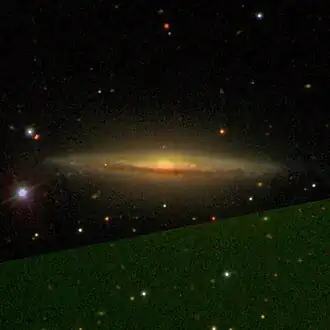 NGC 684 (SDSS) | |
| Observation data (J2000.0 epoch) | |
| Constellation | Triangulum |
| Right ascension | 01h 50m 14.0407s [1] |
| Declination | +27° 38′ 44.472″ [1] |
| Redshift | 0.011798 [1] |
| Heliocentric radial velocity | 3537 ± 1 km/s [1] |
| Distance | 135.03 ± 3.13 Mly (41.400 ± 0.960 Mpc)[1] |
| Group or cluster | NGC 684 group (LGG 32) |
| Apparent magnitude (V) | 12.50 [2] |
| Apparent magnitude (B) | 13.30 [2] |
| Characteristics | |
| Type | Sb edge-on [1] |
| Size | ~137,500 ly (42.15 kpc) (estimated)[1] |
| Apparent size (V) | 3.2′ × 0.6′[1] |
| Other designations | |
| IRAS 01474+2724, IC 165, UGC 1292, MCG +04-05-017, PGC 6759, CGCG 482-022[1] | |
NGC 684 is a spiral galaxy approximately 135 million light-years away from Earth in the constellation of Triangulum.[1] It was discovered by William Herschel on October 26, 1786.[3] Edward Swift, Lewis' son, found this galaxy again on 18 Jan 1890 while "searching for Swift's Comet." and it was reported as a new object in list IX-6.[3]
NGC 684 Group
NGC 684 is the largest member of a group of galaxies named after it (also known as LGG 32), which includes the galaxies NGC 670 and IC 1731.[4]
Supernovae
Two supernovae have been observed in NGC 684:
- SN 2021ass (type II, mag. 18.1122) was discovered by the Zwicky Transient Facility on 18 January 2021.[5]
- SN 2025aml (type II, mag. 18.1168) was discovered by the Zwicky Transient Facility on 31 January 2025.[6]
See also
References
- 1 2 3 4 5 6 7 8 9 10 "Results for object NGC 0684". NASA/IPAC Extragalactic Database. NASA and Caltech. Retrieved 4 December 2017.
- 1 2 "Revised NGC Data for NGC 684". spider.seds.org. Retrieved December 9, 2017.
- 1 2 "Data for NGC 684". www.astronomy-mall.com. Retrieved December 9, 2017.
- ↑ Garcia, A. M. (1993). "General study of group membership. II. Determination of nearby groups". Astronomy and Astrophysics Supplement Series. 100: 47. Bibcode:1993A&AS..100...47G.
- ↑ "SN 2021ass". Transient Name Server. IAU. Retrieved 4 September 2024.
- ↑ "SN 2025aml". Transient Name Server. IAU. Retrieved 31 January 2025.
External links
 Media related to NGC 684 at Wikimedia Commons
- NGC 684 on WikiSky: DSS2, SDSS, GALEX, IRAS, Hydrogen α, X-Ray, Astrophoto, Sky Map, Articles and images
- SEDS

This article is issued from Wikipedia. The text is licensed under Creative Commons - Attribution - Sharealike. Additional terms may apply for the media files.