NGC 150
| NGC 150 | |
|---|---|
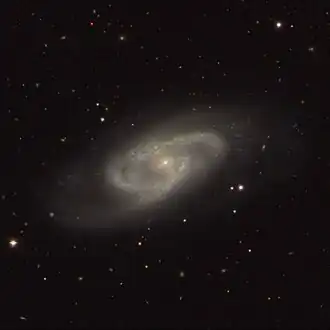 NGC 150 imaged by DECam | |
| Observation data (J2000 epoch) | |
| Constellation | Sculptor |
| Right ascension | 00h 34m 17.0652s[1] |
| Declination | −27° 48′ 21.961″[1] |
| Redshift | 0.005294[1] |
| Heliocentric radial velocity | 1587 ± 1 km/s[1] |
| Distance | 62.92 ± 2.34 Mly (19.291 ± 0.717 Mpc) |
| Apparent magnitude (V) | 11.13[2] |
| Apparent magnitude (B) | 12.04[2] |
| Characteristics | |
| Type | SB(rs)b?[1] |
| Size | 94,300 ly (28.90 kpc)[1] |
| Apparent size (V) | 3.9′ × 1.9′[1] |
| Other designations | |
| ESO 410- G 019, IRAS 00317-2804, UGCA 7, MCG -05-02-018, PGC 2052[1] | |
NGC 150 (also known as PGC 2052) is a barred spiral galaxy in the constellation Sculptor. It is about 63 million light years away from the Solar System, and it has a diameter of about 94,000 light years.[3] It was discovered by Lewis A. Swift on 20 November 1886.[4]
Supernovae
Two supernovae have been observed in NGC 150:
See also
References
- 1 2 3 4 5 6 7 8 "Results for object NGC 0150". NASA/IPAC Extragalactic Database. NASA and Caltech. Retrieved 15 January 2025.
- 1 2 "NGC 150". SIMBAD. Centre de données astronomiques de Strasbourg. Retrieved 19 March 2017.
- ↑ "NASA/IPAC Extragalactic Database". NED results for object NGC 0150. NASA.
- ↑ "New General Catalog Objects: NGC 150 – 199". seligman.com. Retrieved 9 September 2016.
- ↑ Evans, R.; Cooper, K.; Sadler, E. (1990). "Supernova 1990K in NGC 150". International Astronomical Union Circular (5022): 1. Bibcode:1990IAUC.5022....1E.
- ↑ "SN 1990K". Transient Name Server. IAU. Retrieved 6 December 2024.
- ↑ Cappellaro, E.; Danziger, I. J.; della Valle, M.; Gouiffes, C.; Turatto, M. (1995). "The bright linear type II SN 1990K". Astronomy and Astrophysics. 293: 723–732. Bibcode:1995A&A...293..723C.
- ↑ "SN 2025mb". Transient Name Server. IAU. Retrieved 15 January 2025.
External links
| |||||||||
| Stars |
| ||||||||
| |||||||||
| |||||||||
| Galaxies |
| ||||||||
| |||||||||
| |||||||||
 Category Category | |||||||||
This article is issued from Wikipedia. The text is licensed under Creative Commons - Attribution - Sharealike. Additional terms may apply for the media files.