NGC 4900
| NGC 4900 | |
|---|---|
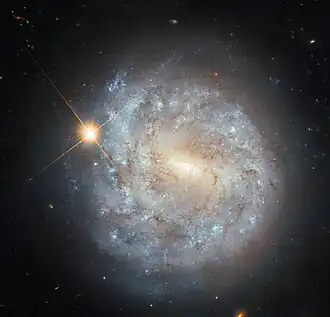 NGC 4900 imaged by the Hubble Space Telescope | |
| Observation data (J2000 epoch) | |
| Constellation | Virgo |
| Right ascension | 13h 00m 39.2568s[1] |
| Declination | +02° 30′ 02.687″[1] |
| Redshift | 0.003212[1] |
| Heliocentric radial velocity | 963 ± 1 km/s[1] |
| Distance | 70.21 ± 5.63 Mly (21.527 ± 1.726 Mpc)[1] |
| Group or cluster | NGC 4753 Group |
| Apparent magnitude (B) | 12.8[1] |
| Characteristics | |
| Type | SB(rs)c;WR HII[1] |
| Size | ~66,100 ly (20.26 kpc) (estimated)[1] |
| Apparent size (V) | 2.2′ × 2.1′[1] |
| Other designations | |
| IRAS 12580+0246, UGC 8116, MCG +01-33-035, PGC 44797, CGCG 043-093[1] | |
NGC 4900 is a barred spiral galaxy in the constellation Virgo. It was discovered by William Herschel on April 30, 1786.[2] It is a member of the NGC 4753 Group of galaxies, which is a member of the Virgo II Groups, a series of galaxies and galaxy clusters strung out from the southern edge of the Virgo Supercluster.[3]
One supernova has been observed in NGC 4900: SN 1999br (Type II, mag. 17.5) was discovered by the Lick Observatory Supernova Search (LOSS) on 12 April 1999.[4][5]
See also
References
- 1 2 3 4 5 6 7 8 9 10 "Results for object NGC 4900". NASA/IPAC Extragalactic Database. Retrieved 5 March 2025.
- ↑ Seligman, Courtney. "New General Catalog Objects: NGC 4900 - 4949". New General Catalog Objects: NGC 4900 - 4949. Retrieved 7 June 2019.
- ↑ "The Virgo III Groups". Atlas of the Universe. Retrieved 2010-11-27.
- ↑ King, J. Y. (1999). "Supernova 1999br IN NGC 4900". International Astronomical Union Circular (7141): 1. Bibcode:1999IAUC.7141....1K.
- ↑ "SN 1999br". Transient Name Server. IAU. Retrieved 5 March 2025.
External links
 Media related to NGC 4900 at Wikimedia Commons
- NGC 4900 on WikiSky: DSS2, SDSS, GALEX, IRAS, Hydrogen α, X-Ray, Astrophoto, Sky Map, Articles and images

This article is issued from Wikipedia. The text is licensed under Creative Commons - Attribution - Sharealike. Additional terms may apply for the media files.