NGC 4651
| NGC 4651 | |
|---|---|
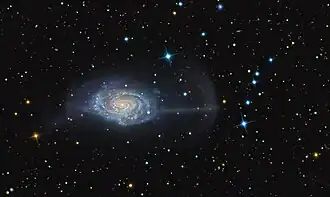 NGC 4651. Note the umbrella-shaped stream. | |
| Observation data (J2000 epoch) | |
| Constellation | Coma Berenices |
| Right ascension | 12h 43m 42.6766s[1] |
| Declination | +16° 23′ 36.222″[1] |
| Redshift | 0.002669[1] |
| Heliocentric radial velocity | 800 ± 1 km/s[1] |
| Distance | 72.0 Mly |
| Apparent magnitude (V) | 11.39[1] |
| Characteristics | |
| Type | SA(rs)c[1] |
| Size | ~87,900 ly (26.95 kpc) (estimated)[1] |
| Apparent size (V) | 4.0′ × 2.6′[1] |
| Other designations | |
| Umbrella Galaxy, IRAS 12412+1639, Arp 189, UGC 7901, MCG +03-33-001, PGC 42833, CGCG 100-004, VV 56[1] | |
.jpg)
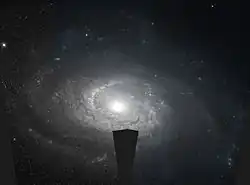
NGC 4651 is a spiral galaxy located in the constellation of Coma Berenices that can be seen with amateur telescopes, at a distance not well determined that ranges from 35 million light years[2] to 72 million light years.[3] It was discovered by German-British astronomer William Herschel on 30 December 1783.[4]
Features
This member of the Virgo Cluster, located on its outskirts,[5] is known as the Umbrella Galaxy due to the umbrella-shaped structure that extends from its disk to the east and that is composed of stellar streams, being the remnants of a much smaller galaxy that has been torn apart by NGC 4651's tidal forces,[2][6] something that explains why NGC 4651 has been included on Halton Arp's Atlas of Peculiar Galaxies as Arp 189 -galaxy with filaments-.
Studies using radiotelescopes of the distribution of its neutral hydrogen show distortions on NGC 4651's outer regions and a gas clump associated with a dwarf galaxy that may have been born in the event that produced the mentioned stellar streams.[7]
Unlike most spiral galaxies of the Virgo Cluster, NGC 4651 is rich in neutral hydrogen, also extending beyond the optical disk,[7] and its star formation is typical for a galaxy of its type.[5]
Supernovae
Two supernovae have been observed in NGC 4651:
References
- 1 2 3 4 5 6 7 8 9 "NASA/IPAC Extragalactic Database". Results for object NGC 4651. Retrieved 2012-08-04.
- 1 2 Nemiroff, R.; Bonnell, J., eds. (15 April 2010). "NGC 4651: The Umbrella Galaxy". Astronomy Picture of the Day. NASA. Retrieved 2012-08-04.
- ↑ Solanes, J. M.; Sanchis, T.; Salvador-Solé, E.; Giovanelli, R.; Haynes, M. P. (2002). "The Three-dimensional Structure of the Virgo Cluster Region from Tully-Fisher and H I Data". The Astronomical Journal. 124 (5): 2440–2452. arXiv:astro-ph/0208147. Bibcode:2002AJ....124.2440S. doi:10.1086/344074. S2CID 116914132.
- ↑ Seligman, Courtney. "New General Catalogue Objects: NGC 4651". Celestial Atlas. Retrieved 6 December 2024.
- 1 2 Koopmann, R.; Kenney, J. D. P. (2004). "Hα Morphologies and Environmental Effects in Virgo Cluster Spiral Galaxies". The Astrophysical Journal. 613 (2): 866–885. arXiv:astro-ph/0406243. Bibcode:2004ApJ...613..866K. doi:10.1086/423191. S2CID 17519217.
- ↑ "Stellar Tidal Streams in Spiral Galaxies of the Local Volume". Retrieved 2012-07-21.
- 1 2 Chung, A.; Van Gorkom, J.H.; Kenney, J.F.P.; Crowl, Hugh; Vollmer, B. (2009). "VLA Imaging of Virgo Spirals in Atomic Gas (VIVA). I. The Atlas and the H I Properties". The Astronomical Journal. 138 (6): 1741–1816. Bibcode:2009AJ....138.1741C. doi:10.1088/0004-6256/138/6/1741.
- ↑ Pollas, C.; Pennypacker, C. (1987). "Supernovae 1987J and 1987K". International Astronomical Union Circular (4426): 1. Bibcode:1987IAUC.4426....1P.
- ↑ "SN 1987K". Transient Name Server. IAU. Retrieved 6 December 2024.
- ↑ Nakano, S.; Itagaki, K. (2006). "Supernovae 2006my-2006ne". International Astronomical Union Circular (8773): 1. Bibcode:2006IAUC.8773....1N.
- ↑ "SN 2006my". Transient Name Server. IAU. Retrieved 6 December 2024.
External links
 Media related to NGC 4651 at Wikimedia Commons
| |||||||||||||
| Stars |
| ||||||||||||
| |||||||||||||
| |||||||||||||
| |||||||||||||
| Galaxies |
| ||||||||||||
| |||||||||||||
| |||||||||||||
 Category Category | |||||||||||||