NGC 3576
| Emission nebula | |
|---|---|
 NGC 3576 | |
| Observation data: J2000.0 epoch | |
| Right ascension | 11h 11m 53.2s[1] |
| Declination | −61° 18′ 26″[1] |
| Distance | 7,800[2] to 9,800[3] ly (2,400[2] to 3,000[3] pc) |
| Constellation | Carina |
| Designations | GAL 291.30-00.7, RCW 57A, BRAN 348A, GUM 38a[4] |
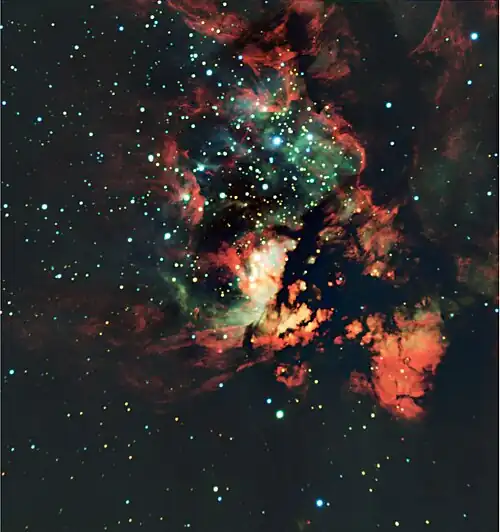
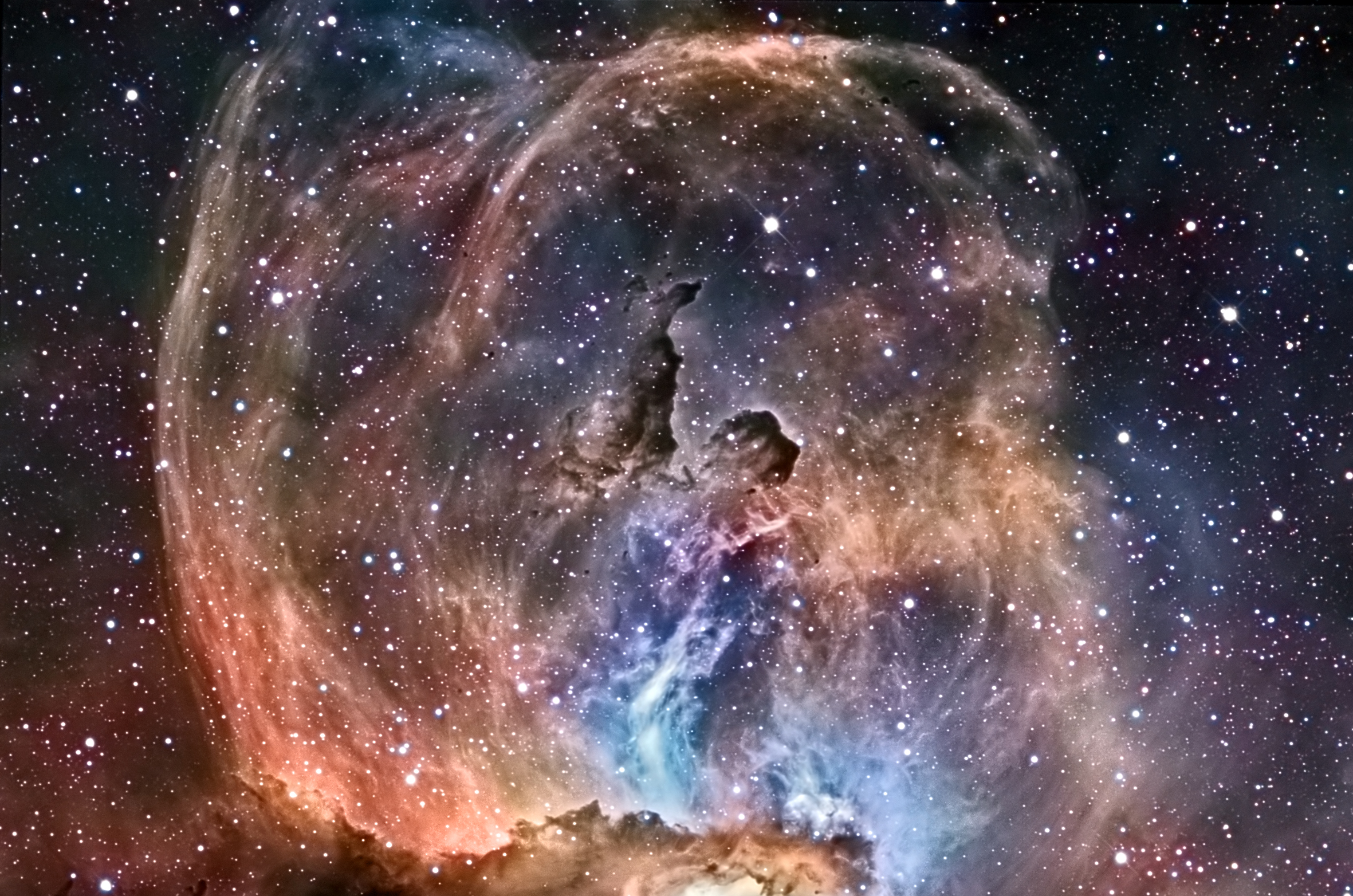
NGC 3576 is a bright emission nebula and star-forming region in the southern constellation of Carina. It was discovered by John Frederick William Herschel on 16 March 1834.[5] Distance estimates for this complex range from 7.8[2] to 9.8 thousand light-years.[3] A popular nickname is "The Statue of Liberty Nebula" because of the distinctive shape in the middle of the nebula. The name was first suggested in 2009 by Dr. Steve Mazlin, a member of Star Shadows Remote Observatory (SSRO).[6]
Observations
This complex is located near the galactic plane along the Carina arm of the Milky Way galaxy.[3] It is approximately 100 light years across and is located near the Eta Carinae nebula,[7] forming the western section of RCW 57.[8] NGC 3576 consists of a giant, star-forming molecular cloud with a luminous H II region positioned just outside.[9] In the infrared, this is one of the brightest H II regions in the galaxy.[10] It is expanding into the molecular cloud and appears to be triggering further star formation.[11] Most of the ionization is believed to be due to two O-type stars, HD 97319 and HD 97484, and two B-type stars, HD 974999 and CPD–60◦2641.[8]
Many of the brightest stars in this formation are still enshrouded in their natal cocoons of gas and dust.[3] A majority of the stars display an infrared excess from the surrounding circumstellar disks.[3] Star formation appears to be progressing in a direction from the northeast to the southwest, with the youngest stars in the latter locale.[3] A very young cluster of massive stars with 130 identified members is embedded deep within the molecular cloud.[2]
Gallery
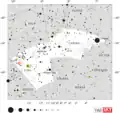 The location of NGC 3576 (circled in red)
 Statue of Liberty Nebula in Hubble Palette by amateur astronomer Mark Johnston
References
- 1 2 Pavlinsky, M.; et al. (May 2022). "SRG/ART-XC all-sky X-ray survey: Catalog of sources detected during the first year". Astronomy & Astrophysics. 661. id. A38. arXiv:2107.05879. Bibcode:2022A&A...661A..38P. doi:10.1051/0004-6361/202141770.
- 1 2 3 4 Persi, P.; et al. (February 1994). "The young stellar population associated with the HII region NGC 3576". Astronomy and Astrophysics. 282: 474–484. Bibcode:1994A&A...282..474P.
- 1 2 3 4 5 6 7 Damineli, A.; et al. (October 2002). Crowther, Paul A. (ed.). "The Stellar Population of NGC 3576". Hot Star Workshop III: The Earliest Stages of Massive Star Birth. ASP Conference Proceedings. 267. San Francisco: Astronomical Society of the Pacific: 359. Bibcode:2002ASPC..267..359D. ISBN 1-58381-107-9.
- ↑ "NGC 3576", SIMBAD, Centre de données astronomiques de Strasbourg, retrieved 2025-03-13.
- ↑ Seligman, Courtney. "NGC Objects: NGC 3550 - 3599". Celestial Atlas. Retrieved 2025-03-14.
- ↑ "Star Shadows Remote Observatory Gallery". Star Shadows. Retrieved 2025-03-13.
- ↑ "APOD: 2008 March 26 - The NGC 3576 Nebula". apod.nasa.gov. Retrieved 2021-02-11.
- 1 2 García-Rojas, Jorge; et al. (August 2004). "Chemical Abundances of the Galactic H II Region NGC 3576 Derived from Very Large Telescope Echelle Spectrophotometry". The Astrophysical Journal Supplement Series. 153 (2): 501–522. arXiv:astro-ph/0404123. Bibcode:2004ApJS..153..501G. doi:10.1086/421909.
- ↑ Persi, P.; et al. (1987). Appenzeller, I.; Jordan, C. (eds.). "Star formation in the southern complex region NGC 3576". Circumstellar Matter, Proceedings of the 122nd Symposium of the IAU Held in Heidelberg, F.R.G., June 23-27, 1986. 122: 93–94. Bibcode:1987IAUS..122...93P.
- ↑ Maercker, M.; et al. (April 2006). "L-band (3.5 μm) IR-excess in massive star formation. II. RCW 57/NGC 3576". Astronomy and Astrophysics. 450 (1): 253–263. arXiv:astro-ph/0512362. Bibcode:2006A&A...450..253M. doi:10.1051/0004-6361:20054372.
- ↑ Purcell, C. R.; et al. (September 2009). "Multi-generation massive star-formation in NGC 3576". Astronomy and Astrophysics. 504 (1): 139–159. arXiv:0909.1223. Bibcode:2009A&A...504..139P. doi:10.1051/0004-6361/200811358.
Further reading
- Saul, M.; et al. (January 2015). "Observations of Warm Carbon Chain Chemistry in NGC 3576". The Astrophysical Journal. 798 (1). id. 36. Bibcode:2015ApJ...798...36S. doi:10.1088/0004-637X/798/1/36.
- Shih, Y. H.; et al. (August 2009). Soonthornthum, B.; et al. (eds.). "Near Infrared Polarimetric Imaging of the Giant H II region NGC 3576". The Eighth Pacific Rim Conference on Stellar Astrophysics: A Tribute to Kam-Ching Leung ASP Conference Series, Vol. 404, Proceedings of the Conference Held 5–9 May 2008, at Merlin Beach Hotel, Phuket, Thailand. 404. San Francisco: Astronomical Society of the Pacific: 27. Bibcode:2009ASPC..404...27S.
- André, Ph.; et al. (November 2008). "First 450 μm dust continuum mapping of the massive star-forming region NGC 3576 with the P-ArTéMiS bolometer camera". Astronomy and Astrophysics. 490 (3): L27 – L30. arXiv:0809.3968. Bibcode:2008A&A...490L..27A. doi:10.1051/0004-6361:200810957.
- Barbosa, C. L.; et al. (November 2003). "Gemini Mid-Infrared Imaging of Massive Young Stellar Objects in NGC 3576". The Astronomical Journal. 126 (5): 2411–2420. arXiv:astro-ph/0308180. Bibcode:2003AJ....126.2411B. doi:10.1086/378960.
- Barbosa, C. L. D. R.; Damineli, A.; Blum, R. D.; Conti, P. S. (2003). De Buizer, James M.; van der Bliek, Nicole S. (eds.). "NGC 3576 IRS 1 in the Mid Infrared". In Galactic Star Formation Across the Stellar Mass Spectrum, ASP Conference Series, Vol. 287, Proceedings of the 2002 International Astronomical Observatories in Chile Workshop, Held 11–15 March 2002 at la Serena, Chile. 287. San Francisco: Astronomical Society of the Pacific: 225–229. arXiv:astro-ph/0208331. Bibcode:2003ASPC..287..225B. ISBN 1-58381-130-3.
- Figuerêdo, E.; et al. (November 2002). "The Stellar Content of Obscured Galactic Giant H II Regions. IV. NGC 3576". The Astronomical Journal. 124 (5): 2739–2748. arXiv:astro-ph/0204348. Bibcode:2002AJ....124.2739F. doi:10.1086/343831.
- Boreiko, R. T.; Betz, A. L. (August 1997). "Far-Infrared Spectroscopy of C II and High-J CO Emission from Warm Molecular Gas in NGC 3576". The Astrophysical Journal Supplement Series. 111 (2): 409–417. Bibcode:1997ApJS..111..409B. doi:10.1086/313026.
External links
 Media related to NGC 3576 at Wikimedia Commons
- Photo of the "Statue of Liberty"
- "NASA/IPAC Extragalactic Database". Retrieved 2007-04-27.
- "Atlas of the Universe". Archived from the original on 2015-07-18. Retrieved 2007-04-27.
| Stars |
| ||||||||||
|---|---|---|---|---|---|---|---|---|---|---|---|
| |||||||||||
| Star clusters |
| ||||||||||
| Nebulae |
| ||||||||||
| Galaxies |
| ||||||||||
| |||||||||||
| |||||||||||
 Category Category | |||||||||||