NGC 3003
| NGC 3003 | |
|---|---|
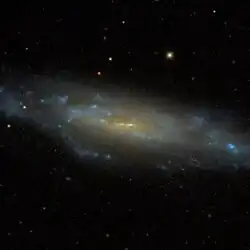 SDSS image of NGC 3003 | |
| Observation data (J2000 epoch) | |
| Constellation | Leo Minor |
| Right ascension | 09h 48m 35.580s[1] |
| Declination | +33° 25′ 17.83″[1] |
| Redshift | 0.004930[1] |
| Heliocentric radial velocity | 1474 km/s[1] |
| Distance | 63.6 Mly (19.50 Mpc)[2] |
| Apparent magnitude (V) | 11.78[3] |
| Apparent magnitude (B) | 12.25[3] |
| Characteristics | |
| Type | SBbc[3] |
| Other designations | |
| UGC 5251, MCG +06-22-013, PGC 28186[1] | |
NGC 3003 is a nearly edge-on barred spiral galaxy in the constellation of Leo Minor, discovered by William Herschel on December 7, 1785.[4] It has an apparent visual magnitude of 11.78,[3] at a distance of 19.5 Mpc from the Sun.[2] It has a recessional velocity of 1474 km/s.[1]
Supernova
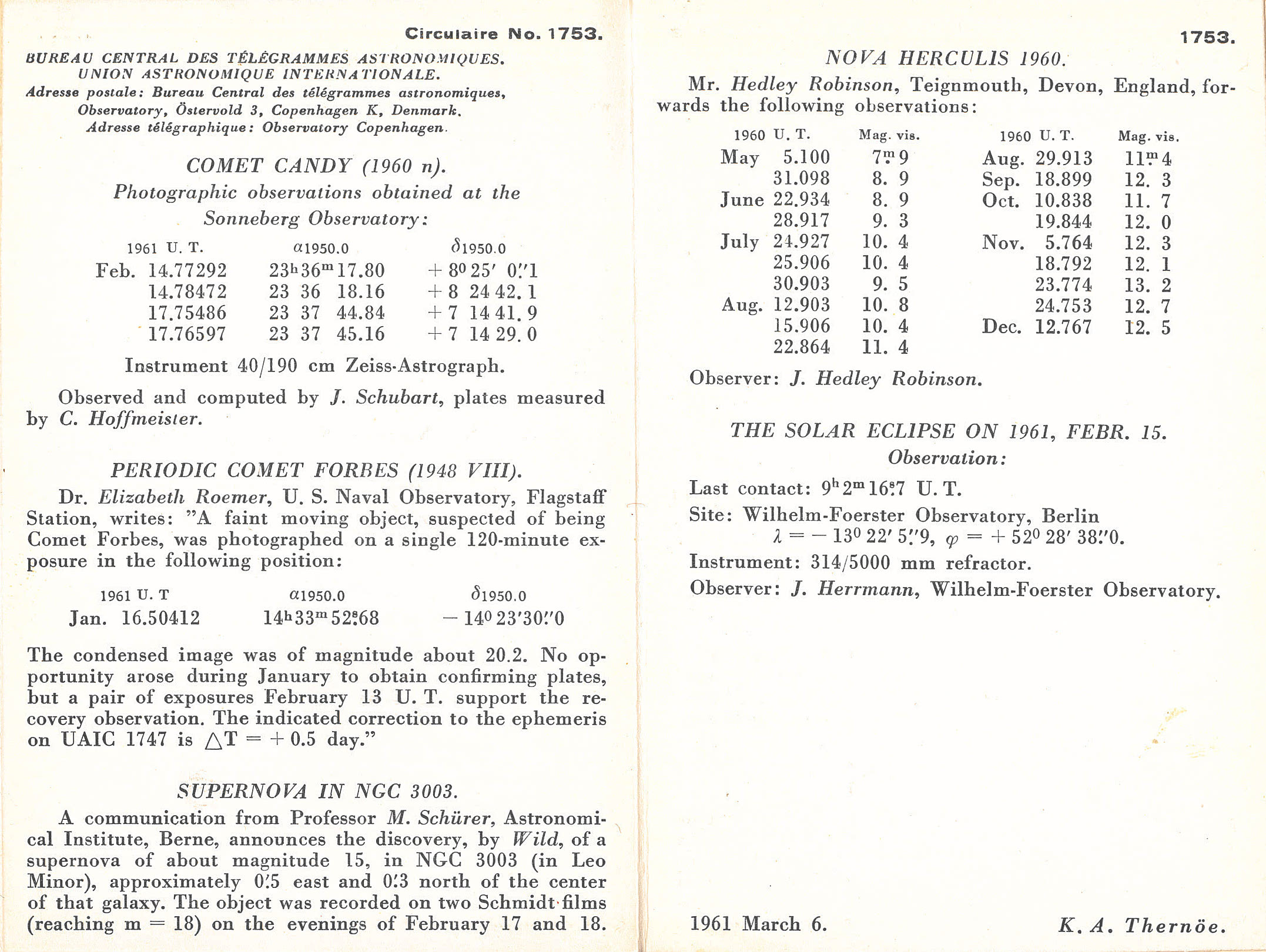
One supernova has been observed in NGC 3003: SN 1961F (type II, mag. 13.1) was discovered by Paul Wild on 21 February 1961.[5][6][7]
References
- 1 2 3 4 5 6 "NGC 3003". SIMBAD. Centre de données astronomiques de Strasbourg. Retrieved 2021-02-10.
- 1 2 Tully, R. Brent; Courtois, Hélène M.; Sorce, Jenny G. (2016). "Cosmicflows-3". The Astronomical Journal. 152 (2): 21. arXiv:1605.01765. Bibcode:2016AJ....152...50T. doi:10.3847/0004-6256/152/2/50. S2CID 250737862. 50.
- 1 2 3 4 "Search specification: NGC 3003". HyperLeda. Université Claude Bernard Lyon 1. Retrieved 2021-02-10.
- ↑ "New General Catalog Objects: NGC 3000 - 3049". cseligman.com.
- ↑ Thernoe, K. A. (6 March 1961). "Circular No. 1753". Central Bureau for Astronomical Telegrams. Observatory Copenhagen. Retrieved 30 November 2024.
- ↑ "SN 1961F". SIMBAD. Centre de données astronomiques de Strasbourg. Retrieved 2021-02-10.
- ↑ "SN 1961F". Transient Name Server. IAU. Retrieved 30 November 2024.
External links
 Media related to NGC 3003 at Wikimedia Commons
| |||||||||||||
| Stars |
| ||||||||||||
| |||||||||||||
| Galaxies |
| ||||||||||||
 Category Category | |||||||||||||
This article is issued from Wikipedia. The text is licensed under Creative Commons - Attribution - Sharealike. Additional terms may apply for the media files.