MOA-2011-BLG-262L
| Characteristics | |
|---|---|
| Apparent magnitude (K) | 22.3 |
| Observation data Epoch J2000 Equinox J2000 | |
| Constellation | Sagittarius[1] |
| Right ascension | 18h 00m 23.48s[2] |
| Declination | −31° 14′ 42.93″[2] |
| Astrometry | |
| Distance | 24,400±3,000 ly (7,490±910 pc)[3] |
| Details[3] | |
| Mass | 0.193±0.029 M☉ |
| Database references | |
| SIMBAD | data |
MOA-2011-BLG-262L is a red dwarf with an orbiting exoplanet, both detected through the gravitational microlensing event MOA-2011-BLG-262.[3] It was once believed to be either an exoplanet with 3.2 times the mass of Jupiter and a exomoon with 0.47 times Earth's mass or a red dwarf with a mass of 0.11 solar masses orbited by a ~17 M🜨 planet,[2][4] but the latter scenario was confirmed in 2024 based on observations of the host star by the Keck telescope, 10 years after the ending of the microlensing event.[3]
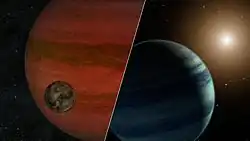
The system is located 24,400 light-years from Earth, in the constellation Sagittarius.[1] The host star is a red dwarf, with 19% the Sun's mass and a faint apparent magnitude of 22.3 in the K-band. It has a transverse velocity of 541.3±65.75 km/s, the highest ever found for any star with a known exoplanet.[3]
| Companion (in order from star) |
Mass | Semimajor axis (AU) |
Orbital period (days) |
Eccentricity | Inclination | Radius |
|---|---|---|---|---|---|---|
| b | 28.92±4.75 M🜨 | 0.98+0.56 −0.20 |
— | — | — | — |
References
- 1 2 "Finding the constellation which contains given sky coordinates". djm.cc. 2 August 2008.
- 1 2 3 Bennett, D.P.; Batista, V.; et al. (13 December 2013). "A Sub-Earth-Mass Moon Orbiting a Gas Giant Primary or a High Velocity Planetary System in the Galactic Bulge". The Astrophysical Journal. 785 (2): 155. arXiv:1312.3951. Bibcode:2014ApJ...785..155B. doi:10.1088/0004-637X/785/2/155. S2CID 118327512.
- 1 2 3 4 5 6 Terry, Sean K.; Beaulieu, Jean-Philippe; Bennett, David P.; Bhattacharya, Aparna; Hulberg, Jon; Huston, Macy J.; Koshimoto, Naoki; Blackman, Joshua W.; Bond, Ian A. (2024-10-11). "A Candidate High-Velocity Exoplanet System in the Galactic Bulge". arXiv:2410.09147.
- ↑ Clavin, Whitney (10 April 2014). "Faraway Moon or Faint Star? Possible Exomoon Found". NASA. Archived from the original on 12 April 2014. Retrieved 19 February 2023.
2013 in space | ||||||
|---|---|---|---|---|---|---|
| ||||||
Space probe launches  |
|    | ||||
| Impact events |
| |||||
| Selected NEOs | ||||||
| Exoplanets |
| |||||
| Discoveries |
| |||||
| Novae | ||||||
| Comets | ||||||
| Space exploration |
| |||||
| ||||||