Barnard 92
| Nebula | |
|---|---|
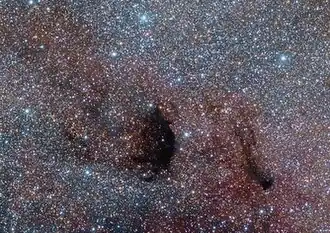 Barnard 92 in front of background stars | |
| Observation data: J2000 epoch | |
| Right ascension | 18h 15.5m [1] |
| Declination | −18° 13′[1] |
| Apparent diameter | 12.0′ × 12.0′[1] |
Barnard 92 (abbreviated to B92) is a dark nebula located in the Small Sagittarius Star Cloud. It was discovered by American astronomer Edward Emerson Barnard.
B92 was initially referred to as "the black hole,"[2] given its appearance, after it was first catalogued in 1913.[3] It was later discovered to be a dark nebula, and the title is now misleading, as the name black hole is used in modern astrophysics to describe a region of spacetime in which gravity is too strong for light to escape.
References
- 1 2 3 "LDN 323". SIMBAD. Centre de données astronomiques de Strasbourg. Retrieved 2024-12-09.
- ↑ Barnard, Edward Emerson (1927). A photographic atlas of selected regions of the Milky Way. Carnegie Institution of Washington. ISBN 9780511761133.
{{cite book}}: ISBN / Date incompatibility (help) - ↑ "More M24: Barnard 92 Dark Nebula". www.messier.seds.org. Retrieved 2023-08-26.
This article is issued from Wikipedia. The text is licensed under Creative Commons - Attribution - Sharealike. Additional terms may apply for the media files.