Fifth edition D&D's experience progression is linear for the first few levels, then takes on an approximately parabolic relationship as shown in the graph on the lower left. However, the amount of experience required to gain a level (i.e. the change in experience between levels) does not follow the approximately linear relationship implied by a parabola, as shown in the graph on the right. At several levels, the amount of experience required to gain a level is the same as what was required to gain the previous level (e.g. level 13 requires 20,000 xp over level 12, and level 14 requires 20,000 xp over level 13). In fact, levels 12, 13 and 14 all require less experience to gain than level 11.

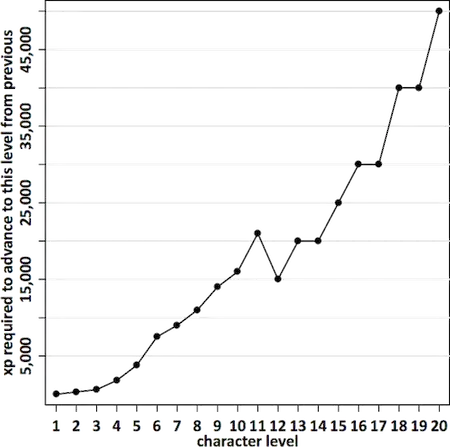
My question in two parts:
Is there a record of game design philosophy explaining the uneven advancement requirements?
Does any such game design philosophy imply that an even and strictly increasing progression of xp requisites from level to level would create specific problem? (E.g. is it actually important that the xp requirement at level 11 be a big bump over the requirements for the succeeding three levels? Is it important that several levels have the same xp requirements as the previous level? Do important things break or work less well otherwise? (Assuming that such an "otherwise" would preserve the same near-parabolic increase in total xp.)
Note: All xp data are based on the 5th edition D&D Player's Hand Book.

