16

In the player's handbook there's a spell called Dimension Door. I know it is used for teleportation but everything else is vague.

How does it really work?

Does the user have to use the door to teleport? If not, then why is it called "Dimension door?"

Purple Monkey
  • 56,893
  • 18
  • 243
  • 314
Malduin
  • 171
  • 1
  • 1
  • 4

3 Answers3

22

No, you don't have to step through a door (magical or otherwise) to teleport. Dimension Door only has a Verbal component, and its duration is Instantaneous. So you say some magical words, and you're instantly teleported. The description doesn't say anything about a door; it's only the title that contains the word "door".

As for why the spell is called Dimension Door, this particular spell goes all the way back to OD&D (I believe it's been in every D&D edition), so the name in 5e is simply a legacy of previous editions.

Miniman
  • 144,275
  • 45
  • 644
  • 782
  • 3
    I believe some of the old descriptions mention the caster opening a door out of nowhere, and stepping through it (whether at the start or end, I can't remember). That is, the door was either somehow summoned, or an otherwise illusory effect as part of the spell. No actual door was required. – Clockwork-Muse Feb 02 '15 at 11:29
  • @Clockwork-Muse The opening of a door text is in neither Men and Magic (OD&D) nor in 1eAD&D PHB, nor in 2e spell description. Maybe a later edition? In both of those it was a limited range teleport without error. (Regular teleport included a chance to screw it up). – KorvinStarmast Jan 25 '16 at 15:21
  • In a deleted post (which should have been a comment here) one user makes the point that the lack of a somatic component only bears on the casting of the spell, not on what manifests when the spell is (verbally) cast. Combined with the 5e artwork (below), is there cause to re-think this answer? – nitsua60 Jan 25 '16 at 15:37
  • (by the way, I actually agree with you--just thought for the sake of a best final product it'd be good to be sure you'd seen the arguments on both sides. The spell description seems pretty unambiguous--"you teleport..." and then never a mention of a door. But all the artistic and fictional depictions always seem to clash with RAW....) – nitsua60 Jan 25 '16 at 15:49
  • @nitsua60 I saw it - I just can't find any reasoning to make it work. – Miniman Jan 25 '16 at 16:01
12

Why is it called "Dimension door?"

Actually, back in the day, you would open a small portal in front of you, take a step through it, and be at the destination. Functionally though, dimension door is any quick battlefield teleportation. For 5e they kept the traditional name and the same battlefield function, but tweaked the "special effects."

So even though there's only a verbal component, the legacy still holds in the 5e illustration of the spell:

5e

There was a cinematic from one of the old D&D computer games that showed a couple of mages using dimension door, and it was an actual door.

This is how the spell was illustrated in 4E:

Illustration of Dimension Door in D&D 4e

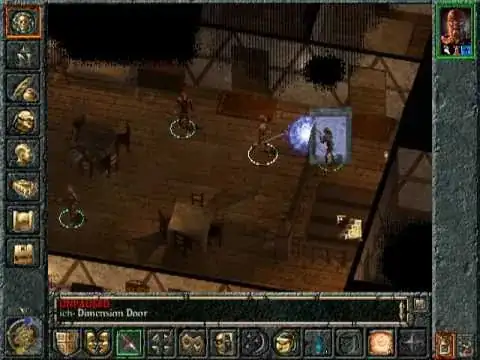
And this is how it was rendered in Baldur's Gate:

Screenshot showing an open Dimension Door in Baldur's Gate

nitsua60
  • 101,437
  • 26
  • 420
  • 540
ShadowKras
  • 61,477
  • 4
  • 97
  • 166
  • 3
    This answer is untrue for the edition of the game asked about. The spell in 5e has only a verbal component, i.e. you can do it while unable to move arms or legs. That would not be true if you had to step through a portal. The illustrations provided are from other editions of the game and are not directly relevant, particularly when they contradict what is actually stated in this edition. – KRyan Feb 02 '15 at 17:55
  • 2
    @Aviose my answer was to his last question: 'If not, then why is it called "Dimension door?"' But i edited my answer to clarify that :) – ShadowKras Feb 26 '15 at 11:42
  • 2
    @KRyan, the components listed only denote what is required to cast the spell, and say nothing about how the spell manifests (visually or otherwise). The spell's description will indicate any consistent description of how the spell manifests. Otherwise, it can manifest with whatever visual, audio, olfactory, etc. characteristics the player/GM decide it should. (And even the descriptive stuff written in the book is up for grabs at many tables, because it is the effect, not the description that matters in the game.) – Theo Brinkman Jan 25 '16 at 21:50
  • 1
    @TheoBrinkman Quoting my comment on the deleted answer you’re copying, does anything suggest that you do have to step through a door, though? The name could just be poetic or something. I’ll buy your counter-argument, but unless it’s paired with a positive argument for your case, it’s not convincing on its own. And remember, this is a 5e-tagged question; you can only use the spell description in 5e as evidence. – KRyan Jan 25 '16 at 21:59
  • 1
    @KRyan - Ok, here's the counter argument using only the 5e rules as evidence. Does the spell description give any hard and fast description for the spell's appearance? If not, then it can look like whatever the player desires and the GM approves. It has no mechanical impact on the spell, and doesn't contradict anything in the spell's description. My fireballs can be red, yours can be blue. My tenser's floating disc can have delicate filigree, yours can look like a riveted slab of metal. My dimension door can look like a door, yours can look like nothing. No change to the spell at all. – Theo Brinkman Jan 25 '16 at 22:25
  • @TheoBrinkman If you think that it’s acceptable for DM to abruptly add on the spot a major confounding limitation to a spell without discussing it with the player prior, e.g. when the player selects that spell, then I don’t want to play with you. If you don’t think that, and would expect a DM to offer warning that dimension door in their game won’t work if the caster is incapable of stepping through the created door, then you acknowledge that it is a houserule that is being made and discussed. – KRyan Jan 25 '16 at 22:27
  • 4
    Where, in any of my comments, did you see the addition of "a major confounding limitation"? In fact, I specifically stated, "No change to the spell at all." Heck, what part of a spell visually manifesting as a door means someone has to step through it? You could just as easily get pulled through by slimy tentacles, or it could appear, open, sweep over you, and close behind you. Changes in appearance do not necessitate changes in mechanics. – Theo Brinkman Jan 25 '16 at 22:30
  • And the portal could be horizontal such that you fall through. – JAB Nov 16 '16 at 22:18
12

An open doorway to a different area of the battle was what the spell looked like in previous incarnations in all artwork associated. Some versions showed the doorway as a shimmering portal and some showed it as an open doorway to that showed the location the caster was teleporting to.

Although, as Miniman's answer stated, the only requirements in 5e is a verbal component and thus you don't have to 'step through' the doorway, it is still completely feasible and possible to describe this as a doorway.

As an additional note of inspiration for the name's modern interpretation, in 4th ed's case, teleportation spells took you through other dimensions in order to teleport. The Feywild was a common route, though the Shadowfell was sometimes used. This was written in to the descriptions of several racial abilities. IIRC, Dimension Door included the same description. So in 4e the emphasis was on the dimensional travel and not the door. 2nd edition and prior also related teleportation spells to extra-dimensional travel (though primarily through the Astral Plane).

After looking further I did find one reference, albeit possibly circumstantial, that alludes to the ties between teleportation and dimension travel. The details of the spell Hallow have a specific subheader about 'affected creatures' that states the following:

Extradimensional Interference. Affected Creatures can't move or travel using teleportation or by extradimensional or interplanar means.

This is not specifically stating that teleports are dimensional travel, but the name of Dimension Door and the text of this passage in this spell allude to it highly, as does the fact that spells that discuss warding against teleportation ward against extraplanar travel and vice versa (examples are Forbiddance, Forcecage, and Planar Binding).


Conclusion

While it isn't specifically stated in 5e, the name Dimension Door alludes to traveling through another dimension in order to move quickly, as does the history of the spell and references of other spells. The aesthetics of the spell are primarily up to the player and the DM collaborating, but visual references do typically use the shape of a doorway to represent the spell.

Aviose
  • 8,473
  • 3
  • 37
  • 56
  • 4
    The Feywild and Shadowfell, and their use in teleportation, are adaptations of earlier non-4e cosmologies, where the Astral Plane and Shadow Plane served these purposes. Some editions of the game even emphasized this by having teleportation spells fail to work if either start or destination was on a plane that was not adjacent to the Astral (or to the Shadow, if using one of the spells that used it instead). Wizards has never been particularly big on that point, though; it was much more a 2e/Planescape thing. – KRyan Feb 02 '15 at 17:59
  • 2
    In 1e AD&D, if something was standing where you intended to DD, you'd get stuck in the Astral Plane. 1e PHB p. 76. – KorvinStarmast Jan 25 '16 at 15:33