Not rules unless stated, but always official content
Great question. The only instance of an image in the rules being the only authoritative source of information is the rules for Creature Size and Space:
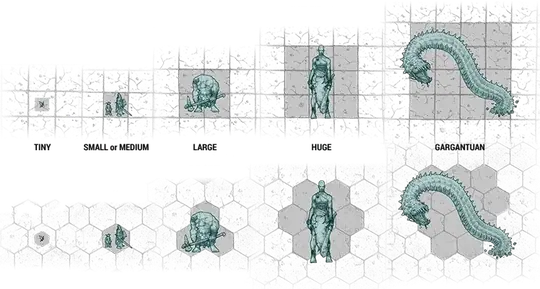
The rules only state that a monster takes up a certain number of hexes but doesn't tell you how to distribute them. For a huge monster it just says "7 hexes" - contrast to the rules for playing on a grid it says "9 squares (3 by 3)".
I imagine most logical and sane DMs (and DMs do tend to be both logical and sane) would distribute 7 hexes in a circle, however there isn't anything in the rules telling us to do that.
I'm not aware of any other images which are necessary to the rules.
Does the rulebook contain fluff?
You have no doubt heard many people say that the 5e rulebooks don't have fluff. There are specific parts of the rulebook where we are explicitly told we are dealing with rules. A great example is the rules for casting spells where it is stated that everything in the description is rules:
Each spell description begins with a block of information, including
the spell's name, level, school of magic, casting time, range,
components, and duration. The rest of a spell entry describes the
spell's effect.
But this can't necessarily be extended to everything in the rulebook. In the introduction of the basic rules it states that several parts of the book are not rules;
Part 1 is about creating a character, providing the rules and guidance
you need to make the character you’ll play in the game. ...
...
Part 3 is all about magic. It covers the nature of magic in the worlds
of D&D, the rules for spellcasting, and a selection of typical spells
available to magic-using characters (and monsters) in the game.
Part 4 is especially for the Dungeon Master. It contains instructions
for how to challenge the player characters with adversaries that are a
good test of their abilities, plus dozens of ready-to-use monster
descriptions. ...
There are many parts of the rulebook which are not considered to be rules by the community, a great example would be class descriptions.
In summary I think we can accept that not everything in the rulebook is a rule, and without some kind of indication that an image is a rule we shouldn't assume it is. They are in the book as official illustrations and that does give them weight in discussion.


