12

Plate armor covers the whole body of the adventurer. A character in my game has resistance to bludgeoning damage but not slashing damage. He was arguing that since the armor covered his whole body, he would still receive damage due to the fact that the attack hit, but since it didn't slice through his armor, it would have a large area smash into his chest, and therefore it would be bludgeoning damage rather than slashing. (Piercing could arguably go through the armor, because arrows and such.)

Since the attack didn't slash through his armor, and it was his armor that hit his skin, would it be bludgeoning damage or slashing damage?

Thomas Markov
  • 148,772
  • 29
  • 842
  • 1,137
NemoAmet
  • 365
  • 2
  • 8

4 Answers4

54

As an addendum to Thomas Markov's excellent answer, I'd like to add the old adage that "HP are not meat points". 5 HPs of slashing damage does not directly translate to a slashing wound, and 5 HPs of bludgeoning damage does not directly break a bone. Rather, many tend to think of HP as a mixed pool of mental resolve, stamina, and vitality.

So while it makes sense narratively to treat slashing damage to plate armor as less effective, this does not result in a game-mechanical reduction of damage. The slashing swing with a longsword against your armor plate removes 5 HP from your "fighting resolve" pool, same as a bludgeoning hit from a mace would.

John Doe
  • 2,054
  • 10
  • 24
47

No, there is nothing in the rules indicating this is the case.

If plate armor had this effect, we would find it in the item description or rules for armor, and we don’t. Weapons generally deal the damage type the rules say they do, unless some feature explicitly changes it.

That said, keeping track of this sounds like a hassle. While it usually wouldn’t unbalance anything mechanically, it’s not something I would care to add to my list of concerns as a DM or as a player, and this player has resistance to bludgeoning damage. Normally, I’d say letting this work wouldn’t unbalance anything, but for a player with resistance to bludgeoning damage, this would give them resistance to slashing damage too, which is a huge advantage. I would recommend not house ruling this when you have a player who would essentially be gaining a second resistance to one of the most common damage types.

Thomas Markov
  • 148,772
  • 29
  • 842
  • 1,137
  • 2
    There is a feat "Heavy Armor Master" that grants resistance and some damage mitigation if that may be helpful to the OP, but agreed, there is no effect I'm aware of to "Take slashing damage as if it were bludgeoning" etc. – Danger Lake Mar 21 '22 at 15:36
28

Not to take away from either of the other answers...

Plate armor is NOT full body protection

Having worked in ren faires, I've seen a fair share of "full armor reenactments". To which, there are many areas, even in what would be considered full plate armor, that give only the minimum of protection. Mostly around the joins (like elbows and knees), the groin, and other areas depending on the manufacturing. People need to be able to move. Here is an example of armor with a few exposed areas.
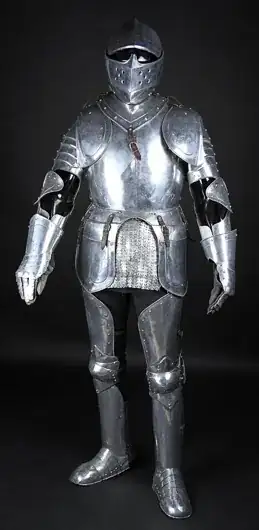
plate armor from Excalibur movie

It is not hard to imagine that a trained swordsman could target these areas and get a slashing wound to their opponent.

Also...

Real longswords are bludgeoning and slashing and piercing

Many swords (that D&D would refer to as "longsword") actually do all three types of damage.

For instance, a number of blades have a Ricasso, or an unsharpened area of the blade, general for gripping with a spare hand, meaning they were only sharp towards the tip.

Combat would entail first bludgeoning your foe to create chinks in the armor. This would would likely take the form turning the sword around, grabbing by the ricasso, and hitting with the pommel/hilt like a hammer. They could also use this for prying open/off armor.

Now that there are more exposed areas, the fighter can either swing and slash at the target, or jab straight in and pierce the target.

But having to keep track of all that would bog down a game. So WotC simplified to (most) everything having a single damage type.

As Thomas pointed out, changing the type of damage every round would bog down the combat considerably. For instance, how many bludgeons would need to hit a creature in plate armor until you could start doings slashing/piercing?

It's just not worth the hassle. Generally, the game treats bludgeoning, slashing, and piercing damage in the same bucket. Barbarian Rage resists all three, the Heavy Armor Master feat treats all three the same, etc.

The only time such a difference would matter would be on things like the black pudding which is immune to slashing, but bludgeoning and (oddly enough) piercing work fine. Or objects, may only be susceptible to one or two damage types.

But those are the times to use ingenuity and not make up rules on how to change damage type.

MivaScott
  • 40,125
  • 5
  • 91
  • 208
  • 3
    "Longsword" is the weapon that Thalhoffer used in his fencing manual - mostly two-handed, but not a full Flamberge, Claymore or Zweihänder, which has at times a leatherwrapped, long "Fehlschärfe" (blunt part). The sword the game usually means is "Arming sword" as in, the backup blade. – Trish Mar 21 '22 at 21:24
  • 1
    @Trish, Understood. I'm focusing on the general "hand-and-a-half" style. Ones that can be used one- or two-handed, to coincide with the "Versatile" trait. – MivaScott Mar 21 '22 at 21:40
  • 2
    That's the Thalhoffer type. also known as "Bastard" or "Anderthalbhänder" – Trish Mar 21 '22 at 21:48
  • 2
    The murder stroke existed, sure, but it wasn't the standard approach to armoured fencing or intended to create gaps in the armour - what you'd usually do is close in and wrestle the opponent to the ground and then stab them through the visor or a gap, or you'd remove the helmet or another piece of armour, possibly by cutting through some of the straps. The sword could be used as a lever in wrestling, pommel strikes can set up throws by dazing an opponent - the downed opponent could be stabbed in halfsword, or just with a dagger. – Pahlavan Mar 23 '22 at 14:14
12

There is nothing in the rules that suggests damage types could change when interacting with armor. It really wouldn't make a lot of sense to do so; since all armor is designed, at its heart, to spread a blow across a wider area of the body, this effect isn't unique to plate, and contemplating it is opening the door to a lot of argument-to-reality about whether or not a given set of armor should "count" as converting damage, and to what degree. Ultimately the protective quality of armor is represented by the AC it grants, and after that point we don't worry about whether the injury from an axe blow would be a bleeding wound or a cracked rib -- to whatever degree a combat "hit" reflects actual injury anyway, which seems to be "not at all" since D&D doesn't model a loss of combat capability as the wounds rack up, until you lose the last hit point and go down.

I guess my real question would be, under what circumstances this would actually matter? Damage types are largely irrelevant unless you're trying to damage an object (where some types may not work) or the target has immunity, resistance, or some other form of damage reduction against specific damage types.

If you have immunity/resistance/reduction to bludgeoning damage but not slashing, and you're trying to find a way to make it apply to attacks it clearly does not apply to -- or contrariwise, if you're trying to find a way to make a vulnerability to slashing damage not "count" -- that's not okay. The rules do not and should not allow you to expand the number of attacks you resist by making appeals to the physics of combat. D&D is not a physics simulator, and we hand-wave away these kind of issues as being outside the scope of the rules.

Darth Pseudonym
  • 74,915
  • 12
  • 190
  • 341