That site is good if you're familiar with how the encoding works but if you're just starting I'd skip it for now.
The best starting point is probably the Intel's Architectures Software Developer Manuals. Have a look at CHAPTER 2 INSTRUCTION FORMAT in the Volume 2, and also the appendices, particularly APPENDIX B INSTRUCTION FORMATS AND ENCODINGS and APPENDIX A OPCODE MAP. They describe how to decode instructions in great detail.
Once you're a little familiar with parts of the instruction encodings, the notations in the instruction listing pages will start to make sense. For example, let's check the one you need.
On the page for MOV, find the variant you need. This one looks like it:
Hex     Mnemonic          Encoding   Description
8E /r   MOV Sreg,r/m16**  RM         Move r/m16 to segment register.
Looking up 'RM' in the following table, we get:
Op/En Operand 1     Operand 2     Operand 3 Operand 4
RM    ModRM:reg (w) ModRM:r/m (r) NA        NA
And so we can start assembling the opcode.
The first byte is fixed to be 8E.
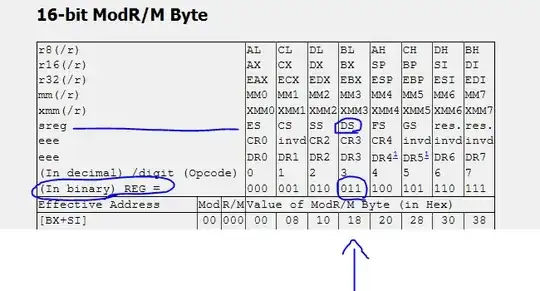
The second byte is the ModRM byte. It consists of three fields: mod, reg and r/m. Let's assemble it with the help of this nice table from Sandpile.
First up is the mod field. Since our second operand is a register and not a memory reference, this corresponds to mod=11.
From the RM encoding line we see that reg encodes the first operand, in our case DS. Looking it up in the table, we can see that DS is encoded as 011.
And finally is the r/m field encoding operand 2, i.e. AX. It is encoded as 000.
So our ModRM byte is 11:011:000, or D8. This makes the full opcode to be 8E D8. You can check it with your favorite disassembler, e.g. XED:
>xed.exe -d 8E D8
8ED8
ICLASS: MOV   CATEGORY: DATAXFER   EXTENSION: BASE  IFORM: MOV_SEG_GPR16   ISA_SET: I86
SHORT: mov ds, ax
(BTW, the /r notation in the encoding line tells us that the reg field of the ModRM byte encodes a register and is not an opcode extension. In the latter case the notation would have a /<digit> notation where is the value of the reg field).