13

A classic old puzzle

A monk starts climbing a mountain at 10 AM. He reaches the peak at 8PM and rests at the peak for the night. The next day he starts climbing down the the mountain at 10 AM and reaches the bottom at 8 PM again. Prove that there was a certain time of the day where the monk was at the same height on both days.

Notes

  • The monk doesn't necessarily move at a constant rate, he might move fast or slow or even rest for some time. He can also turn back while climbing up or down. It is only certain that the monk starts his journey at 10 AM and finishes at 8PM.
Rohcana
  • 4,010
  • 21
  • 49
  • With the only certainty and information being the distanced traveled in either direction and the time frame, how can you reliably prove the answer if there is one? – moonbutt74 Aug 31 '15 at 15:28
  • 1
    @moonbutt74 like Bailey did – Rohcana Aug 31 '15 at 16:13
  • I do see a the graph, but i guess my problem is still with the question. With the randomness of stops and starts i don't see how a reliable answer can be reached. I am assuming that you mean that the same time on both days at an identifiable/specified elevation. – moonbutt74 Aug 31 '15 at 17:25
  • 1
    @moonbutt74 the question is not about finding the answer. You just have to prove that a solution exists. – Rohcana Aug 31 '15 at 17:38
  • But if a reliable answer cannot be found/achieved/determined then a "solution" does not exist or is false/flawed at best, and then not a solution. – moonbutt74 Aug 31 '15 at 17:43
  • 3
    @moonbutt74: Imagine that I have drawn a circle, and I ask you what its diameter is. You wouldn't be able to tell me, given that you haven't seen my circle. Even so, you would be able to tell me, conclusively, that it has one. In a parallel construction, this question isn't asking for an answer; it's asking if there is one. The former is impossible to answer, the latter is (surprisingly enough) trivial. – Andrew Coonce Aug 31 '15 at 23:11
  • @AndrewCoonce , okay i can see that, it just seems a strange question and a strange way to ask it. Is there any reading on this type of question you could recommend? – moonbutt74 Aug 31 '15 at 23:17
  • 3
    @moonbutt74: See Anubian Noob's answer, drawing parallels to the analogous "Intermediate Value Theorem". They've done a great job with their write-up. – Andrew Coonce Aug 31 '15 at 23:23
  • Anachor, reading alot on IVT, quick question, is there a next step after you prove a value does/can exist? Is using this part of an established chain of (something)? – moonbutt74 Sep 01 '15 at 14:04
  • 2
    @moonbutt74 You can actually construct the solution if you know the paths of the monk. To do so just draw the graphs and take the intersection as in Bailey's answer. This is a bit like solving a quadratic equation. I can tell you how to solve one, but without the actual values of the coefficient, you can't determine the specific solution. – Rohcana Sep 01 '15 at 14:10

4 Answers4

26

I'm gonna give a slightly more mathematical answer here.

The Intermediate Value Theorom is defined as follows:

If $f(x)$ is a continuous function on $[a,b]$, for every $d$ between $f(a)$ and $f(b)$, there exists a $c$ between $a$ and $b$ so that $f(c) = d$.

Before we apply this theorom to the monk, let us define some values:

  • Let $t$ be the time since the monk has begun an ascent or descent, in hours.
  • Let $f(t)$ be the height of the monk going up the mountain.
  • Let $g(t)$ be the height of the monk going down the mountain.
  • Let the height the monk starts at be $0$, and the height of the mountain be $m$.

We are attempting to prove that there exists some $t$ in $[0,10]$, such that $f(t)=g(t)$.

We know that the height of the monk is a continuous function of time, both going up the mountain and back down, so we can add a couple more conditions:

  • The domain of $f(t)$ and $g(t)$ are $t=[0,10]$.
  • Both $f(t)$ and $g(t)$ are continous functions with the following properties:
    • $f(0)=0$
    • $f(10)=m$
    • $g(0)=m$
    • $g(10)=0$

Let us construct a function $d(t) = f(t) - g(t)$. This function is on the domain $t=[0,10]$ and the range $[-m,m]$, and remains continuous.

By applying the Intermediate Value Theorom, we know that for any $h$ in $[-m,m]$, there is a $t$ such that $d(t)=h$. If we take $h=0$, then we know that there is a $t$ such that $d(t)=0$.

Thus, we have proved that there is a $t$ such that $d(t)=f(t)-g(t)=0$, proving that there is a $t$ such that $f(t)=g(t)$. $\blacksquare$

Joe K
  • 1,098
  • 7
  • 7
Anubian Noob
  • 361
  • 2
  • 7
25

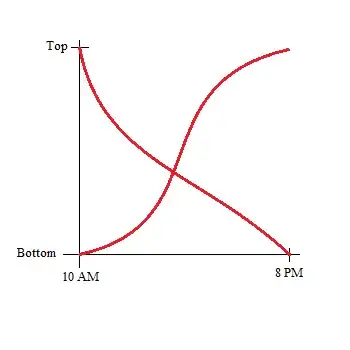
We can prove this using a simple graph:

Graph

No matter how you bend the lines, it should be clear that they will at some point intersect. This is always true because the monk's movement is continuous, so there can't be any jumps from one location to another.

Bailey M
  • 16,973
  • 2
  • 69
  • 119
  • 4
    "No matter how you bend the lines, it should be clear that they will at some point intersect." True, unless you time travel – Rohcana Aug 31 '15 at 16:08
  • 12
    @Anachor "A Time Lord starts climbing a mountain..." – Sabre Aug 31 '15 at 17:44
  • The only snag with this (and other solutions) is that the "bottom" of the mountain may not be a constant depending on what side you're on. If there's a plateau on the north side of the mountain and a deep valley on the south, it's possible that if the monk goes up one side and down the other, he will not necessarily be at the same height at the same time on both days. – Darrel Hoffman Sep 04 '15 at 13:16
  • 1
    @DarrelHoffman unless the bottom of the mountain is taller than the mountain itself, by these guidelines there still has to be a point at which the monk crosses paths with his previous self, so to speak. – Bailey M Sep 04 '15 at 13:18
  • Wait - yeah, you're right, never mind. It would just be later in the day in that circumstance. (Or earlier if he started on the plateau side.) – Darrel Hoffman Sep 04 '15 at 13:28
  • The other gotcha is teleportation, in which the monk goes from one location to another without passing through the intermediate points.  Then (at least one of) the lines would have (at least one) vertical gap, so the lines could cross without intersecting.     :-)     ⁠ – Peregrine Rook May 24 '18 at 01:04
  • @BaileyM , what software/app did you use to make this graph ? – Hemant Agarwal Oct 29 '20 at 06:57
10

Bailey M has given the correct answer already. But I am going to provide another angle of attacking the problem.

Call the original monk A. Take another monk B and on the second day, have him mimic the actions of monk A on the first day. Since B climbs from bottom to peak and A from peak to bottom, they must cross (in terms of height) at some point. Since monk B is mimicking A, monk A must have been at this height at this time on the first day. So, this is our desired answer.

Rohcana
  • 4,010
  • 21
  • 49
  • But by monk B mimicing monk A you break the random element proposed in the original question don't you? – moonbutt74 Aug 31 '15 at 17:20
  • 6
    @moonbutt74 No, because Monk A's "random" movement was done on Day 1, thus is already known on Day 2. – lemuel Sep 01 '15 at 07:44
  • @lemuel okay, thanks, that was throwing me, I'm still a little confused but I understand more than i did yesterday. =) – moonbutt74 Sep 01 '15 at 13:43
  • 1
    This only works if monk A takes the same path down the mountain that he took on the way up. If he went down the other side of the mountain, they would never meet, so this doesn't work. (They would of course be at the same height at some point, but they wouldn't technically "meet".) – Darrel Hoffman Sep 01 '15 at 16:05
  • @DarrelHoffman Being at the same height is enough. Thanks for pointing it out. Edited. – Rohcana Sep 03 '15 at 22:12
8

Lets imagine you have the monks location charted strictly on a line representing the distance they are along the path. If you start plotting with time they start on opposite ends eventually they will have to pass each other. This is the critical moment. In order for the monk to get to the bottom he has to get below the past self's location at some point. in order to do that he has to be at the same distance along as the other past self at the same time. I apologize for the poor wording

The dots are monk

Going hamateur
  • 6,053
  • 19
  • 46