30

I'm struggling to understand the notion of "war crimes". It refers to acts within the context of a war that are considered especially heinous and outside the normal parameters of armed conflict (the Geneva Conventions).

But why is initiating the war itself considered acceptable in the first place? E.g. in the current situation, why do we only condemn Putin of committing war crimes when we find evidence of attacks on civilians, but not the initial act of invading Ukraine?

Obviously, if a country is attacked they need to be able to defend themselves, and we would only accuse them of war crimes if they went beyond this. But shouldn't an initial, unprovoked attack be prohibited entirely?

JJJ
  • 39,094
  • 10
  • 121
  • 182
Barmar
  • 10,086
  • 3
  • 26
  • 53
  • 1
    Defining unprovoked will be very difficult - I'm sure Putin will say the invasion of Ukraine was provoked, by Ukraine or NATO or some entity. – Allure Mar 26 '24 at 02:53
  • @Allure Yes exactly. That's what I'm saying in my answer. See also the gods from engineering's answer & Eric Nolan's comment below it – BCLC Mar 29 '24 at 11:10

5 Answers5

65

An actual judicial definition of these crimes can be found in the Rome Statute that established the International Criminal Court. The statute distinguishes 4 crimes:

  • The crime of genocide;
  • Crimes against humanity;
  • War crimes;
  • The crime of aggression.

War crimes refer to criminal conduct of war that breaks established rules of armed conflict. Punished are the soldiers performing such illegal acts, as well as any superiors who failed to properly control their troops.

That's different for the crime of aggression:

For the purpose of this Statute, “crime of aggression” means the planning, preparation, initiation or execution, by a person in a position effectively to exercise control over or to direct the political or military action of a State, of an act of aggression which, by its character, gravity and scale, constitutes a manifest violation of the Charter of the United Nations.

That is, the crime of aggression is a leadership crime. Punished are those who control the state, not the soldiers who fight the illegal war.

Put differently, soldiers are required to conduct themselves according to the rules of war, while politicians are required to conduct themselves according to the rules of international relations.

And that's one reason why the distinction between war crimes and the crime of aggression matters: Both are illegal, but the perpetrators are different.

meriton
  • 4,155
  • 12
  • 21
21

Waging a war of aggression is prohibited under international law in the same way as war crimes, although it isn’t a war crime itself - these are generally defined as crimes that take place during the waging of a war, such as wilful killing, torture, the taking of hostages, and so on.

The UN Charter is pretty clear in its first article that waging a war of aggression is against international law:

The Purposes of the United Nations are:

To maintain international peace and security, and to that end: to take effective collective measures for the prevention and removal of threats to the peace, and for the suppression of acts of aggression or other breaches of the peace, and to bring about by peaceful means, and in conformity with the principles of justice and international law, adjustment or settlement of international disputes or situations which might lead to a breach of the peace;

And in Article 2:

All Members shall refrain in their international relations from the threat or use of force against the territorial integrity or political independence of any state, or in any other manner inconsistent with the Purposes of the United Nations.

In fact, the resolution passed by the emergency session of the UN at the beginning of March specifically condemned Russia for breaching this article:

  1. Deplores in the strongest terms the aggression by the Russian Federation against Ukraine in violation of Article 2 (4) of the Charter;

After the passage of UN General Assembly Resolution 3314, which adopted a definition of aggression, the Rome Statute was amended in 2010 (the amendment came into force in 2017) to expand the remit of the International Criminal Court, granting it the jurisdiction over crimes of aggression, defined in Article 8 bis of the Statute as:

The planning, preparation, initiation or execution, by a person in a position effectively to exercise control over or to direct the political or military action of a State, of an act of aggression which, by its character, gravity and scale, constitutes a manifest violation of the Charter of the United Nations.

CDJB
  • 106,388
  • 31
  • 455
  • 516
19

Others have already explained that war is in fact generally prohibited in international law. The notion of war crimes is still important because it means that even if you engage in an illicit war, you should still follow some rules. This also applies to all belligerents, not only the aggressor.

Historically, some of these ideas predate the modern notion that war is bad in general. Rules on conduct during a war (jus in bello) were codified at the end of the 19th Century (the Geneva Convention but also the Hague Conventions).

A general prohibition of war and the modern jus ad bellum came much later, after World War II and the “crime of aggression” (as an individual offense, not a breach of international law by a state) is very recent.

Relaxed
  • 30,938
  • 2
  • 75
  • 109
  • 5
    Good point. Before the modern era and the formation of the UN, invading and taking land and people by force was considered normal ("might makes right"). So it would hardly make sense to consider war to be a crime by itself. – Barmar Apr 14 '22 at 20:11
  • @Barmar : even today it's considered sort-of "normal", they just use some other excuses. The USA got involved in over a hundred military conflicts, of them five were major wars, after the formation of the UN. They just used the term "peacekeeping" or similar, for their invasions of other countries (which only the most naive would believe were completely selfless). And Russia is doing the same thing. For them it's not a war of conquest, in their eyes it's just a "special operation" to restore order and get rid of terrorists and nazis in a region which joined them by referendum. – vsz Nov 22 '23 at 18:09
11

But shouldn't an initial, unprovoked attack be prohibited entirely?

It is prohibited (in theory); it's just called something other than a war crime, namely

A crime of aggression or crime against peace is the planning, initiation, or execution of a large-scale and serious act of aggression using state military force. The definition and scope of the crime is controversial. The Rome Statute contains an exhaustive list of acts of aggression that can give rise to individual criminal responsibility, which include invasion, military occupation, annexation by the use of force, bombardment, and military blockade of ports. Aggression is generally a leadership crime that can only be committed by those with the power to shape a state's policy of aggression, rather than those who carry it out. [...]

Aggression is one of the core crimes in international criminal law, alongside genocide, crimes against humanity, and war crimes. In 1946, the International Military Tribunal ruled that aggression was "the supreme international crime" because "it contains within itself the accumulated evil of the whole".

However, that Wikipedia article also notes that "No one has been prosecuted for [the crime of] aggression either before or since the 1940s."

the gods from engineering
  • 158,594
  • 27
  • 390
  • 806
  • 1
    It might be worth noting the difficulty of proving who the aggressor is. Some people might think the country that rolled tanks over the border is the aggressor but others might say they were defending themselves, or their allies, against other forms of aggression. Especially in a situation where there is no real ability to punish the perceived aggressor. Countries A to Y: "You engaged in an illegal war of aggression". County Z: "We're the real victims here. We were just defending ourselves. You can all suck it". – Eric Nolan Apr 21 '22 at 08:16
  • @EricNolan & the gods from engineering what do you think of my answer please? especially you Eric Nolan you could've posted that as an answer. I'm surprised no one really said like - the point is 'who's the "aggressor"?' i.e. 'who's the "bad guy" ?' doesn't usually have a clear answer. – BCLC Mar 25 '24 at 17:31
-5

Part0 - Intro

I also was wondering about this around the time you posted the question re the Russia vs Ukraine war. And after some thought and asking similar questions over the past 2 years, I realised something recently re

  1. Israel vs Hamas/Palestine/Arab war in Gaza - In 2024Jan I watched Ben Shapiro's debates at Oxford in late 2023. [Around 6:45] someone asks Ben

How do you reconcile your conservative political views with the religious values of compassion and your your own Jewish faith and your stance on the Israeli and Palestine War?

Response:

I don't see why it's uncompassionate to call for the overthrow of Hamas a terrorist group in the Gaza Strip which has been oppressing its people and stealing billions of dollars from its own people. Ismail Haniyeh is living in a 5 star hotel in Qatar while his people are living in absolute misery because of a war that he initiated

  1. 2024Feb - when the Netflix adaptation of Avatar: The Last Airbender came out and people talked about how the air nomads supposedly didn't have a military (I don't think it was said in netflix, but it's said in the series).

And then that made me realise it might be nonsensical for the air nomads to not have a military. But ok maybe this deserves a discussion of its own. (Preview: Someone told me the air nomads are based on Buddhist monks. Unsurprisingly, this person hadn't heard of the Rohingya genocide by Myanmar. LOL.)

Part1

I'm surprised everyone was giving like legalistic textbook answers and not really more 'human' answers: I believe the point is answering 'who's the "aggressor"?' i.e. 'who's the "bad guy" ?' doesn't usually have a clear answer...at least nowadays.

I think nowadays (and even at the time in the ATLA universe. Well certainly later in TLOK this applies), no one (at least publicly, i.e. based on what they say explicitly) views themselves as 'aggressors' even when they’re the ones who declare the war eg US/UK Vs Iraq or Russia Vs Ukraine. Like, when was the last time someone really waged a war of conquest/aggression in the sense of when the whites conquered the native Americans/Australians or when Spain conquered the Philippines and really stated such publicly as their outright explicit intent of ruling the inhabitants of such area/s? I think what leaders do is use propaganda to justify their wars of aggression by bringing up defense of this or that as a pretext.

I mean, if you think of the idea of 'just war theory'... It's like if it wasn't 'just', then they wouldn't do it, right?

The reason for going to war needs to be just and cannot, therefore, be solely for recapturing things taken or punishing people who have done wrong; innocent life must be in imminent danger and intervention must be to protect life. A contemporary view of just cause was expressed in 1993 when the US Catholic Conference said: "Force may be used only to correct a grave, public evil, i.e., aggression or massive violation of the basic human rights of whole populations."

So yeah just like in court of law where each side (publicly) believes they're the 'good guy' in the legal case, each side in war believes that they're the good guy defending innocent life when they prosecute a war. Who’s the judge really to answer ‘who’s the aggressor or the "bad guy"?’ ? Maybe whichever side commits more war crimes might give a hint as to who the 'bad guy' is, but supposing both sides fight their war justly, then what?

As the gods from engineering says

  1. It is prohibited (in theory)

  2. However, that Wikipedia article also notes that "No one has been prosecuted for [the crime of] aggression either before or since the 1940s."

  3. (comment in answer by Eric Nolan) It might be worth noting the difficulty of proving who the aggressor is. Some people might think the country that rolled tanks over the border is the aggressor but others might say they were defending themselves, or their allies, against other forms of aggression. Especially in a situation where there is no real ability to punish the perceived aggressor. Countries A to Y: "You engaged in an illegal war of aggression". County Z: "We're the real victims here. We were just defending ourselves. You can all suck it".

Part2 - Going back to Netflix Avatar

  1. For the original series, the comics do give more insight for the justification of the war. But in the original series alone, it was just like a kids' show excuse 'oh we just wanna rule the world.'

  2. The netflix series does this a lot better (at least than the original series without the comics) where the fire nation says that they really (publicly) believe that they are bringing balance to the world by unifying the world under their rule.

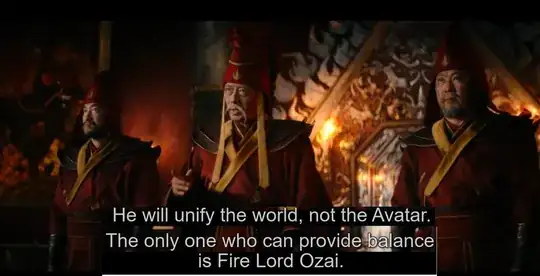
enter image description here

enter image description here

Part3 - Conscience

It seems that it's more like a 'conscience' thing to decide if a war is really just. And then what's really determined in courts is if you're prosecuting the war justly.

I mean, when was the last time someone was brought to ICC/ICJ for really declaring a war but then the whole war they never really committed any war crimes?

I read the following when it comes to the principles of proportionality & military necessity, and I think they apply as well to the decision to declare a war:

A

It can be difficult to retrospectively evaluate decisions that balance the expected military advantage against the collateral loss of civilian lives, which partly explains why prosecutions before national and international criminal courts for wartime attacks on civilians are scarce and difficult

B

The judgement of a field commander in battle over military necessity and proportionality is rarely subject to domestic or international legal challenge unless the methods of warfare used by the commander were illegal

Part4 - Russia vs Ukraine

In Putin's case, Putin believes (or at least is publicly stating but then of course lying that e believes), this war is waged in defense of Jews and of the people of Donbas/Donbass. As for the anti-Putin side, many believe that defense is a pretext for wanting to rule Ukraine or whatever.

enter image description here

BCLC
  • 961
  • 6
  • 18
  • This answer could be improved by removing the extended analogy to Avatar. It just makes things less clear for those who are unfamiliar with Avatar. On a politics site, I would not assume people would know it. – Joel Harmon Mar 26 '24 at 00:38
  • Perhaps this fits more on a blog. – lr0 Mar 26 '24 at 02:36