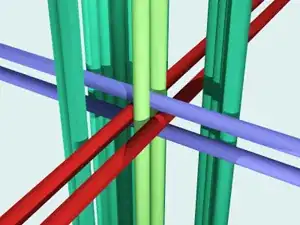
16

Suppose you have a supply of infinite-length, opaque, unit-radius cylinders, and you would like to block all visibility from a point $p \in \mathbb{R}^3$ to infinity with as few cylinders as possible. (The cylinders are infinite length in both directions.) The cylinders may touch but not interpenetrate, and they should be disjoint from $p$, leaving a small ball around $p$ empty. (Another variation would insist that cylinders be pairwise disjoint, i.e., not touching one another.)

A collection of parallel cylinders arranged to form a "fence" around $p$ do not suffice, leaving two line-of-sight $\pm$ rays to infinity. Perhaps a grid of cylinders in the pattern illustrated left below suffice, but at least if there are not many cylinders, there is a view from an interior point to infinity (right below).
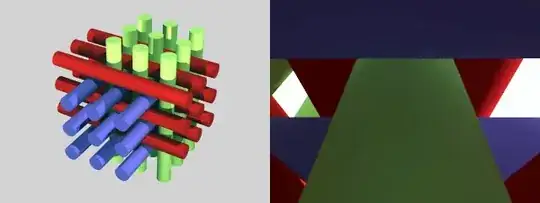
Crossed Cylinders

I feel like I am missing a simple construction that would obviously block all rays from $p$. Perhaps crossing the cylinders like the poles of a tipi (teepee) could help, but it seems this would at best lead to inefficient blockage. Suggestions welcome—Thanks!

Addendum1. Perhaps if the weaving above is rendered irregular by displacing the cylinders slightly by different amounts, so that cracks do not align, then a sufficient portion of the weaving will block all visibility.

Here (left below) is the start of Gerhard's first suggested construction (a portion of the weaving above), which I don't see how to complete. But perhaps seeing this depiction will aid intuition.
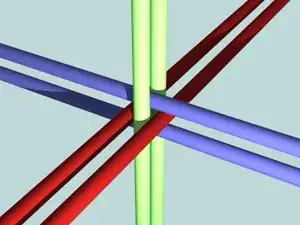
Crossed Tangent to sphere Cylinder forest

Addendum2. To the right above I added (three-quarters of) a forest along the lines (but not exactly as) Yaakov suggested.

Joseph O'Rourke
  • 149,182
  • 34
  • 342
  • 933
  • can you arrange $3$ cylinders vertically with their centers forming a equilateral triangle around $p$, and then seal off the top and bottom holes with (I'd guess) $4$ other cylinders for each hole? – Olivier Bégassat May 09 '11 at 14:47
  • 1
    @Olivier: But I intended that all cylinders must be infinite in length. Likely my figure misled in that regard. Edited to make clearer. – Joseph O'Rourke May 09 '11 at 15:05
  • I posted a bad comment and deleted it. I think the question is interesting for dounbly infinite cylinders. If cylinders are allowed to be singly infinite take a hexagon of seven doubly infinite cylinders eg vertically and cut the middle one to allow space for p.

    (previous comment was six in a triangle - but until you get ten in a triangle there is no central one, and when you have ten it is only the central hexagon which counts)

    – Mark Bennet May 09 '11 at 15:17
  • You can mimic larger cylinders by groups of small cylinders. Should you not then be able to place large groups far enough away to patch any holes that a close and densely packed arrangement leaves? Gerhard "The Forest Is The Trees" Paseman, 2011.05.09 – Gerhard Paseman May 09 '11 at 17:34
  • 1
    Perhaps my visualization skills could use some assistance. What about 6 cylinders tangent (or near tangent) to a unit sphere (say a certain subset of your red, blue, and green in your picture) and then 8 small groups of 2 or 3 cylinders close but not touching to block the remaining lines of sight? Gerhard "Ask Me About System Design" Paseman, 2011.05.09 – Gerhard Paseman May 09 '11 at 18:24
  • @Gerhard: Your idea is plausible but remains a little vague to me. I'll mull it over. Thanks! – Joseph O'Rourke May 09 '11 at 23:08
  • I agree that Gerhard's idea should work but I can't easily pin down the details. There are 8 small apertures close to the origin whose view must be blocked and 8 appropriately tilted flat disks of radius 2 (or 4 or 6) not too far out should do that if allowed. Instead use a cyclinder (or a group of 2 or 3 parallel and touching cylinders). With the freedom to rotate each (group) one should be able to avoid any interior intersections. – Aaron Meyerowitz May 10 '11 at 20:15
  • It would be nice to find a small collection of disjoint unit spheres which block the view (as in a recent planar problem) then embed each one in a cylinder keeping the cylinders disjoint (possibly using pairs of spheres). Gerhard's idea (with some touching spheres) probably fits this construction with a sphere centered on each of the 14 rays through a vertex or face center of a cube. Equivalently, through the rays on the face centers of he 14 faces of a cuboctehedron. Other semi-regular polyhedra might work as well. – Aaron Meyerowitz May 10 '11 at 20:16
  • For construction purposes, take 4 large (and 4 larger) cylinders at a sufficient distances and place their axes parallel to 4 of the faces of a central large (and a central larger) octahedron. This may be a helpful visualizing step to take before reading Aaron's comments above. Gerhard "Ask Me About System Design" Paseman, 2011.05.10 – Gerhard Paseman May 10 '11 at 20:23
  • Alternatively, cover the unit sphere with six lunes(?) representing shadows of the cylinders on a sphere (looking from infinity into the central point). There are eight spherical triangles remaining to be covered. I think eight lunes suffice and they will be not much larger than the existing lunes. Tell me how much larger (I don't have my spherical trig slide rule handy) the lunes need to be, and I'll try to tell you how many more cylinders are needed and where to put them. Gerhard "The Light Is This Way" Paseman, 2011.05.10 – Gerhard Paseman May 10 '11 at 20:31
  • What about in four dimensions? – Louigi Addario-Berry May 10 '11 at 23:28
  • @Louigi: Indeed the problem generalizes to $\mathbb{R}^d$. @Gerhard and Aaron: I can't keep up with all the suggestions! :-) – Joseph O'Rourke May 11 '11 at 00:51
  • Awesome graphics! Yaakov "There Is No Light At The End Of The Tunnel" Baruch. – Yaakov Baruch May 11 '11 at 07:51

1 Answers1

5

Here is one construction. On the horizontal xy plane place a forest of vertical cylinders of radius r<1/2 (or =1/2 if we allow contacts) centered at each point in $(\mathbb{Z} \backslash{\lbrace0\rbrace})\times(\mathbb{Z}\backslash{\lbrace0\rbrace})$; moreover place 2 similar cylinders parallel to x centered at (y=+/-1, z=0), 2 more parallel to y centered at (x=0, z=+/-1) and the last 2 parallel to z and centered at (x=+/-1, y=0). Then (0,0,0) is blocked by the forest in all directions except those in the xz and yz planes, which are blocked by the other 6 cylinders. The forest clearly does not need to be infinite and it should be easy to find an upper limit on its size.

${\bf UPDATE}$ As pointed out by Mark in a comment, the forest should be based on $(\mathbb{Z} \backslash{\lbrace0\rbrace})\times(\mathbb{Z}\backslash{\lbrace-1,0,1\rbrace})$.

  • I think this construction is very close to what Gerhard meant with his second comment to the question. – Yaakov Baruch May 10 '11 at 13:07
  • I realize now, I simply added a forest of green cylinders to the last picture. – Yaakov Baruch May 10 '11 at 13:11
  • 1
    @Yaakov: I'm afraid I don't follow. The cylinders parallel to $x$ seem to intersect with the trees in your forest with centres at $(x,\pm 1)$? – Mark Grant May 10 '11 at 13:14
  • @Mark: you are right - I need to move the 4 islands of the forest a bit further away from the x-axis - I'm editing my answer accordingly. – Yaakov Baruch May 10 '11 at 13:28
  • 1
    CLARIFICATION: a finite forest suffices because the projection of any open cylinder on the surface of the unit sphere is open and the sphere is compact. – Yaakov Baruch May 10 '11 at 16:21
  • For general interest, I think there are a sequence of two or three (concentric?) not too large octahedron on whose faces one can lay one or two, or possibly three cylinders per face, tilted at different angles, so that the center point cannot see the points at infinity. Gerhard "Let Me Speak a Picture" Paseman, 2011.05.10 – Gerhard Paseman May 10 '11 at 16:46