6

Is there a $d$-dimensional convex polytope (convex hull of finitely many points, not contained in a proper subspace), with $d\ge 4$ and the following properties?

  • All facets are congruent,
  • it has an insphere (a sphere to which each facet is tangent to), and
  • it is not facet-transitive.

In 3-dimensional space there is an example with the "memorable" name Pseudo-deltoidal icositetrahedron, depicted below. I believe its the only such polyhedron. I am not aware of any higher dimensional examples.
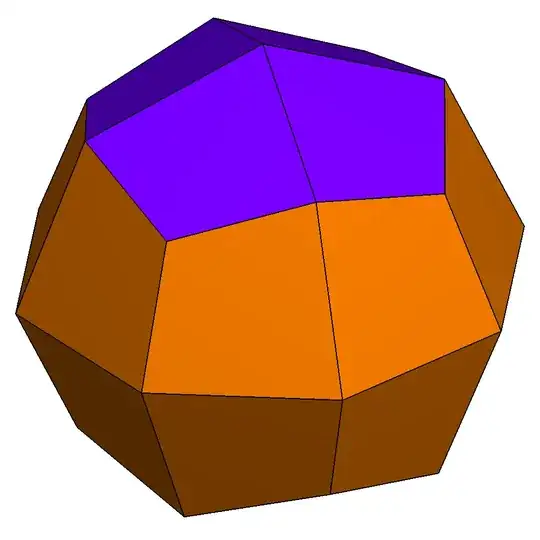
M. Winter
  • 12,574
  • 1
    This seems possibly related to a previous MO question about irregular, but fair dice. Is your 3D example the same as the example described in this answer? https://mathoverflow.net/questions/46684/fair-but-irregular-polyhedral-dice/48689#48689 – Yoav Kallus Jun 03 '20 at 17:54
  • @YoavKallus Interesting link! Yes that's exactly the same polyhedron. – M. Winter Jun 03 '20 at 18:14

1 Answers1

4

First, a simple remark: If a polytope with congruent facets is inscribed in a sphere, then it is circumscribed about a sphere as well, and the two spheres are concentric.

Next, there is a series of examples described and pictured in my old question Can the sphere be partitioned into small congruent cells? . Each of these examples is what you want in $R^3$. If you begin with any one such example and place it on a great 2-sphere of the 3-sphere in $R^4$ (say, the "equator"), then suspend it from the poles, you will get an example answering your question. The construction generalizes inductively to all higher dimensions.

  • Thank you for your answer! Very interesting linked question of yours. However, I object to the claim in the first paragraph: the rhombic dodecahedron has congruent faces, an insphere that touches all faces, but no circumsphere that contains all vertices. – M. Winter Jun 03 '20 at 22:10
  • You are right, an additional assumption is needed, namely the facets should be inscribed in a sphere of one dimension lower. Thank you, I am correcting my mistake. – Wlodek Kuperberg Jun 03 '20 at 23:27
  • I know it is not relevant for the answer (which I am going to accept soon), but how can I see that your modified first paragraph indeed holds? – M. Winter Jun 04 '20 at 08:52
  • Proof. Let P be a convex polytope with congruent facets and inscribed in a sphere S centered at the origin. Obviously, the origin is an interior point of P. Now, let S_0 be the largest sphere centered at the origin and contained in P. Then S_0 touches the boundary of P at at least one point, and the point must lie on some facet F of P. Since P is inscribed in a sphere, the facet is inscribed in a circle lying on S, hence S_0 touches F at the center of the circle. Since all facets are congruent, the distance from the origin to the center of each circle circumscribed about any facet is the same. – Wlodek Kuperberg Jun 04 '20 at 12:49
  • @M.Winter, one more remark, in a similar vein and with a similar proof, that may interest you: If a convex polytope with edges of the same length is inscribed in a sphere, then it has a sphere tangent to all edges as well, and the two spheres are concentric. – Wlodek Kuperberg Jun 04 '20 at 15:28
  • 1
    Thank you. This direction now seems plausible to me for faces of all dimensions, as long as they are congruent. – M. Winter Jun 04 '20 at 16:12
  • I don't see why every such example gives a polytope in $\mathbb{R}^3$ - this tiling of the sphere, for example, does not yield a monohedral polyhedron if one takes the convex hull of its vertices, because points that are colinear on the sphere don't remain so in Euclidean space (in particular, the problem arises when we have vertices which lie on the edges of some of the tiles). – RavenclawPrefect Mar 29 '22 at 11:53