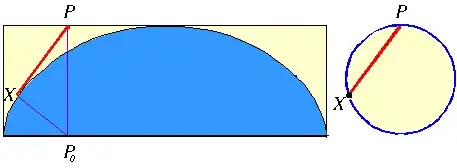
I'm not sure that the following is what you are looking for but I hope that it sheds some useful light on the topic of your query and suggests further applications. Given a curve
in the plane with parametrisation $(c_1(u),c_2(u))$ one can consider the transformation $$F(u,v)=(c_1(u)+\sqrt {2 v} \dot c_1(u),c_2(u)+\sqrt {2 v}\dot c_2(u)).$$
(We are actually interested in the network this mapping introduces in the plane---the image of the coordinate network---which has a natural geometrical interpretation related to the OP). A simple computation shows that the determinant of the Jacobi matrix of this mapping is $\ddot c_1(u)\dot c_2(u)-\dot c_1(u)\ddot c_2(u))$. From this we can deduce various useful facts:
$1.$ The parametrisation $c$ does not appear explicitly (only its derivatives). This is the reason for the satement at the start of the OP.
$2.$ The determinant is independent of $v$ (this was the reason for the strange dependence of $F$ on $v$). In particular we can choose a parametrisation for $c$ for which this is identically $1$ which means that $F$ is area-preserving. This can be used to garner a plethora of results for particular curves.
$3.$ The case of the cycloid has some special features which explains some results and methods in the works quoted If we use the standard parametrisation $(t-\sin t,1-\cos t)$, then the above determinant is $1-\cos t$ which is just the height of the given point above the $x$-axis.
Much more could be said about this topic, but we would like to close with the remark that these facts were not just pulled out of thin air---behind them there lies an important concept, that of a Samuelson configuration, which was introduced by the economics laureate Paul Samuelson (not under that name, of course) in his Nobel acceptance speech, i.e., over 40 years ago.