7

This is part of a set of three related questions but note they are each specific and distinct, they are not duplicates.

In all the languages I'm familiar with that have an indefinite article, the word is related to the word for "one". In fact in English it's more opaque than for most languages I know: "a" / "an" vs "one".

But are there languages which have the indefinite article but in which it is not related to the word for "one"? Perhaps one word or the other has been borrowed from another language, or perhaps the two words evolved from separate roots? Is this known to be possible?

N.B. Louis Rhys has pointed out that some languages have various kinds of indefinite articles but this question is only concerned with the "main" indefinite article despite my inability to express that succinctly is a single sentence. For instance if French or one of its dialects or creoles were to lose the words "un" and "une", and "des" assumed their role it would be an example of the affirmative.

hippietrail
  • 14,687
  • 7
  • 61
  • 146
  • 2
    what do you mean that "des" is not the main indefinite article? In French (unlike English), bare plural nouns are not allowed, so "des" is as necessary and as important as "un"/"une" and English "a"/"an" – Louis Rhys Oct 02 '11 at 11:32
  • 2
    @Louis: I guess I don't know how to explain it. Maybe "Are there languages for which none of its indefinite articles are related to its word for 'yes'?" would be clearer. – hippietrail Oct 02 '11 at 12:20
  • Why did you change the title so much? It's a different question now... – Alenanno Oct 02 '11 at 12:45
  • @Alenanno: Because this is the question I wanted to ask but due to my poor prose skill I inadvertently asked the wrong question and didn't realize it until I saw answers addressing an unintended interpretation of the question. – hippietrail Oct 02 '11 at 12:55
  • Then maybe I should change it... – Alenanno Oct 02 '11 at 12:57
  • SORRY!! The "none" in the new version of the question was a typo. It was supposed to change but not that much. Apologies again. – hippietrail Oct 02 '11 at 13:00

3 Answers3

8
  • the French plural indeterminate article "des"

Il y a des livres là-bas ("There are books over there")

  • in Standard Arabic, indefiniteness is marked by a suffix -n (tanween). For example, compare

al-bustaan-u l-kabiir-u
DEF garden NOM DEF big NOM
'the big garden'

bustaan-u-n kabiir-u-n
garden NOM INDEF big NOM INDEF
'a big garden'

*Arabic sample taken from "Definiteness" by Christopher Lyons page 91-92 (you can find the pages in Google Books). The book lists the tanween under "indefinite articles" out of the other indefiniteness marker types, also says that this "putative article" .. "cannot plausibly be argued to be a cardinality expression"

Louis Rhys
  • 8,501
  • 6
  • 45
  • 71
  • Hmm that could be an unforeseen loophole in the phrasing of my question since French does also have "un"/"une". Let me revisit the wording and see if I can hone it... – hippietrail Oct 02 '11 at 11:09
  • "Des" is not an indefinite article, it's a partitive article. – Alenanno Oct 02 '11 at 11:52
  • 1
    It can be used as both a plural indefinite article (like unos in Spanish) and a partitive article. – Louis Rhys Oct 02 '11 at 11:58
  • Could you show me these two cases? One case where it's indefinite and one where it's partitive? – Alenanno Oct 02 '11 at 12:02
  • 1
    @Alenanno indefinite Il y a des livres là-bas ("There are books over there") and partitive Peux-tu me donner des conseils ? ("Could you give me some advice?"). The partitive is used for "something that is uncountable but plural in French" – Louis Rhys Oct 02 '11 at 12:09
  • but I admit this confuses me a bit, I hope someone with a strong French knowledge will clear this up. – Louis Rhys Oct 02 '11 at 12:11
  • Honestly I don't remember about this distinction. When I studied it, it was used when the quantity was not specified, but it was not related to countable/uncountable. But yeah, you're right, let's wait for some French speaker. :) – Alenanno Oct 02 '11 at 12:14
  • In any case French "des" is not what I'm looking for due to gaps in my terminology and ability to phrase my question, not because I'm being pig headed or anything. – hippietrail Oct 02 '11 at 12:28
  • @hippietrail how about Arabic? it fits what you have in mind, no? – Louis Rhys Oct 02 '11 at 12:33
  • Which arabic though? There isn't just one... – Alenanno Oct 02 '11 at 12:43
  • 2
    @LouisRhys: Yes Arabic might fit! My knowledge of Arabic is not very good though and I thought it had only a definite article. You got my upvote though (-: – hippietrail Oct 02 '11 at 12:47
  • @Alenanno I believe it is Standard Arabic – Louis Rhys Oct 02 '11 at 12:52
  • 1
    I would count the Arabic tanween as a type of marking of -definiteness which is not an indefinite article, but accept that it is a fairly good answer to my question so far. – hippietrail Oct 02 '11 at 13:34
  • 2
    Dear @Louis and @ Alenanno, you're both right for des: it qualifies both for the plural indefinite article and as a partitive article. And I also agree with hippietrail (the loophole thing) because it is not the singular article. In the 11th century you could find uns and unes (cf Sp. unos unas) as an indefinite plural article and you could find dels (contraction of "de les") as a partitive article later pronounced and spelt des. So that in all likeliness des started as a partitive article. du (contraction of "de le", singular partitive article) did not replace un. – Alain Pannetier Oct 02 '11 at 16:07
  • @AlainPannetier Thanks for the contribution! So it's both... I did notice that the occurrences were overlapping. :) – Alenanno Oct 02 '11 at 18:48
4

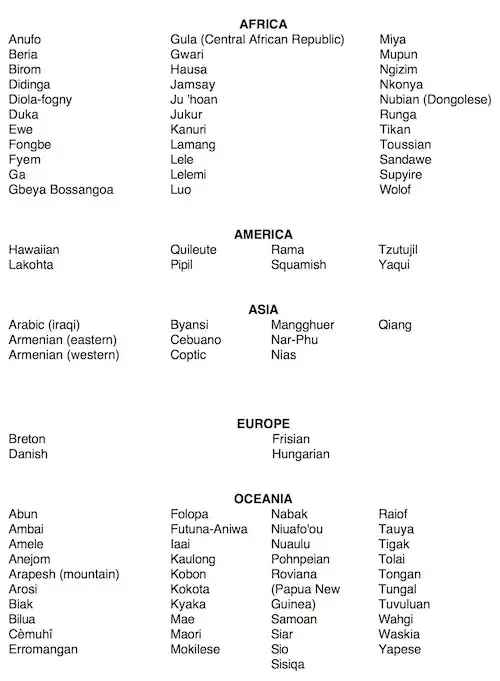
As you can see from this map on the Wals.info site, there are many. More explanations on the main page.

After a quick search I did, it surprised me to see some languages on this list that seemed to use the same word for one and the indefinite article, such as Dutch. I might be wrong, it seems, so you might want to look more in depth for the ones you want to study more.

Anyway, there seem to be around 100. I'll list them below for ease of reference alphabetically and ordered according to the continent.

Note: I removed some obvious false positives that arose as not fitting but some may remain.

enter image description here

hippietrail
  • 14,687
  • 7
  • 61
  • 146
Alenanno
  • 9,388
  • 5
  • 48
  • 80
  • I don't know how to use WALS but there are clearly some false positives in this list: Japanese and Thai are not generally considered to have articles at all. In Albanian "një" is both the number "one" and the indefinite article. English is specifically covered in my question and why I chose "related" and not "identical". Given these that I know there are bound to be more false positives in those that I don't know. But +1 for the effort invested so far! – hippietrail Oct 02 '11 at 12:26
  • 2
    The inclusion of English and Dutch makes this list questionable. Also Mauri "he" is thought to be related to the word for one "mahi". I have no idea about the rest of the cited languages :) – Louis Rhys Oct 02 '11 at 12:33
  • @hippietrail Yes, I know about those cases. It sounded wrong to see Japanese that has no articles at all or Dutch. But I merely transcribed the map so people wouldn't be forced to visit the link. If you want I can go more in depth for those. – Alenanno Oct 02 '11 at 12:46
  • @Alenanno: You've removed the false positives we know about for sure but since the data has proven to be unreliable so I might water down the claim a little further if you don't mind... – hippietrail Oct 02 '11 at 18:00
  • @hippietrail "water down"? – Alenanno Oct 02 '11 at 18:33
  • @Alenanno: "Water down" means to reduce the strength of a claim for instance. Rather than "the false positives were removed", the weaker claim "the false positives we were aware of were removed but some others may well remain". I know you kind of said that anyway I just wanted to make it clearer. – hippietrail Oct 02 '11 at 18:35
  • @hippietrail I didn't know that expression ehehe :D thanks for explaining. I understand we don't know all of those languages so we can't really be sure considering what arose before. I was honestly surprised that it showed languages we certainly know to have such characteristic. – Alenanno Oct 02 '11 at 18:38
  • @hippietrail this page explains why Dutch is there. WALS applies different criteria from yours. Apparently the numeral een [en] and the indefinite article een [ən] are pronounced differently, which makes them distinct. And English, whose indefinite article and numeral one are completely different words, obviously counts as distinct using the same criteria. – Louis Rhys Oct 05 '11 at 12:43
  • @LouisRhys I don't know for Dutch, but he was right about English, the word one and an are etymologically related. So we had to exclude it. I think the list shows this contrast: what is now and what is etymologically. :) – Alenanno Oct 05 '11 at 12:44
  • @Alenanno Yes, what I was trying to say was, in hippie's question the relatedness is determined by etymology, but in the WALS it is much stricter, even words that are spelled the same (nevermind those that only share etymologies) but pronounced differently are classified as distinct, as demonstrated by the Dutch. Since the criteria are different, of course the list is different from what hippie was expecting – Louis Rhys Oct 05 '11 at 13:01
  • I see, yeah I think I agree with you. :) – Alenanno Oct 05 '11 at 13:09
  • I was asking about relationship, WALS was talking about distinctness. They are not the same. So the WALS list may be a starting point but it may also lack all information we need to sort out other related terms. – hippietrail Oct 05 '11 at 17:47
  • 1
    @hippietrail Re Japanese, the source WALS cites (Hinds) seems to have 'aru' in mind as the marker for indefiniteness but is careful to state that Japanese does not have an indefinite article. (Which I suppose leads to a restatement of your previous question - what makes an article different from a word for "an"?) – Muke Tever Nov 05 '11 at 15:18
  • 3
    I suppose one issue with the list is that the WALS map is labelled "Indefinite word distinct from numeral for 'one'", so whether the word is considered to be part of a class of articles may not necessarily be being taken into account. This is lightly touched on in the text. – Muke Tever Nov 05 '11 at 15:29
2

Czech seems to be developing some sort of definite/indefinite articles with definite ones being evolved from demonstrative pronoun "ten" (this), while indefinite ones from the undetermined pronominal adjective "nějaký" (some), which has no connection to the numeral "one".

Mind you this is far from fully grammaticalised form but even now the uses are very close to the typical one for artcicles (particularly the definite one seems to be on its path to becoming fairly obligatory).

a) Je tam (nějaký) chlap. - There is a guy over there.

b) A co ten chlap dělá? - And what does the guy do?

For the first example, the emerging article can be easily omitted, in the second one, it would sound fairly strange.

Eleshar
  • 2,363
  • 15
  • 21