On another forum, we were discussing my proposal (presented in a paper I published in Valpovački Godišnjak and Regionalne Studije in 2022) that the river name Karašica comes from Illyrian *Kurrurrissia, borrowed into Proto-Slavic as *Kъrъrьsьja which would give "Karaš-ica" in modern Croatian by regular sound changes:
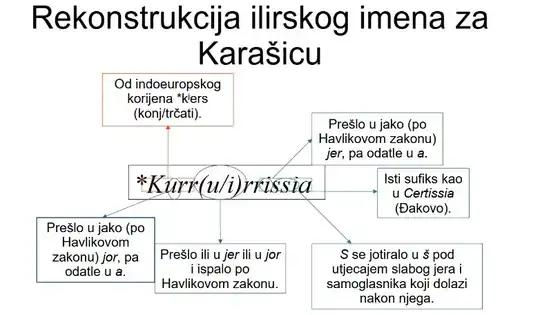 Somebody said that they think that Proto-Slavic phonotactics didn't allow four consecutive syllables with yers as vowels (as in *Kъrъrьsьja). So, is that true? There clearly are a few few words with three consecutive syllables with yers, such as *dьnьsь (today).
Asked
Active
Viewed 188 times
4

FlatAssembler
- 624
- 3
- 17
-
Even if there were such a rule which I doubt it applies only for native words but not for borrowings. – Sir Cornflakes Jan 17 '24 at 08:38
-
@SirCornflakes doesn't this just depend on whether it's an accidental gap or an active phonotactic prohibition? The former can certainly fail to apply to loans (cf initial p in Germanic), and it'd be very tricky to tell which category such a PSl rule was in – Tristan Jan 17 '24 at 11:45
-
My understanding is a yer is very short, which is why they have been elided in many descendant languages. Given this, I would expect an even number of adjacent yer syllables to display some apocope of each iamb, and consequent reanalysis as a sequence of closed syllables – Omar and Lorraine Jan 17 '24 at 14:37
-
@OmarandLorraine >> consequent reanalysis as a sequence of closed syllables << You realize Proto-Slavic didn't have closed syllables, right? – FlatAssembler Jan 19 '24 at 17:01
-
@FlatAssembler, I have heard such a thing, but I won't commit to saying whether it's true or not. But but: read my previous comment carefully again and you will see that I meant that the "reanalysis as a sequence of closed syllables" happened "consequently", i.e. in "many descendant languages", not in Proto-Slavic. – Omar and Lorraine Jan 20 '24 at 22:25