1

I am doing natural language processing and I am trying to figure out how to parse the following sentence (I am using BNC tags to mark parts of speech):

Have I seen the man?

As far as I see it is like:

Have > VHB
I > PNP
seen > VVN
the > AT0
man > NN1

After that we have:

the + man > np
I > np
have > aux (auxilary verb)
seen > verb

My question is, since sentence should be in form np vp, what is the initial np here? Is it 'Have I'? I do not understand how does 'Have' fit in the whole thing, since it's before the initial np 'I' but should belong with 'seen'.

Alenanno
  • 9,388
  • 5
  • 48
  • 80
mzm
  • 15
  • 2
  • 1
    If you're going for just CFG, there would be no direct link between I and seen; the link would be through Have. – prash Oct 30 '13 at 16:27
  • 2
    You'd better come up with a syntax that recognizes more sentence types than np vp. This is a question, which is not a "simple sentence". This sentence has been done things to. – jlawler Oct 30 '13 at 20:18
  • I don't understand your POS tags, but as others have pointed out, you've stumbled upon one of the many inadequacies of phrase structure grammars for treating natural language - that is, without introducing transformations. You should read Chomsky '57 'Syntactic Structures'. It's a classic. – P Elliott Nov 01 '13 at 02:59

2 Answers2

1

The sentence will be a CP in traditional GG: [CP [C have] [IP I seen the man]]. Note that constituent trees represent sentence topology rather than grammatical relations. In the example at hand, "have" and "seen" are coheads but they don't appear contiguously in the sentence.

Atamiri
  • 2,590
  • 1
  • 14
  • 15
1

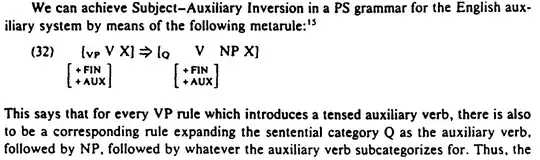
See Gazdar's 1981 paper on handling questions in a phrase structure grammar for English.

enter image description here