I do not know if "helps" is a verb, an auxiliary verb, a tense, a complementizer phrase, or something else. Could someone attach a picture of the correct tree?
Asked
Active
Viewed 3,189 times
2


-
Help is not an auxiliary verb, but a verb that takes object + bare infinitive (without "to"), like I made him cry, I saw him leave, I let him live, and probably a few others. – Cerberus Oct 10 '13 at 08:23
-
@Cerberus what about "I helped to make him cry"? – curiousdannii Oct 10 '13 at 12:35
-
@curiousdannii Good example. It looks like help is a control verb - specifically, this is an instance of partial subject control, where the PRO subject of the embedded infinitive has to at least contain the matrix subject as part of its reference. It seems like help can appear in a number of different frames. – P Elliott Oct 10 '13 at 16:30
-
@curiousdannii: The verb help can be used in/with different constructions: either with a bare infinitive or with a to infinitive. The rest is as usual. – Cerberus Oct 10 '13 at 19:22
-
This question appears to be off-topic because it is about help with particular syntax trees. – hippietrail Apr 01 '14 at 10:20
-
If you want to post a "help me with my homework" question, you should post additional evidence of your efforts to find answers for it. – James Grossmann Jul 01 '14 at 07:43
2 Answers
2
I would analyse it like this:
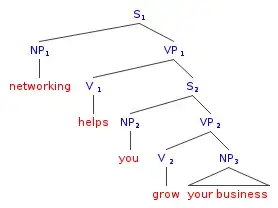
helps is definitely a verb - the /-s/ suffix is the third person present tense agreement marker.
I drew the tree with an internal sentence, but it might also be called an Inflection Phrase or a Tense Phrase. There's little consensus on the syntactic categories.
(You can make trees like this easily at http://ironcreek.net/phpsyntaxtree/)

curiousdannii
- 6,193
- 5
- 26
- 48
-
1I'd agree with that. The first word networking may be a derived noun, as you have it, but it could also be the remains of a deceased gerund complement clause: i.e, [np [s [np
indefnp] [vp networking vp] s] np] – jlawler Oct 10 '13 at 17:39
1
I tend to agree with @Cerberus that help in your sentence takes a direct object and a bare-infinitival clause as complements. You really feels like an argument of help, and therefore should be its direct object. There might also be some syntactic tests we can use to try to establish that. If you is a direct object, then it should be possible to move it up the sentence by using the cleft construction:
(1) It is you that networking helps grow your business (not me).
The problem with this test and others like it is that we can’t really find sentences where the main verb is followed by a noun phrase and a bare-infinitival clause and yet behaves differently with respect to the test. So we don’t have a contrast showing that in one such sentence the relevant noun phrase is a direct object and in another it is the subject of the embedded bare-infinitival.
In ch. 14 of The Cambridge Grammar of the English Language (eds. Huddleston & Pullum), the same distinction is discussed regarding sentences where the main verb is followed by a noun phrase and a gerund-participial clause. It is established there that in (2), Kim is the direct object of the main verb, whereas in (3) it is the subject of the embedded clause:
(2) He caught Kim drinking his beer.
(3) He resented Kim drinking his beer.
Does the clefting test distinguish between these two sentences? I’m not sure.
(4) It was Kim that he caught drinking his beer.
(5) It was Kim that he resented drinking his beer.
(4) is grammatical, as expected, but I’m not sure about (5) (I’m not a native speaker of English). If (5) is grammatical, this means that subjects of embedded non-finite clauses can be clefted.
The same holds for the relativization test (with an embedded bare-infinitival clause). Is (6) grammatical?
(6) You are the person whom networking helps make new connections.
To summarize, It would be nice to find syntactic tests clearly showing that You in Networking helps you grow your business is the direct object of the main verb.
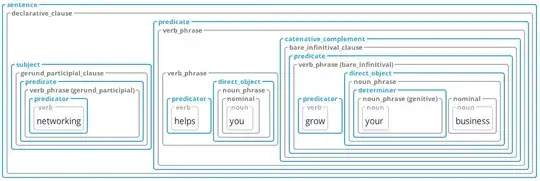
In the meantime, here is a syntactic tree generated by Contextors where you is the direct object (we follow the syntactic framework in The Cambridge Grammar of the English Language, where non-finite complements have the functional category catenative complement; also, we analyze networking as a gerund-participial clause).

Shai Cohen
- 351
- 1
- 5
-
1
-
Thanks, Otavio! The Contextors tree generator is not available for outside use at the present. We are working on making it public in the future.You are most welcome to subscribe to our mailing list to receive updates – Shai Cohen Nov 20 '13 at 08:11
-
Also, if you are wondering about specific sentences, you are most welcome to contact me through the Contact section on the Contextors website. – Shai Cohen Nov 20 '13 at 08:21