10

I read in the Linguistics section on the Wikipedia page for American Sign Language that ASL was "proven [to be a natural language] to the satisfaction of the linguistic community by William Stokoe, and contains phonology, morphology, semantics, syntax and pragmatics just like spoken languages" (emphasis mine).

Are these elements, of phonology, morphology, semantics, syntax, and pragmatics, generally accepted as the necessary and sufficient components of a natural language? Would a constructed language which developed such features be accepted as "natural"? (Note that American Sign Language itself would be an ambiguous case, being a systematically modified version of Old French Sign Language, a signing language which developed "in the wild", so to speak, in the deaf community in Paris well before the French Revolution.)

To consider a somewhat flippant example: what would be the necessary conditions, linguistically (as opposed to sociologically) speaking, for either Esperanto or Klingon to develop dialects which would be considered natural?

Edited to add: I am accepting Alennano's answer as being the most factually correct with respect to what it means for a language to be "natural"; but I also think that, from the answers and comments, the question of whether a language is "natural" is completely beside the point on a matter of linguistics, except inasmuch as the vast majority of "vernacular languages" happened to evolve more-or-less organically most of the time from a prehistoric origin.

  • 1
    I don't think this is how a SE is supposed to work. You could add that part to the previous wording, but rewording completely the question is not the solution. What do we do with the existing answers? – Alenanno Sep 20 '11 at 17:44
  • Any edit can invalidate previous answers. In this case, it looks like he simply narrowed the scope of the question. – Alek Storm Sep 20 '11 at 17:50
  • @NieldeBeaudrap: It looks like you're redefining some entrenched terms, which is likely to cause confusion. I would replace your usage of "vernacular" with "language", and "language" with "system of communication" (especially in the title). – Alek Storm Sep 20 '11 at 17:52
  • 1
    @NieldeBeaudrap: I don't see how it's trivial. Birdsong is a system of communication. Esperanto is a constructed language, and English is a natural language. – Alek Storm Sep 20 '11 at 18:02
  • Whether Esperanto is on topic or not, it doesn't matter, it's still a language, although being a constructed/planned one. – Alenanno Sep 20 '11 at 18:14
  • 2
    If you have a separate question, you should post it separately. Severely revising a question invalidates any answers that people spent time on to answer your original question. – Rebecca Chernoff Sep 21 '11 at 05:55
  • I have asked a question on meta about the confusion over the edits. – Niel de Beaudrap Sep 21 '11 at 08:42

4 Answers4

13

I'd say a natural language has (or had) native speakers. Natural languages don't cease to be natural when their last native speaker dies. A native speaker is one that learnt it as a child. This means that it had at one time been learned as the first language of children (one child is not enough). So if adults got together to learn a language, it couldn't be a natural language until their children could use it as their sole and first language. A language that is no longer learnt by children will go extinct.

The test of a definition of natural language is what to do with Esperanto. It now has at least three generations of native speakers (though they are all multilingual). Can a constructed language become a natural language by being the first language of children or will a constructed language always be a mere constructed language no matter what. It should be noted that the Esperanto these people speak is different and more complex than the Esperanto of the parents, who learnt it as adults.

kaleissin
  • 4,163
  • 24
  • 36
  • Given your remarks about Esperanto, are you saying that a natural language is one that is or was the native tongue of a substantial number of children, except when it's not? – Niel de Beaudrap Sep 19 '11 at 14:13
  • A minor point: the phrase "sole and first language" muddies the waters a bit with respect to multilingualism, a situation in which children can have more than one "first" language. Regardless of whether they speak another language, whether the Esperanto-speaking children speak Esperanto as a first language (learned fully during the critical period) is precisely what is at issue in deciding whether it has become a natural language. The structural complication you point to argues that the answer is "yes." – Aaron Sep 19 '11 at 14:33
  • @Niel: I think what kaleissin is trying to say is that a -first- language cannot be taught academically, and to be a language at all for a first learner, it must be part of a community (more than 1). Any artificial language can become native by the first first-language learner. Modern Hebrew could be considered this way (it was an academic/sacred language, like Latin, for centuries until resurrected). I would expect large changes/adaptations of the rules of the constructed language into the natively spoken one, just like the change from pidgin to creole. – Mitch Sep 19 '11 at 14:34
  • @Mitch: that makes plenty of sense to me; my concern was basically whether kaleissin was laying forth criteria for whether a language is natural, and then saying that "we still have to find out" whether a language which fits those very criteria is natural. I was concerned whether the goalposts were being moved (by the academic community), essentially. – Niel de Beaudrap Sep 19 '11 at 14:39
  • @Niel: What is 'is'? Esperanto 'is' considered a constructed language, but may 'be' formally a native language now (because of first-language transfer), even though it may not be recognized by most that way. Modern Hebrew 'is' a native language, even though it was essentially extinct and therefore only learned prescriptively for many years, just like Latin. – Mitch Sep 19 '11 at 14:50
  • @Mitch: well, on first principles I would say that the distinction between 'natural' and 'constructed' is probably not the correct one; from a descriptivist standpoint the importance is almost certainly how much a language is used, i.e. whether it is alive. (Are there people who use it every day for essentially everything, or not?) The link to evolution due to usage is telling. This neatly bypasses the question of the meaning of 'is': it is a conlang, and (depending on one's definition) is or is not alive, or natural, or whichever positively-connoted adjective you prefer. – Niel de Beaudrap Sep 19 '11 at 14:55
  • @NieldeBeaudrap: If I get what you said, I'd say that Latin is not "used" like English or Italian, but it's still a natural language. – Alenanno Sep 19 '11 at 16:52
  • 2
    Saying that a "natural language" is a language that has native speakers is an incorrect usage of the term in the field of linguistics. Esperanto, though totally awesome, is not a natural language, though it has native speakers. – mollyocr Sep 19 '11 at 17:48
  • @mollyocr aha but that's where people disagree. Some linguists consider it natural now, others do not. How these "native" Esperantists speak is a matter of research. They're called "denaskuloj" in esperanto, might be some interesting ghits on that. The question that interests me is if the latter group of linguists will ever say that a language that started out constructed can turn into a naturally evolving language through use, or will forever remain constructed. – kaleissin Sep 19 '11 at 19:45
  • @kaleissin It can evolve naturally, through usage, nothing denies it from doing that. But "native speakers" doesn't mean consequently "natural language". – Alenanno Sep 20 '11 at 07:29
  • @kaleissin: I think we need some examples of linguists in each camp. – hippietrail Sep 20 '11 at 11:10
  • @Alenanno: indeed --- one can say that Latin was used, but is no longer used; it is no-one's vernacular any more, whereas at one point Esperanto was not anyone's vernacular yet. Possibly as yet, Esperanto is not really anyone's vernacular; but this is a question which can be asked of any language and which does not depend on its historical origin, which is in principle a totally independent matter. The criterion of a society of native speakers suggests that the issue is essentially no more or less than whether a language is someone's vernacular. – Niel de Beaudrap Sep 20 '11 at 15:18
  • @NieldeBeaudrap Even if Latin lost its status as a living language, it will always remain a natural language. The fact that, let's say, it has no native speakers anymore, doesn't mean it's not a natural language. Simply because that is not the criterium to decide whether a language is natural or not. – Alenanno Sep 20 '11 at 15:33
  • @Alenanno: I do know that; I've just come to the conclusion that asking whether a language is natural is the wrong question, if one is interested in linguistics rather than history. – Niel de Beaudrap Sep 20 '11 at 15:56
  • @NieldeBeaudrap Sorry, I am not sure I understood: do you mean that this question is more about History than it is about Linguistics? I think it was a good question about Linguistics actually. – Alenanno Sep 20 '11 at 16:20
  • @Alenanno: I mean that, given a language which is or was "a vernacular", asking whether or not that language is 'natural' is a question of history, and not linguistics. (While if the language was never "a vernacular", it may not be the proper subject of linguistics at all.) That is to say: naturalness of a language is to linguistics as the luckiness of a number is to mathematics. – Niel de Beaudrap Sep 20 '11 at 16:42
  • @NieldeBeaudrap I don't really agree, but well, like we say "il mondo è bello perché è vario" (I don't think there is an English translation, but it literally means "the world is beautiful because it's varied." :D – Alenanno Sep 20 '11 at 17:11
8

A natural language has developed spontaneously over time and it has done it gradually. While an artificial language has been created in a relatively short time, usually for a definite aim. Now that other one is the main difference: it has been created. Also natural languages are man-made but the genesis is totally different, in terms of procedures and time.

No-one thought "let's create a language called English", over time from Old English to the English we know, it developed "by itself", through people's usage. While Esperanto, for example was created in more or less 15 years.

Unlike pidgins, an artificial language has a fairly complex grammar in addition to a good phonology system that is usually as complex as the creator's language, a good furnished lexicon and it's provided with syntax too.

Natural languages have all these things as well, but like I said, in contrast to the artificial languages, they were acquired over time. There were influences, development. In other words: an evolution.

EDIT: I read your question again and I wanted to add that those parameters (syntax, phonology, semantics, syntax, etc) are not parameters to distinguish a natural language from the rest, since also artificial ones have them.

I'm not sure how it works with Sign Languages (about being a natural language or not), but since you mentioned spoken languages too, I answered to that.

EDIT 2: Answering to your comment, the point was to prove that ASL was not a "bad gesturing imitation" of the English language, but rather a true language on its own; this was done by Stokoe, who also encountered many obstacles doing it. The American Sign Language is complex enough under all those points, so it can't just be a simplified version of English; not to mention that it didn't even derive from English. Stokoe wrote some texts about this in case you're interested to go more in depth.

Alenanno
  • 9,388
  • 5
  • 48
  • 80
  • 1
    This does not preclude, however, an evolutionary trail of language starting at an artificial language. The differences you are describing between an artificial language and a natural one are not really linguistic in nature; I thought there might have been such a distinction, as discussion of "constructed languages" were proposed to be excluded from this site entirely. – Niel de Beaudrap Sep 19 '11 at 10:34
  • It doesn't preclude it, sure. But contrasting an artificial language and a natural one, that one is the main distinction: a spontaneous language vs a purposely created one. – Alenanno Sep 19 '11 at 10:38
  • Why the artificial languages have proposed to be excluded? Anyway, I mentioned them just to make the "natural language definition" clearer. I figured a distinction would help to visualize things better. :) – Alenanno Sep 19 '11 at 10:46
  • Why it was proposed (by others who were defining the scope earlier) that constructed/artificial languages be excluded would be a question for the meta subsite. – Niel de Beaudrap Sep 19 '11 at 11:21
  • So, do you think that in the case of ASL, the point was to prove that it was a language, as opposed to a less rich or systematic mode of communication? – Niel de Beaudrap Sep 19 '11 at 12:43
  • Check the answer. :) – Alenanno Sep 19 '11 at 13:55
  • @Alenanno: I think the main reason artificial languages should be excluded is because they are 'made up' prescriptivist rules, which exist purely in the fantasy of the authors. Of course, they can become more like real languages. – Mitch Sep 19 '11 at 14:37
  • @Mitch Thanks, I was just wondering why they were excluded. :) But, although I'm not particularly interested in any, I should say that not all planned languages are totally made-up. There is another category where those derived from natural languages belong to. But I guess that is another topic. :D – Alenanno Sep 19 '11 at 14:42
  • Without meaning any offense, Alenanno, I have un-accepted your answer (and would un-upvote it if possible), because I have been directed to modify my question so as to render your answer out of scope rather than ask a new and improved question getting at what I actually care about. Thanks for taking the time to answer the original question, though. – Niel de Beaudrap Sep 20 '11 at 17:43
  • I may be re-accepting your answer, depending on whether this meta-site question clarifies matters at all. – Niel de Beaudrap Sep 21 '11 at 08:50
1

Phonology, morphology and etc are not elements or components that can be developed, they are levels of linguistic analysis. At the level of the morpheme, rules tell how the morphemes fit together into a structure. If they are just jumbled together with no structure, there is no language. That was thought to be the case with ASL, until Stokoe proved otherwise.

If someone invented a language it would by definition have such structures at each level of analysis. Later, if users of the language developed different rules and structures, one could ask if it was now sufficiently different to be a new language, and if so, if that language was 'natural'.
ASL was proven to be a natural language by showing that it was not invented, it is not a modified version of OFLS or anything else; it was not planned, it arose spontaneously, with genetic roots in at least three existing signed languages, and none in any spoken language.

Not all sign language is ASL. Not all “sign language” is a natural signed language. Some is just gestures; some is Signed English or a manual code for some other spoken language. Signed English is an artificial language which was planned and so forth; ASL is a natural language.

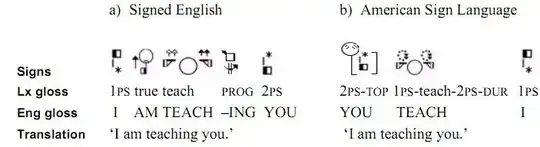
enter image description here

Being a constructed language, Signed English has structure at all the above named levels. At the level of phonology its structure is partly that of ASL and partly invented. At the levels of syntax and morphology it has the structure of English. Syntactically, as shown here, the two languages have different word order. Morphologically, Signed English uses one sign for each English word, ASL uses fewer words and more affixes.

It's worth noting that there are children whose first and only language is Signed English, but that doesn't make SE a natural language.

Joe Martin
  • 643
  • 6
  • 4
0

To answer the question: IMO, Esperanto and Klingon (and other constructed/synthetic languages) are not and therefore never will be natural languages. Among native speakers, the languages will begin to act like natural languages because there will always be language change with time, but I think we'll need to coin a new phrase for these types of languages. (The language formerly known as constructed? Bam! Prince joke.)

I'm still not sure about calling ASL a natural language. It is definitely a language of its own right, but it did not happen entirely spontaneously. I guess I wonder about calling any sign language a natural language when it develops in the context of a spoken language society. This is why Nicaraguan Sign Language is so interesting, which developed (among children!) like a pidgin>creole language in an almost entirely deaf community, which may be the closest a sign language could get to being natural since it comes from necessity instead of planning. By the time researchers came in to observe, it already had a basic grammar.

mollyocr
  • 1,413
  • 9
  • 19
  • This no longer answers my question as it is worded, although thank you for taking the time to answer it as it was originally worded. – Niel de Beaudrap Sep 20 '11 at 17:42