5

I am studying speech recognition by Lawrence Rabiner's book. I am unable to find a proper and easy to understand answer for the following question :

Difference between production of vowels, diphthongs and semi-vowels

The author has just stated a single statement about their difference like
Vowels : Vowels are produced by exciting fixed vocal tract with quasi-periodic pulses of air caused by vibration of vocal cord
Diphthongs : Produced by varying the vocal tract smoothly between vowel configuration appropriate to diphthongs
Semi-Vowels : Characterized by a gliding transition in vocal tract area function between adjacent phonemes.

Can I get some more points ?

hippietrail
  • 14,687
  • 7
  • 61
  • 146

3 Answers3

8

Assuming you know what vowels are, diphthongs are phones which may be described phonetically as a sequence of two vowels (or vowel targets) but which function (phonologically) as a single vowel phoneme in a given language. Semivowels are phones which are phonetically vowels (or vowel-like) but which function as a consonant phoneme in a given language. The distinction between phonetics and phonology is crucial as phonetically identical phones may function as a vowel phoneme in one language, and as a consonant in another. As well, a phonetically identical sequence of two vowels may function as a diphthong (ie single phoneme) in one language and as a sequence of two vowel phonemes in another.

Gaston Ümlaut
  • 6,697
  • 30
  • 46
3

I'm just going to tackle the "terminology" aspect of your question:

  • Diphthongs (and triphthongs) are a kind of vowel. You can contrast them with "pure vowels".

  • Pure vowels have a single "target" where diphthongs (etc) have two (or more) targets. So for the English vowel sound in "pie" the first target is like the "a" in "car" and the second target is like the "ee" in "fee". This seems to be unintuitive for many people not acquainted with linguistics and could be compounded in English where the spelling of diphthongs often doesn't reflect its components.

  • Semivowels can function as either vowels or consonants, depending on their context (what comes before and after them).

hippietrail
  • 14,687
  • 7
  • 61
  • 146
  • @hippietrail----great man. How do you understand all these things so nicely ? I never thought of this example. Could you suggest some good books? – Rameshwar.S.Soni Sep 07 '12 at 08:31
  • @hippietrial-- can i see speech recognition as a career, i am interested in it but find it very difficult? I cannot up-vote your answer since i don't have 15 repution. – Rameshwar.S.Soni Sep 07 '12 at 08:33
  • I dunno. I became fascinated when I was about 10 years old I think. In Australia we followed the British system of IPA in dictionaries where each phoneme had one symbol and each diphthong had a pair of symbols. It seemed odd so I started analysing. That's nerdy kids for you (-: – hippietrail Sep 07 '12 at 08:34
2

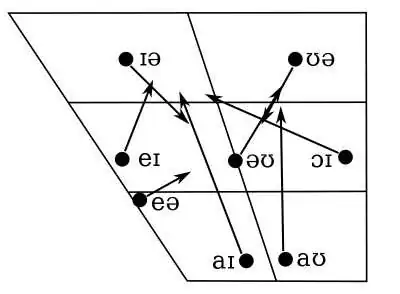
In an addition to hippietrail's great answer, here's the visual representation of English diphthongs as it appears here:

Diphthongs chart

Legend:

/eɪ/ as day, pay, say, lay
/aɪ/ as sky, buy, cry, tie
/ɔɪ/ as toy, boy
/ɪə/ as beer, hear
/eə/ as bear, pair, hair
/ʊə/ as tour, poor
/əʊ/ as phone, no, go
/aʊ/ as how, cow

As a side note, an automated speech recognizer should be able to determine at which point of the chart the speaker's voice stays at a given moment. Having this in place, detecting diphthongs is no more difficult than finding a gesture on a 2D map, and there are plenty of effective algorithms for it.

Be Brave Be Like Ukraine
  • 8,629
  • 9
  • 38
  • 66