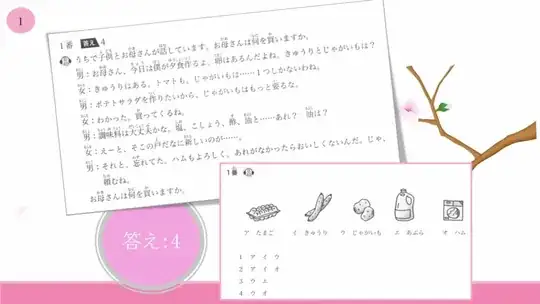
うちで[子供]{こども}と[お母さん]{おかあさん}が[話しています]{はなしています}。[お母さん]{おかあさん}は[何]{なに}を[買います]{かいます}か。
[男]{おとこ}:[お母さん]{おかあさん}、[今日]{きょう}は[僕]{ぼく}が[夕食]{ゆうしょく}[作る]{つくる}よ。[卵]{たまご}はあるんだよね。きゅうりとじゃがいもは?
[女]{おんな}:きゅうりはある。トマトも。じゃがいもは・・・・・・1つしかないわね。
[男]{おとこ}:ポテトサラダを[作りたい]{つくりたい}から、じゃがいもはもっと[要る]{いる}な。
[女]{おんな}:わかった。[買って]{かって}くるね。
[男]{おとこ}:[調味料]{ちょうみりょう}は[大丈夫]{だいじょうぶ}かな。[塩]{しお}、こしょう、[酢]{す}、[油]{あぶら}と・・・・・・あれ?[油]{あぶら}は?
[女]{おんな}:えーと、そこの[戸だな]{とだな}に[新しい]{あたらしい}のが・・・・・・。
[男]{おとこ}:それと、[忘れてた]{わすれてた}。ハムもよろしく。あれがなかったらおいしくないんだ。じゃ、[頼む]{たのむ}ね。[お母さん]{おかあさん}は[何]{なに}を[買います]{かいます}か。
1 たまご きゅうり じゃがいも
2 たまご きゅうり ハム
3 じゃがいも あぶら
4 じゃがいも ハム答え:4
There’s one sentence saying 「それと、忘れてた」. What does それと here mean?
P.S. I did search それと’s meaning in this https://www.weblio.jp/content/それと. I still don’t get it.


新しいのがrefers the lastly mentioned油. The rest of the sentence is ellipsed, most likely because it is obvious what is meant (that there is a new one in that cupboard), especially in an in-person dialog when one can indicate the meaning through gesture for example. – desseim Sep 03 '19 at 23:19それとis more akin toThat, andthanAnd that. It'sそれ+と. Think of it as "That which I just mentioned. Now that I established it for sure, let me add something to it : also, etc". So yeah, in this dialog, theそれpart ("That") most likely refers to the previously mentioned油in the boy's mind, if that helps you understand the logic behind using that construct. But I'd argue it's irrelevant to our understanding ofそれと: what's important is that it indicates there is one more thing (indeed, I think you could as well translate it byOne more thingin English). – desseim Sep 03 '19 at 23:37それとis a semantical break: whatever comes after it is a new subject. In this case the new subject is the ham, and since忘れてたcomes afterそれとit refers to the ham. Up toそれとthe subject is油, whatever coming after talks aboutハム. As soon asそれとis uttered, the contextual subject has been changed: the oil won't be talked about anymore.それと、ハムもよろしく。ごめんね、忘れてた。or忘れてたけどハムもよろしくorそれと、忘れてたけどハムもよろしくwould have the same meaning as your textbook sentence. – desseim Sep 26 '19 at 15:15それは忘れてた。which would mean he had forgotten about the oil remaining in the cupboard. In this case the subject would remain the oil. Butそれとchanges the subject, in the case of your example to the ham. – desseim Sep 26 '19 at 15:22