4

According to my textbook, verb and i-adjective sentences can be chained with the 連用中止【れんようちゅうし】 form like this:
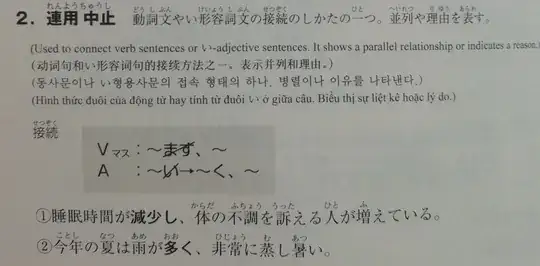
enter image description here

Later on, I came across this exercise where I'm required to replace the adjectives' endings by the corresponding 連用中止. But I do not know how to turn 静かで into 連用中止 in the following sentence:

enter image description here

北海道【ほっかいどう】の7月の海は、深【ふか】く、青【あお】く、静【しず】か ___、絵のように美しかった。

Is this feasible? What about sentences that end with a noun?

Thank you very much

jarmanso7
  • 6,641
  • 2
  • 16
  • 41

1 Answers1

5

No, you cannot omit で after 静か. As your textbook clearly says, this grammar is about verbs and i-adjectives.

北海道の7月の海は、深く、青く、静か、絵のように美しかった。

See: いAdjective. difference between くて and く

EDIT: You can also use copula-like である and say "深く、青く、静かであり、絵のように美しかった", too.


You may see two na-adjectives connected without a particle ("簡単、便利なチャットアプリ" instead of "簡単で便利なチャットアプリ"), but this is another story.

naruto
  • 313,860
  • 13
  • 324
  • 625
  • 1
    I see. My intent typing 静か____ was not to ask whether I can omit で or not, but to ask if I can place something there ____ that works similarly for the case of なadjectives. Maybe something along the lines of 「…青く、静かであり、絵のように美しかった」? I am not sure if your answer just points out that omitting で is not possible or you actually want to say that 静かで is the only possible option. Thank you. – jarmanso7 May 05 '19 at 20:55
  • I'm not a native speaker, but 静かであり sounds completely unnatural to me in this context. Also, note that what you are suggesting would involve substituting a shorter, simpler form for 深くて and 青くて, while substituting a longer, more complex form for 静かで. In that sense, you'd be making the terms less parallel, rather than more so. – Nanigashi May 05 '19 at 21:14
  • Please take a look to this entry and this answer. Thank you for your thoughts on this. – jarmanso7 May 05 '19 at 21:19
  • Hmm, what do you mean with less parallel? I mean, to me くて、くて sounds more natural than く、く、 just because I'm used to the former construction, but at the end, both are valid. I don't see why it should'nt be the case with で and であり (provided both are valid, which I'm not sure). – jarmanso7 May 05 '19 at 21:24
  • 3
    である conjugates like a verb, and "深く、青く、静かであり" sounds completely natural to me. It's stiffer and more bookish than "深くて、青くて、静かで". – naruto May 05 '19 at 22:29