10

I was exploring France in Google Maps and I looked at some city names:

  • La Roche-sur-Yon
  • Fontenay-le-Comte
  • Saint-Maixent-l'École

And so many others.

Why do French cities names have these dashes? Why are they necessary?

In English also we use dashes but only when without them the sentence is misread; for example:

A cheap-car factory vs A cheap car factory.

But we don't have dashes, for example, in Saint Petersburg.

Toto
  • 14,992
  • 8
  • 37
  • 62
Snack Exchange
  • 203
  • 1
  • 6
  • 7
    On pourrait retourner la question : Pourquoi n'y a-t-il pas de tiret en anglais ? https://fr.wikipedia.org/wiki/Wikip%C3%A9dia:Conventions_typographiques#Toponymes – Toto Nov 20 '23 at 10:42
  • 1
    It's a convention. A typographic choice so that all city names are consistent. – Teleporting Goat Nov 20 '23 at 11:08
  • I suggest they're no more 'necessary' in French than, for instance, English would demand Weston-super-Mare rather than the same without the dashes.

    However, even without the power of tradition, France has an Acadamie Francais which tries to enforce umpty rules, hopefully over all of Francophilia, while no Anglophile country has anything similar.

    Doesn't that suggest, this is due more to culture than to language?

    – Robbie Goodwin Nov 20 '23 at 21:05
  • Agreed with Toto: why not? – Frank Nov 20 '23 at 21:33
  • @RobbieGoodwin Don't overestimate the Académie Française power or role and don't confuse love with speech :-) – jlliagre Nov 20 '23 at 23:13
  • 9
    "In English also we use dashes but only when without them the sentence is misread". This premise is false - Shakespeare was famously from Stratford-upon-Avon. Many other examples exist. – Carl-Fredrik Nyberg Brodda Nov 21 '23 at 07:46
  • @Carl-FredrikNybergBrodda - I have been personally to Weston-super-Mare, Stratton-on-the-Fosse, Shoreham-by-Sea, Stoke-on-Trent, and Chapel-en-le-Frith in England. – Michael Harvey Nov 21 '23 at 20:40
  • "Saint Petersburg" is a really bad example of an "English" place name as it has a rather convoluted etymology involving multiple languages and lots of history and politics. https://en.wikipedia.org/wiki/Saint_Petersburg#Toponymy It's an English calque of a Russian name that was meant to sound German and the city was renamed thee times, the last time back to its original name. Also it only has a space in its translated English form. In the original Russian, it has a hyphen. – smithkm Nov 21 '23 at 21:41
  • 1
    Does no-one here believe that French is a unique language, written according to its own rules? – Robbie Goodwin Nov 21 '23 at 21:56
  • @smithkm And in Russian they call the saint part sankt. – Snack Exchange Nov 22 '23 at 10:17

3 Answers3

17

Saint-Étienne is a city, Saint Étienne was a man. Saint Petersbourg would be an hypothetical saint, Saint-Petersbourg is a city. Les États-Unis is the name of the US while les états unis would be the name of a group of states united for some reason, which ones depending on the context.

Most toponymic names are hyphenated in French, precisely to make clear they are a single unit and not a phrase. When there is an initial definite article (le, la, les), it is separated from the remaining part of the name by a space, not an hyphen.

A probable reason for it is that despite being part of the name, is is nevertheless still an article subject to contraction with the prepositions de or à.

That's the reason why Le Mans gives Les 24 heures du Mans and not Les 24 heures de Le-Mans. Similarly, we say Je vais aux Sables-d'Olonne, not Je vais à Les Sables-d'Olonne.

Reference:

1· Typographie Le nom de lieu n’est écrit qu’avec des lettres, des traits d’union, des apostrophes ou des espaces, et ne comprend aucun caractère spécial : esperluette (&), barre oblique (/), guillemets (« » “ ”), etc.

1·1· Traits d’union Le trait d’union unit deux ou plusieurs mots pour n’en former qu’un seul. Aussi, à la seule exception de l’éventuel article défini initial, l’ensemble des mots composant un nom de lieu officiel doivent être joints par des traits d’union, qui ne sont jamais précédés ni suivis d’espaces (Clermont-Ferrand [63], D’Huison-Longueville [91], Saint-Julien-Mont-Denis [73], Saint-Béat-Lez [31]). Les éléments d’un nom composé peuvent parfois être agglutinés sans trait d’union ou contractés (Beauvallon [26] en 1890 et [69] en 2018, Valencisse [41] en 2016, etc.), même si ces évolutions constituent habituellement des transformations historiques de graphies étymologiques.

Source: Choisir un nom de lieu, Guide pratique à l’usage des élus, 2019.

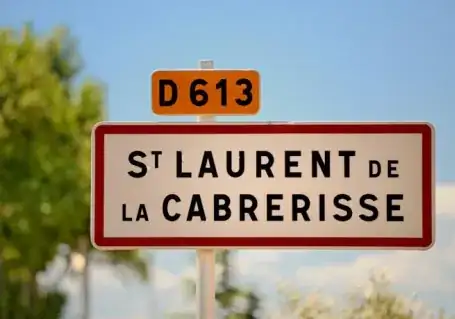
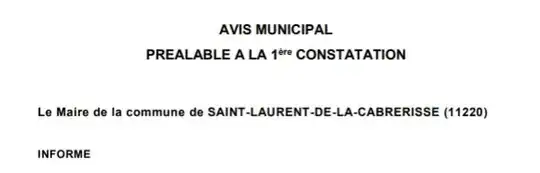
Note however that these rules are related to official / administrative documents. Actual everyday usage can be much more relaxed, e.g.:
enter image description here

enter image description here

jlliagre
  • 148,505
  • 9
  • 106
  • 237
  • 1
    Isn't capitalizing the first letters enough to make it clear in the United States case? – Snack Exchange Nov 20 '23 at 12:48
  • 3
    In the U.S., we have a United States Board on Geographic Names which standardizes them. This is why Pittsburgh is the only city in the U.S. which doesn't spell its suffix burg and why Martha's Vineyard is one of only a handful of geographic localities that have an apostrophe--they had enough political power to resist the Board's decisions. When I first read this question, I assumed that something simiiar had happened in France. After all, you do have l'Académie française. – Peter Shor Nov 20 '23 at 13:08
  • 1
    @SnackExchange Right although that would still be ambiguous if for some reason, the whole sentence is written in capitals. – jlliagre Nov 20 '23 at 13:10
  • @PeterShor Yes, French toponyms are standardized too. – jlliagre Nov 20 '23 at 13:13
  • 2
    Note how the french text makes a singular exception for a possible definite article: No hyphens in e.g. the harbour city of Le Havre, or the ski & climbing resort of Les Houches. – user3445853 Nov 20 '23 at 20:53
  • 2
    @user3445853 I think the first definite article doesn't attach to its noun. Look at the first example in my question: La Roche-sur-Yon. See? La isn't hyphenated with Roche. I think your examples also show this. – Snack Exchange Nov 20 '23 at 23:57
  • @SnackExchange That's the point of user3445853's comment. The French document explicitely states that exception: *à la seule exception de l’éventuel article défini initial*. When there is an initial definite article, no hyphenation occur between it and the remaining of the name. – jlliagre Nov 21 '23 at 00:44
  • @jlliagre explicitly occurs – Snack Exchange Nov 21 '23 at 09:37
  • @SnackExchange It occur to me constantely ;-) – jlliagre Nov 21 '23 at 10:58
4

This is the result of an administrative rationalization.

Toponyms created/used for administrative purposes are regulated, in order to remove ambiguities. The rule is: Purely conventional elements are linked with hyphens, and elements still relevant to describe the place are kept alone:

Parmi les mots composant en français un toponyme, même désignant un lieu situé hors de France, sont joints par des traits d’union les mots ayant perdu dans la composition leur sens ou leur syntaxe habituels

E.g. compare:

  • la côte de Granit rose in which côte, granit and rose meaning is accurate and still relevant: Pink granite coast,

  • with le cap Gris-Nez, gray nose cape, in which cap is still relevant, but Gris and Nez are since centuries the corruption of craig nes, meaning rocky promontory, the name given by the English occupant to this place.

Many city names are now single-word (using hyphens) as the result of a few basic elements:

  • The country is one of the most dense for rivers, river names have been added to many city names for centuries. But cities have expanded, and the banks are now far from view. The river name and the preposition/article are hyphenated.

    • Moret sur LoingMoret-sur-Loing
  • The country has been influenced by Catholicism. Names of cities founded by catholic figures, subsequently promoted to saints, embedded their founder name. In the now secular nation, saints and martyrs names or other connections to religions have been hyphenated.

    • Saint Laurent du VarSaint-Laurent-du-Var
    • Thun l'Evêque ⟶ Thun-l'Evêque*.
    • La Chapelle Saint-SépulcreLa Chapelle-Saint-Sépulcre
  • Along the same line, the country was once feudal, with city names embedding their feudal status. As there are no more viscounts, kings or ducs, these seigneurial mentions have been hyphenated:

    • Bar le DucBar-le-Duc,
    • Choisy le RoiChoisy-le-Roi.
    • La Chaize le Vicomte (i.e. viscount residence) ⟶ La Chaize-le-Vicomte
  • Cities have merged, taking a compound name made of previous names linked by an hyphen:

    • Cities of Cergy and Pontoise merged in 1970 into the town of Cergy-Pontoise.

There are exceptions in this administrative effort, e.g.

Rules have been relaxed for maps created by State surveying agencies, because splitting these long one-word names result in unsightly hyphen stacks:

Toutefois, en cartographie, l’omission d’un trait d’union ou d’une majuscule normalement exigés par la grammaire peut être acceptée conventionnellement pour signifier des informations non pertinentes en toponymie courante ou pour minimiser la longueur typographique des écritures portées sur la carte, si ces conventions sont explicitées en légende.

So what you see on maps may not be the official typography, in particular regarding the use of hyphens.

mins
  • 383
  • 2
  • 7
0

I don't know if it's only the case in the Canadian province of Québec, but the latter hyphenates names of places or streets named after deceased people. Ex. Aréna Maurice-Richard (dead ice hockey legend). Places or streets shall not be named after people who are still alive.