3

enter image description here

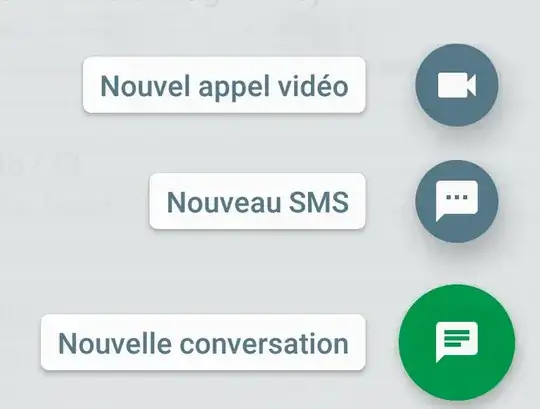
Ok I thought I was doing pretty good with French but it's things like this that make me sigh...

Same screen, same word in English, 3 different related words in French. Can you please explain exactly why each variation is used? I'm sure it's partly gender, but French only has 2 genders...

BetterSense
  • 650
  • 1
  • 7
  • 15

1 Answers1

5

If the next word is Féminin, like "conversation", we use Nouvelle.

If the next word is Masculin like "SMS", but starts with a consonant, we use Nouveau.

If the next word is Masculin like "Appel", but starts with a vowel, we use Nouvel

Greg
  • 17,226
  • 1
  • 30
  • 60
shaax
  • 448
  • 2
  • 11
  • 2
    Actually, this is a very interesting case: un nouveau SMS or un nouvel SMS ? Either you consider SMS starts with a consonant letter and it should be then nouveau, or you consider it starts with a vowel sound, and then it is nouvel. My own feeling is that both are correct, I can't find a clear grammar rule on such cases, and I have found occurences of both. – Greg Jun 24 '19 at 06:45
  • @Greg: Is that because S is a consonant letter, or just because S is the name of a letter? My understanding is that the names of letters can act like they don't start with a vowel sound even when they do; i.e. they act like words with an h aspiré, at least in certain respects: we can say "le s" and also "le a" with no elision. I made an earlier post summarizing my understanding, but I still have a lot to learn about that subject. – sumelic Jun 24 '19 at 06:56
  • @Greg: For example, on this page I found someone who wrote "J'ai fait un nouveau AR sur Milan la semaine dernière" ("Que pensez vous de la compagnie Alitalia?") – sumelic Jun 24 '19 at 07:00
  • @sumelic: my point is that SMS is pronounced ɛs‿ɛm‿ɛs. I think it is different than the case of individual letter, but that is a good point, you would also say "le SMS", then it is indeed logical to say "un nouveau SMS"... but still, in French, usage can often supersede logic... – Greg Jun 24 '19 at 07:16
  • 1
    @sumelic: ... and I have found many examples of "un nouvel AR" (with AR in the sense of "arrêté royal"). I really can't make up my mind if there is a valid rule for these cases, and if it should just play "by ear" and leave it to whatever "sounds" better in terms of euphony. See eg https://www.agoria.be/WWW.wsc/rep/prg/ApplContent?SessionLID=2&ENewsID=26200 – Greg Jun 24 '19 at 07:19
  • 1
    @suiiurisesse: gotcha ! SMS n'est pas un acronyme : ) – Greg Jun 24 '19 at 08:16
  • 3
    @sumelic While individual letter names do usually block sandhi, initialisms behave a bit differently, usually blocking sandhi when they start with a consonant letter even if they phonologically begin with a vowel (le SPF, la SA, le FN, le MMS), but allowing sandhi if they begin with both a vowel character and actual vowel (l'OMS, les[z]USA, l'UEFA). While the usage has obviously been influenced by the spelling, it seems well established. There's some minor variations (hence your finding of some "le nouveau AR"), but as you'll notice "le nouvel AR" gets a lot more google hits. – Eau qui dort Jun 24 '19 at 10:37
  • 2
    Oh, and words that have integrated a letter block sandhi too: le énième, le ixième, ta Nvidia. – Eau qui dort Jun 24 '19 at 10:55
  • 3
    This makes sense to me now. I was not thinking that "SMS" begins with a consonant letter. I would think the sound would dominate. In English we order "a CAT scan" but we order "an X-ray". Even better example would be when diving in water we use "a SCUBA system" (always pronouncing SCUBA as a word) but in firefighting we use "an SCBA" system". And certainly we always send "an SMS". – BetterSense Jun 24 '19 at 19:13