This words are always written with æ but I always hear them pronounced like thenk, lend, end... I read that this pronunciation was and old-style, but I have hardly ever heard them pronounced -[ænd]. How would I have to pronounced them ?
Asked
Active
Viewed 1,267 times
1


-
3Please tell us the location where you are hearing this. What country are you in? What part of that country? It may simply be a regional pronunciation. – chasly - supports Monica Jul 12 '15 at 00:38
-
3For sang, thank and words containing /æŋ/, /æŋk/ in general, it's widespread in the U.S. But most Americans don't do it with land or other words containing /ænd/. Do people really pronounce land and lend the same where you are, or do they change the vowel in lend to something else? – Peter Shor Jul 12 '15 at 01:50
1 Answers
3
A merger of the phoneme /æ/ with /ɛ/ is uncommon in native English accents. That is, it is rare for a single speaker to pronounce "land" and "lend" the same way. There is a lot of phonetic variation in this sound, though: one speaker's "land" might sound like "lend" to a speaker of another variety of English.
Beyond this, for many speakers of North American English, the phoneme /æ/ is pronounced in different ways depending on the following consonant. It's generally raised, or brought more in the direction of [ɛ], before the nasal consonants /m/ and /n/. It is also generally raised to a lesser degree (as well as lengthened) before voiced non-nasal consonants. Its treatment before other consonants, /ŋ/ in particular, varies considerably depending on the dialect.
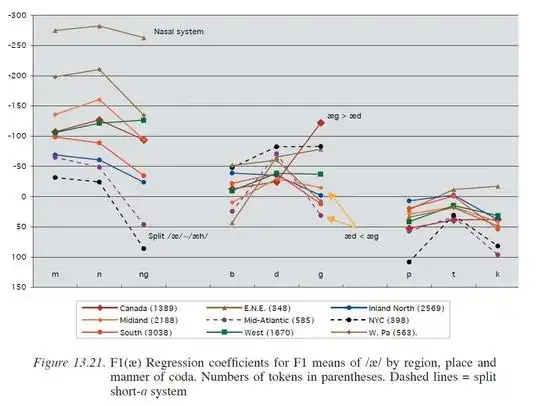
(Labov, 2006)
(I got much of this information and the chart from a discussion on the Wordreference forums that might be worth a look-over.)
In British English, I've never heard of /æ/ raising being common before nasal consonants. British English varieties are more likely to have the trap-bath split, which involves a backing and lengthening of /æ/ to /ɑː/ in some words in various phonetic contexts, including /ænt/~/ɑːnt/, /antʃ/~/ɑːntʃ/ and /æns/~/ɑːns/.

herisson
- 81,803
-
Oh ! Such a complecated image ! :D I am not a phonetician, though I understand phonetic. Per example, in my English book (Assimil) the speakers are British, and they pronounce thanks thenks (sorry it's conplecated to use IPA on iPhone), bit they pronounce all short a as in cat [æ] or [a]. – pretuiol Jul 12 '15 at 10:04
-
@pretuiol: are you sure that they pronounce land as lend, and that you're not being confused by the way vowels behave in your native language? British people certainly don't pronounce land and lend the same. – Peter Shor Jul 12 '15 at 13:01
-
@pretuiol: In this chart, the dots higher up represent a pronunciation closer to [e], while the lower ones are closer to [æ] or [a]. But this is just in North American English. From my knowledge, British English generally doesn't follow this pattern. – herisson Jul 12 '15 at 17:31
-
Perhaps not for land, but for thAnks I'm sure it is not the same as cAt – pretuiol Jul 12 '15 at 18:33
-
Since very few words have /ɛŋ/, the combination /æŋ/ can slide up towards /ɛŋ/ without any confusion (maybe bangle and Bengal, but these words are pretty unlikely to get confused). This certainly happens in some varieties of AmE. Maybe it happens sometimes in British English, too. – Peter Shor Jul 12 '15 at 18:38
-
But it seems to me that I have hardly ever heard people, even who pronounce cat [kat] or [kæt], saying [θæŋks], but almost always [θɛŋks]. And as foreigner, I don’t want to have a regional accent in English, so which pronunciation would I have to adopte ? All short a the same ? And which between [a] and [æ] is more common ? Thanks – pretuiol Jul 12 '15 at 22:09
-
Perhaps there is the same phenomenon in some British accents as in that schema, but not in modern RP. – pretuiol Jul 17 '15 at 00:07