Time is frequently used in Scripture in a singleton sense without an article (in the English KJV), but it is also frequently used with the indefinite article ("a time", as in Joshua 8:14, Judges 9:8, Ezra 4:10, Nehemiah 2:7, Psalm 32:6, Ecclesiastes 3:1-8, Daniel 7:25, Revelation 12:14 and dozens more). "A time" in every such instance refers to a span or period of time, an era, or a deadline.
Apparent singleton uses are rare and will be addressed shortly.
First, it does not make sense to say that "time does not apply to God" or that "causality does not apply to God". He would have had to have caused causality before He could cause causality, which is simply circular reasoning and is absurd on its face. God is not absurd. His ways are higher, not lower, than our ways.
Without the eternality of causality, it would be impossible for God to have created, or to have condescended and participated in time with all of its constraints and demands. This was and is no illusion; otherwise we make the prophecies of Isaiah and every Messianic saying a deceit. God not only became subject to time, but the Son of God subjected Himself to our time in order to redeem all Creation that pertains to it.
In Hebrew, there is no indefinite article comparable to what we often see in English, further complicating attempts to differentiate between seeming singleton time and instances of time.
In terms of causality, the nature of time can easily be visualized and understood using a computing metaphor:
while(True):
with newHeavensAndEarths() as heavens_and_earths:

    redeemAndPerfect(heavens_and_earths)
Of course God is able to (and does) create many different worlds in parallel, but this serial example is sufficient to understand the nature of time and causality relative to eternity.
Those familiar with the computer science concept of scope will have a head start in understanding this. A scope in computing is essentially the lifetime of a piece of data or of a function. Scope begins when a data item is created or allocated and ends when it is destroyed or deallocated, or when a function begins and ends. According to the strict definition, all functions begin and end. All scopes except the so-called "global" or "universal" scope will have a definite beginning and a definite ending in all useful programs. Scope is visualized in the above program by the indentations. An indentation denotes the beginning of an inner scope, and an unindentation denotes the end of that scope, and the dissolution (but not annihilation) of what was created within it. Scope essentially means that an item is created within a certain context and does not exist outside of that context.
"Time" is analogous to the inner loop where new heavens and new earths are created, and God does His work on each of them. Within that inner loop or scope, time is measured according to the system or systems in which the work occurs.
Eternity is likened to the outermost loop, which has no end (and unlike a computer program, also has no beginning). One could replace this with "always and forever" or some such thing. Suffice the analogy to say it is recognized as an infinite loop.
By this very simple example we can see certain properties, for example that there are many different times, each pertaining to and measured by its own heavens and earth, and each has a definite beginning and ending.
Of course I am not saying that Creation is a simulation; it is not a simulation and is very real. Crucially this analogy allows us to dispense with nonsensical notions such as that universal progression (which we might call universal time) or causality itself was "created". Existence itself makes no sense if we dispense with causality, and Creation would have been impossible.
When time is referred to in the singleton sense in English renderings of Scripture, it refers to global time, not universal time. In other words, it refers to the time of this Earth, not God's time.
with the Lord one day is as a thousand years, and a thousand years as one day (2 Peter 3:8).
This shows that although progression is measured with respect to a different system in God's eternal realm, it is not devoid of progression, causality or forward movement, which are properties of the time we are familiar with. All things that are earthly are types and shadows of the heavenly.
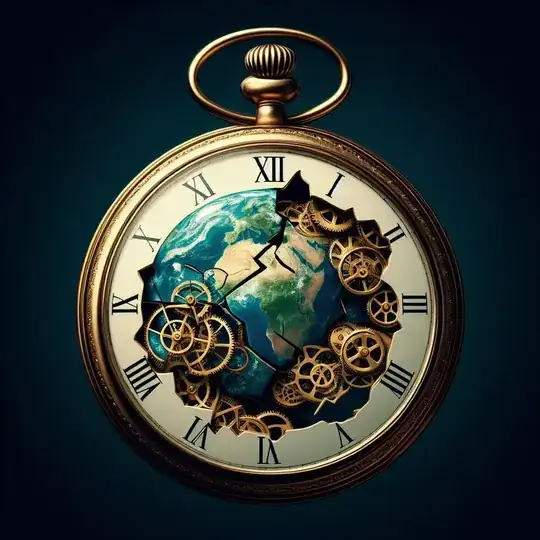
A second analogy is a watchmaker. God is likened to a watchmaker creating, tuning and winding up watches. When a watch has wound down or worn out, it needs re-winding or repair or replacing. "A time" in the singleton or even global sense therefore always refers to time as measured by and within a specific system.
This allows us to make sense of this verse in Revelation that states that "time will be no longer":
And sware by him that liveth for ever and ever, who created heaven, and the things that therein are, and the earth, and the things that therein are, and the sea, and the things which are therein, that there should be time no longer: (Revelation 10:6)
That is to say, the grandfather clock of this Earth around its Sun will cease, and our appointed time of probation will have ended. The Greek text shows this instance of time, rendered in English in a singleton sense without an indefinite article, is the same word as occurs elsewhere in the New Testament to specify "a time" (indefinite, non-singleton usage). Thus "singleton time" is an illusion imparted by the English language, the King James translators, or our own modernist projections of meaning. Proving the pattern of the Watchmaker or the Programmer creating new things and assigning each its time within the infinite scope of eternity, we further read:
And I saw a new heaven and a new earth: for the first heaven and the first earth were passed away; (Revelation 21:1)
Therefore God, while He lives in eternity, uses eternity everlastingly to create, finish and perfect His works in various frames of time.
God existed before and will remain into eternity outside of our time when it has ended but He is not immune to causality. He never had a beginning and will have no end. Even though the heavens and Earth shall pass away, we will continue also. We are eternal beings; the Scriptures say so, for otherwise we would cease to exist when this Earth's time is ended. But the Scriptures say that such an idea is false, and that all will continue to exist forever, either in a state of endless misery or in a state of never-ending joy according to our works done in the time appointed to us, and the desires we grew and exercised during that time.
Neither the ubiquitous passages in the Bible referring to God as the Creator (nor any other passages) indicate that God does not use time, does not respect causality, or exists "outside time" in a sense interpreted to violate progression, causality, or time in His sphere. We might appropriately call His time Celestial time. Per all of our observations, I cannot say it ever goes backwards. The eternality of God cannot contradict His causality, nor does anything preclude the continuation of further Creations.
It is true that for our purposes who dwell here on this Earth, our time will run out, and we must stand to be judged before God and enter into an unchangeable eternal state.
Is there not an appointed time to man upon earth? are not his days also like the days of an hireling? (Job 7:1)
This life is our time of testing, and it will surely end.
Of that rapidly approaching day, the Lord says:
the time is at hand.
He that is unjust, let him be unjust still: and he which is filthy, let him be filthy still: and he that is righteous, let him be righteous still: and he that is holy, let him be holy still.
And, behold, I come quickly; and my reward is with me, to give every man according as his work shall be. (Revelation 22:10-12)
God having foreknowledge is not at all incompatible with scoped time in eternity, and the immutability of causality, nor is it incompatible with our ability to choose.
If God wanted to redeem all of His children and could do so by having Adam and Eve go back in time and preventing them from partaking of the forbidden fruit, I suppose He could have done so, but He didn't, doesn't, and by all appearances never will, which strongly suggests there is an unmovable reason for that.
In the end, it is necessarily true that God's own time respects causality and the course of eternity is irreversible, otherwise there could be no such thing as the eternal and final judgment of which the Scriptures continually warn.


What does that leave?
– Robbie Goodwin Dec 23 '23 at 00:19Again, how are your mind ('my mind') and 'our minds' comparable?
Do you insist you speak for everyone, or could you stop equating your mind ('my mind') and 'our minds' or do you see another useful option?
– Robbie Goodwin Dec 23 '23 at 00:39