What sort of city?
You ask specifically about Dallas, Texas. This is interesting, because Dallas, along with most American cities, is unique compared to world cities due to its level of sprawl. Dallas in particular is really rivaled only by Atlanta among American cities due to its sprawl. So it is an interesting city to try to build, since no other city requires you to build outwards so far.
First, lets get some data. Dallas and Tarrant Counties, TX have an area of 4499 km$^2$ and a population of 4,177,173 at the last census; a density of 928 people per km$^2$. A similar sized but much denser US city is Boston. Suffolk, Norfolk, Middlesex, and Essex counties in MA have an area of 4605 km$^2$ and a population of 3,855,210; a density of 837 people per km$^2$. Another similar sized but denser still European city is Rome, which has 4,340,915 people in a metro area of 5352 km$^2$; a density of 811 people per km$^2$.
So Dallas is evidently more densely populated than either of its peers, why do I keep calling it low density? Lets look closer in. Dallas’s city itself is 999 km$^2$ and has 1,197,816 people. Boston and its nearest suburbs$^1$ have 2,237,072 people in 1017 km$^2$. The Rome commune, without the Cassia Flamina Municipio has 2,531,062 in 967 km$^2$. Dallas’ density is 1199, Boston is 2199, Rome is 2617.
Even closer in, it gets even more disparate. I have built a program that estimates US cities’ densities at certain areas using zip code information. Dallas’ densest 100 km$^2$ holds about 223,000 people; Boston 676,000; and Rome’s I, II, V, and VII municipios around 883,000.
Why mention this?
There is little data available on building a city outwards. No US city with a population over a million has been founded recently (Oklahoma City is probably the most recent, in 1890) so it is hard to tell how long it takes to expand a cities footprint so large.
But you are only asking about a downtown. Dallas’ downtown isn’t very big. If you count the 100 km$^2$ that I talked about before, my calculations land 223,000 people and 299,000 jobs; good enough for 20th out of the US cities. A city that large is pretty easy to build. I will give you answer the benefit of the doubt and assume you wanted something a little more built up. Boston’s densest 100 km$^2$ has about 676,000 people and 697,000 jobs, good for 3rd in the US, after Chicago and New York. Lets see how long it takes to build a city that big.
20 Years
Here is a picture of Dubai:
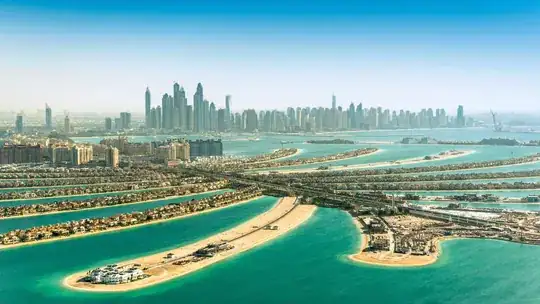
Dubai has a lot of tall buildings. In fact, if you look at a list of them, Wikipedia list 104 buildings in Dubai over 180m. Dallas, by comparison, has 12. Going back to that first list, we can see that only one of the 104 buildings on that list was built before 1999. In 1995, Dubai's population was about 674,000; 20 years later it is around 2.4 million.
If you are interested strictly in building up, it is possible for a city to move from a provincial town of less than a million to having the 13th most highrises of any city in the world, including 22 300m buildings (the United States in total has 19), and add housing for almost 2 million people, all in about 20 years.
Footnotes:
1: Suburb list: Boston, Cambridge, Somerville, Chelsea, Malden, Everett, Brookline, Winthrop, Watertown, Revere, Belmont, Arlington, Newton, Medford, Melrose,Quincy, Milton, Saugus, Lynn, Marblehead, Swampscott, Salem, Braintree, Weymouth, Nahant, Stoneham, Winchestser, Womburn, Wakefield, Reading, Lynnfield, Peobody, Waltham, Wellesley, Needham, Dedham, Westwood, Norwood, Canton, Randolph


