19

I am writing a story in which the characters have some power over the physical world - literally able to transform their knowledge of physics into powers. I am trying to determine a good way for them to fly. Literally anything is available to them that has some kind of physical law attached to it.

My current plan is just to say that they can choose to cancel out gravity, but I realize it means they would just start floating, not necessary moving in any particular direction. If they change the air pressure around themselves, then they'll have to do all sorts of odd things in order to not pop their eardrums and whatnot. If they create explosions by concentrating oxygen and spiking the temperature, then they're going to die from being exploded (hah).

Edit: I'd like to say that I really appreciate everyone's input on this question and I hope it helps other people playing with such a world. I accepted the answer that worked best for me, but there's still plenty of great answers in here! Please upvote everyone, they deserve it.

bowlturner
  • 49,161
  • 5
  • 104
  • 238
C Bauer
  • 329
  • 2
  • 13
  • 5
    This sounds more like what you want is magic, that is explained using physics. Because your characters are going to be altering physics, which is magic. In any case, I highly recommend The Grimnoir Chronicles by Larry Correia, it's filled with characters who alter different branches of physics for their powers. It's 'Hard Magic'. – Samuel Dec 10 '14 at 00:42
  • 1
    You know, I'm surprised we haven't had a question like this before now. Also, you can see this for an amusing idea or two. – HDE 226868 Dec 10 '14 at 01:22
  • Do they have to be able to do it using just their own body's physiology? Or can they use a device? (IE a jet pack) – TylerH Dec 10 '14 at 14:09
  • 3
    "literally anything with a physical law" -- I'm not sure how much physics you know, but that's dangerous (for you as a writer). Everything has physical laws attached to it, so you have "can do everything" magic (boring) and you (and your characters) are likely to look silly at some point, that is to all readers who know some physics you don't which solves a problem you introduce for your characters (at least if you explain the powers in the story). Why fly if I can just tunnel my body there? Why not disable the laws of thermodynamics? – Raphael Dec 10 '14 at 14:11
  • 3
    You need more restrictions. For instance, borrowing from quantum physics, say "wizards" can change the probability of atomic events (larger change means larger drain of energy; skill needed to orchestrate effects). Or you can flip signs in equations that govern interactions of the molecules of your body with everything else (skill needed for picking the proper equation and managing it right; every flip costs power). With such a restriction in place, your question makes sense. – Raphael Dec 10 '14 at 14:13
  • @TylerH They could use a jetpack, but these are mostly kids who don't have a forge or anything they would need to fabricate devices of varying complexity. It would be like trying to build a microcontroller using a sledgehammer. – C Bauer Dec 10 '14 at 14:17
  • @Raphael - Good point. There are limits - they need to use the energy around them to affect major things, the device that enables these powers can only make the change, but the energy still needs to come from somewhere. They are "more powerful" when there's a lot of energy being expended around them, not on their own. – C Bauer Dec 10 '14 at 14:17
  • The "Inheritance Cycle" aka Eragon Series by Christopher Paolini has a magic system that does almost exactly what you say. There is a lengthy discussion in one of the 4 books where Eragon learns the physics of flying. – John Dec 10 '14 at 14:22
  • 1
    @CBauer Which kind of energy can they access? Mass is just energy, after all, and that would give you unlimited power (for "every day tasks" like nuking a town) with, say, a pencil. – Raphael Dec 10 '14 at 14:24
  • Sure - character goes to airport, buys airline ticket, gets on plane... – Oldcat Dec 10 '14 at 22:39
  • We have agreed not to use the fantasy tag, please use magic instead (or something more appropriate) http://meta.worldbuilding.stackexchange.com/questions/1830/so-lets-talk-about-burning-the-fantasy-based-tag – Vincent Oct 16 '15 at 15:08
  • What would be appropriate for a 'future state of technology whereby we can perform X?' where X is modification of the physical world via technology? We already have microwaves that heat up whatever they are pointed at, and that would not be considered magic. – C Bauer Oct 16 '15 at 15:11
  • Welll I was thinking of the simplest method... If they can use their powers based on the laws of physics, why can't they just push the air under and around them to lift themselves up and forward? Basically, they're flying on a really strong breeze? – ASH-Aisyah Apr 26 '16 at 15:09
  • If you could cancel out gravity, then all you need is literally any force to move you, increasing/ air pressure on your feet is all you need to go in the opposite direction of your feet. you could also reduce it down there to send you towards them. No pressure change by the ears, but you still get dozens of pounds of force pushing you, and with no gravity you can keep on accelerating. – Ryan Apr 26 '16 at 15:59
  • if you cancel out gravity you do not float, you get hucked off the planet at 460 meters per second thanks to centrifugal force. remember the earth and you are spinning at very high speed. – John Jan 07 '21 at 00:12
  • Would you not maintain your current velocity despite not being effected by gravity? – C Bauer Jan 07 '21 at 14:29

15 Answers15

8

If your characters played with the gravitational constant, reducing or even negating it in the direction of the major mass, and increasing it in the direction they wanted to go, this would provide a net force that would move them (and anything around them that wasn't fixed) in any direction they wanted:

$F = G \frac{m_1 m_2}{r^2}\ $,

where:

  • $F$ is the force between the masses,
  • $G$ is the gravitational constant, usually approximately equal to 6.674×10⁻¹¹ N m2 kg−2,
  • $m_1$" is the first mass,
  • $m_2$ is the second mass, and
  • $r$ is the distance between the centres of the masses.

EDIT:

$m_2$ does need to be another object, the closer and larger the better. However, if in one direction (i.e. down), $G$ is reduced to $0$ or less, this negates gravity's usual downward pull, and may provide a localised upward thrust. $G$ could also be increased in the direction of desired travel, so the character could be both pushed away from the earth and pulled toward it. The secret of this is the differential between $G$ in different directions relative to the character.

However, other objects in space could also be used - just increase $G$ enough in the appropriate direction, though that might cause other problems if it was increased too much...

...The ability to manipulate $G$ in a localised way could also be an incredibly powerful and dangerous weapon - imagine that pretty much anything could be shot off into space, or a miniature/quantum black hole could be created from any convenient mass. Resetting $G$ to its usual value after having created a tiny black hole would mean that the black hole would probably then promptly evaporate, in an explosion equivalent to the total conversion of the mass involved to energy - think megatons to gigatons of explosive power - or more.

Edit 2:

Another, related idea occurred to me:

If one of these physics-bending characters carried an object of significant mass, they could make its mass negative, allowing it it be used in a diametrical drive.

HDE 226868
  • 101,188
  • 25
  • 303
  • 542
Monty Wild
  • 60,180
  • 11
  • 135
  • 304
  • 2
    Creative. My only criticism is that $G$ is universal and a scalar quantity - it behaves the same all over, no matter what direction you're traveling in. But the mini-black hole should work. That's actually a brilliant idea. – HDE 226868 Dec 10 '14 at 00:36
  • 3
    @HDE226868, The question is effectively a combination of magic and real-world physics. Based on the question, I interpreted this as "the characters can locally alter the physical constants". – Monty Wild Dec 10 '14 at 00:42
  • 1
    @MontyWild Okay, I see that. Makes sense. – HDE 226868 Dec 10 '14 at 00:43
8

In this answer, I discussed a "pufferpolyp" - essentially, a (fictional) creature$^1$ that can fill itself with a lighter gas and thus float up through the atmosphere. I think this could work here. Here's what you do:

  • Choose your atmosphere. The whole operation hinges on this. Try a heavy gas, such as oxygen, that will sink towards the ground relative to other gases. Of course, it has to be breathable, but I suppose you can adjust your creatures so they survive. Here, I'll go with $H_2O$.
  • Choose your creature's gas. My strategy for this would be to have the creature turn some of the gas in the atmosphere into a lighter gas. In this case, you could have the pufferpolyp use electrolysis to turn the $H_2O$ into $H_2$ and $O_2$ (use the reaction $2H_2O \to 2H_2 +O_2$).
  • Carry out the reaction. The creature expands a sac to take in some of the air. It then applies a small electric charge to separate the gas, and then expels some of the unused gas (in this case, if the creature were to use $O_2$ to breathe, you have another benefit).
  • Fly! Go as high as you want, then compress the sac and release the gas inside. You can do this until you float or sink.

You then have the issue of moving forward, backward, or to the side - after all, you can rise here, but you can't go anywhere! So let's say that when you expel the unwanted gas, you can direct the flow in nearly any direction, propelling you in the opposite direction. Need more propellant? Just take in some of the outside air, undergo electrolysis, and fly higher and farther!

$^1$ It's a figment of my imagination, by the way. Just in case anyone was thinking of buying one, which would seem to be a bad idea due to their tendency to float away. Get a good leash.

HDE 226868
  • 101,188
  • 25
  • 303
  • 542
  • 2
    +1 Excellent Answer! Once the gas blatter nulifies the creature's weight, couldn't conventional wings provide lateral momentum & manuvering? Starting with a hollow-boned humaniod frame, couldn't the blatters surround an atrophied torso and legs, leaving the upper chest and arms muscular enough to power a set of wings. There would be a design issue, trading off energy reserves for weight, but that should still allow for short bursts of speed seperated by long lazy glides. If the gaseous water atmosphere was dense enough to host some free floating sugar, that might solve the energy issue. – Henry Taylor Dec 10 '14 at 01:17
  • *Couldn't conventional wings. . ." I am so . . . bloody . . . stupid. Of course they would! You'd have to have a proper skeleton, but I suppose that's easier than having an air sac inside you! – HDE 226868 Dec 10 '14 at 01:18
  • I'd vote for both, air sacs and wings! Maybe even throw in your multi-directional exhaust vent, so that the creature can do what most birds can't... hover. – Henry Taylor Dec 10 '14 at 01:24
  • This was supposed to be an edit of my earlier comment, (so we don't get in trouble for having a conversation in comments) but the software wouldn't let me (5-minute limit on editing comments), so... Thank you for that link. I had forgotten hummingbirds hovering (from Bio-101, 30-years ago). Have they figured out how hummingbirds do it yet? When I was young, they couldn't figure out the wing motions that could induce non-directional flight. With high speed cameras, I bet they know by now... I will go look it up. Thanks again! – Henry Taylor Dec 10 '14 at 01:32
  • 1
    @HenryTaylor they're getting a better idea. Though it's not unique to hummingbirds. –  Dec 10 '14 at 02:05
  • @MichaelT I think I'm starting to owe you for all this good info. – HDE 226868 Dec 10 '14 at 02:08
7

An old Soviet-era sci-fi had a flying protagonist who could directly control the direction of Brownian motion in his body. Instead of all his molecules moving randomly and having a net force of zero, he was bio-engineered to be able to introduce a bias so that the Brownian motion in the molecules of all his cells did have a non-zero vector sum.

Thus, flight achieved without awkward lighter-than-air floating!

The novel is called Ariel. However, I don't know if any English translations exist.

vsz
  • 11,248
  • 7
  • 36
  • 64
  • This answer is awesome! I wonder if you could really achieve movement that way. – C Bauer Dec 12 '14 at 15:07
  • @CBauer : I've finally found it: http://en.wikipedia.org/wiki/Ariel_%28novel%29 However, I don't know if any English translations exist. – vsz Dec 13 '14 at 11:52
  • I did a little research and I can't find any translations either. Also holy crap, he died of starvation? How terrible. – C Bauer Dec 14 '14 at 02:42
  • 4
    @CBauer About as well as you could fly by lifting yourself with your own arms. Brownian motion is due to random (in the sense of being unpredictable) collisions between particles in a fluid. Even if you could bias those collisions in a certain direction, the particles bouncing off each other are all inside the person, so he's not going anywhere because of good old fashioned Newtonian physics—for each collision resulting in a particle vectored toward the desired direction, there is another particle traveling in the opposite direction. – Joshua Hanley Jun 08 '15 at 17:31
  • 1
    @JoshuaHanley, you could try altering Brownian motion of air beneath you, so the particles would push you upwards. Not sure if it can be enough for flying, though. –  Apr 25 '16 at 14:51
  • 1
    Using a Brownian motion would be a nice idea. He could push himself from each molecule by his need and fly around , consuming for that a kinetic energy of the air molecules - that means, an air around him would become colder, that feature also can be used in book :D –  Apr 25 '16 at 11:44
5

If they have finesse of these things, then cancelling gravity in one direction and increasing it in another could work, it would be more like falling horizontally. By strengthening and weakening the forces could allow for speeding up and slowing down.

bowlturner
  • 49,161
  • 5
  • 104
  • 238
  • Oh god, that's so obvious, I'm a fool! I don't want to accept this and close the question immediately because I'd like to hear other possible answers as multiple options means twists and turns if the characters are fighting for control over the same force, or trying to sabotage one-another. – C Bauer Dec 10 '14 at 00:21
  • 1
    @HDE226868 It's a mix of scifi and metaphor - I don't want the story to be completely implausible and hope to be able to play with some of the rules. Like MontyWild's answer - if one character is trying to move laterally toward an object by increasing it's mass, another could be resisting him and decreasing it in order to slow him down. – C Bauer Dec 10 '14 at 00:28
  • /it's/its/ you want the pronoun. – JDługosz Dec 10 '14 at 02:23
  • 3
    You should read "The Stormlight Archives". The characters with certain powers in that do a lot by attracting things to each other. – Tim B Dec 10 '14 at 09:54
  • 1
    @TimB I've read the first one in the series, Brandon Sanderson is one of my favorite authors. Have you read the Mistborn series? lots of pulling and pushing. – bowlturner Dec 10 '14 at 13:33
  • I was literally just about to post this and cite Stormlight, but someone beat me to it. Ah well, at least there are other Sanderfans on this site. – Epiglottal Axolotl Dec 11 '14 at 01:39
  • I actually think that Mistborn has better physics of flight than the Stormlight series, as it the pulling and pushing of metals works exactly as it would work if I was pulling or pushing the metals with my hands. The Stormlight Archives is more of "Pick a direction and fly!" – Nathan Merrill Dec 12 '14 at 19:36
4

"When I cancel gravity, I can't control which way I float."

First make a costume with plenty of fabric that you can use as a control surface. This may be an ankle-length shirt, as worn by John Darling of Peter Pan or the squeaky-voiced Seville kids in 1980s Alvin and the Chipmunks. Or it may be a cape, as worn by Mario of Super Mario World. Or it may be a dress with a full skirt, as worn by Peach of Super Mario Bros. 2. If you're not worried about fitting in, it could even be a full-on flying squirrel costume, as the technique you're about to learn is derived from gliding.

Then take a running leap, and as you push off from the ground, cancel gravity. In some settings this may involve various forms of technobabble; in others you need only cover yourself with a form of dust and think happy thoughts.

While you're in the air, move the control surfaces with your arms and legs to control your trajectory. Eventually you will stall. Temporarily allow gravity to work again, dive until you've regained speed, pull back into a climb, and cancel gravity again.

Damian Yerrick
  • 2,230
  • 15
  • 25
3

In this comment I analyze the realisticness of HDE's pufferpolyp.

I will model the animal as a spherical object, with an internal cavity of radius $r$, surrounded by skin and flesh and bodily material of thickness $d$ on the outside, with the density being that of water ($\text{density} = 1000 \text{ kg/m}^3$). Inside the cavity is the hydrogen ($\text{density} = .085 \text{ kg/m}^3$) produced by electrolysis, and the outside atmosphere is water vapor ($\text{density} = .804 \text{ kg/m}^3$). Of course the temperature difference to make the body liquid but the outside gaseous is a bit strange but it's an assumption I'm fine with making.

The buoyant 'force' (technically the mass; I'm ignoring $g$ because it cancels out anyway. Pretend $g=1$ if it makes you happy) applied by the water vapor is density times volume, which is $$.804(r+d)^3 \times \frac{4}{3} \pi$$ The weight of the animal is the weight by the gas and the weight of the flesh: $$\left(\frac{4}{3}\pi\right)((.085)(r^3) + 1000 ((r+d)^3-r^3))\left(\frac{4}{3}\pi\right)$$ The $\left(\frac{4}{3}\pi\right)$ terms cancel out.

We are left with:

$$.804(r+d)^3 = (.085)(r^3) + 1000 ((r+d)^3-r^3)$$

For $d = 1 \text{ cm}, r = 41.7 \text{ m}$. For $d = 2 \text{ cm}, r = 83.4 \text{ m}$. For $d = 5 \text{ cm}, r = 208 \text{ m}$.

If the animal was made of (liquid) ammonia, with density $681 \text{ kg/m}^3$:

For $d = 1 \text{ cm}, r = 28.4 \text{ m}$. For $d = 2 \text{ cm}, r = 56.3 \text{ m}$. For $d = 5 \text{ cm}, r = 142 \text{ m}$.

Conclusion: The animal is absolutely ridiculous, assuming that all my units were proper. The smallest number here is the $28.4 \text{ m}$ one, which would weigh $69047 \text{ kg}$.

1

In the Jumper series of novels(I think I was reading Exo; something like that), it was pointed out that teleporting to different latitudes etc. Required a change in momentum as well as position. She figured out how to jump in-place while adding momentum. I was thinking "I guess that's how Superman does it."

If you're making it a point to be physical for teaching and illustration (like the early stories by Robert L Forward) you need to follow conservation laws. If some other thing took the opposite momentum, and a non-instantaneous energy-carrying field linked the two, that could be interesting.

A way to have a seemingly reactionless drive would be a dark matter rocket. Particles in the air can be converted to dark matter through supersymmetry laws, liberating energy by choosing an unbalanced reaction, and having all the produced particles fly off in one direction.

But what are the boundaries of the rules? By using physics, what can be done (that doesn't work in the real world) and what can't? What's the unifying principle? The story needs a succinct super rule that the audience can grasp and understand what is allowed or not.

Brythan
  • 25,284
  • 10
  • 52
  • 103
JDługosz
  • 69,440
  • 13
  • 130
  • 310
  • Basically characters wearing a self-powered super computer that can translate their knowledge of physics into phenomena - like another poster said, the intersection of magic and technology.The more you understand natural laws and constants, the more things you can do with it. If I could explain it further than that I'd be building prototypes instead of writing fiction about it! – C Bauer Dec 10 '14 at 12:32
  • The computer can do that but doesn't have physics knowledge itself? – JDługosz Dec 10 '14 at 17:14
  • Kinda the classic "humans fearing AI finding them obsolete" scenario. It can interpret thought into phenomena, but it doesn't think. – C Bauer Dec 10 '14 at 17:24
  • Thanks for the fixes, @brythan. My tablet fake keyboard was giving me fits. – JDługosz Dec 30 '14 at 09:25
  • IIUC, we don't know that dark matter even exists. We hypothesize that it does as a possible explanation for various observations that otherwise don't fit our knowledge, but that's not proof. This makes it questionable whether characters in the OP's world should be able to manipulate it. (It also means that if they can, the story is inventing physics, although that's hardly uncommon; see every instance of FTL ever.) – Matthew Aug 06 '20 at 14:06
  • 1
    Yes, we know that dark matter exists. It is "stuff" that can be arranged in a spacial extent and density independently from the normal matter. We just don't know what it is in the sense of how it relates to the Standard Model, but we know quite a bit about it. – JDługosz Aug 14 '20 at 14:38
1

Habatchii says;

Deep psychological hypnosis. A study on metaphysics and superhuman capabilities was conducted in Germany during both World War One and Two in which hypnotism and subliminal suggestion were used to recreate a 'virtual' environment so invocating suggestive response in human subjects.

Top secret experimentation did lead to specific technologies common in the marketplace today. Such 'benchmarks' may be used as marketing devices for further psychological assessment. Additional capabilities in human conditioning may be attributed to geographical location, dietary restriction, selectivity and ethnic purification; respectfully.

Other psychological drivetrains may entail an agent provocateur relationship between a host and subject in which routine examinations help build the subjects 'skill' according to the agent-agency protocol. The subject may or may not be concious during the sessions, but depending upon the extensibility of the research the virtual reality will be quite realistic with minimum degree of negative deviation.

  • Um, I'm not sure how this answers the question, but it's got an almost creepy level of insight into the world I'm building, so I actually really appreciate it. – C Bauer Dec 12 '14 at 15:06
  • This answer only suggests at an answer to the question very tangentially. You might want to add more how this actually deals with the question? – bowlturner Dec 12 '14 at 15:10
1

A newer question on magic & conservation laws reminded me of this question.

What if the super AI was like Maxwell's Demon? It can cause improbable things to happen, and specifially reverse anything that happens easily. A minute expendature of normal energy and knowledge allows reversing of entropy in our physical world at the expense of having to dissapate the information entropy somewhere else or consume large amounts of power.

Unlimited hero with limits imposed: if he doesn't get back to home base in time (to discharge the divice with its special dock) then it, he, and everything around within a few feet will catastrophiclly give up energy, freezing to liquid helium temperatures.

JDługosz
  • 69,440
  • 13
  • 130
  • 310
0

Your current version sounds a lot like a basic form of what Brandon Sanderson uses in Stormlight Archives - cancel out gravity. What makes it flying is that they can also let gravity act upon them in any custom direction. So the flying becomes a bit of falling with style.

My personal preference would be a combination - cancel gravity and then use wind to steer yourself where you want to go. If you're weightless (NOT massless), you will accelerate a bit slow (because of your mass relative to the air), but you'll be blown away by any wind.

Gloweye
  • 1,161
  • 6
  • 9
  • Welcome to Worldbuilding, Gloweye! If you have a moment, please take the [tour] and visit the [help] to learn more about the site. You may also find [meta] and The Sandbox useful. Here is a meta post on the culture and style of Worldbuilding.SE, just to help you understand our scope and methods, and how we do things here. Have fun! – Gryphon Aug 15 '18 at 16:43
0

Make use of the butterfly effect.

A butterfly flapping its wings in one place can cause a tornado in another. If you could harness this then, for very little effort on your part you could be propelled around by your own personal hurricane.

Maybe you would have small wings on your heels (like the god Mercury) but instead of flapping them to provide lift, you use them to cause a boomerang butterfly effect. There would be a time delay but you could learn to control this with experience.

In chaos theory, the butterfly effect is the sensitive dependence on initial conditions in which a small change in one state of a deterministic nonlinear system can result in large differences in a later state.

Wikipedia

chasly - supports Monica
  • 49,370
  • 15
  • 152
  • 305
0

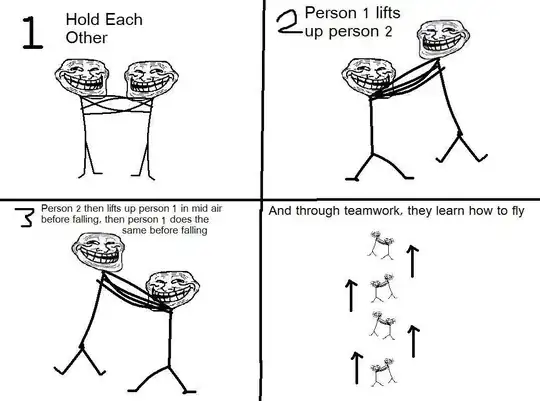
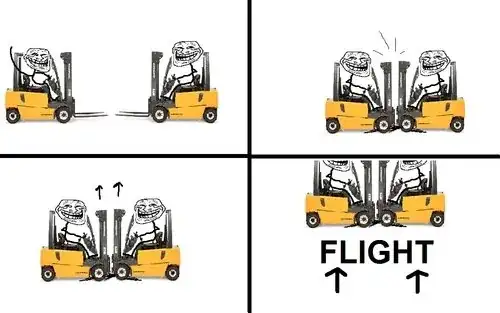
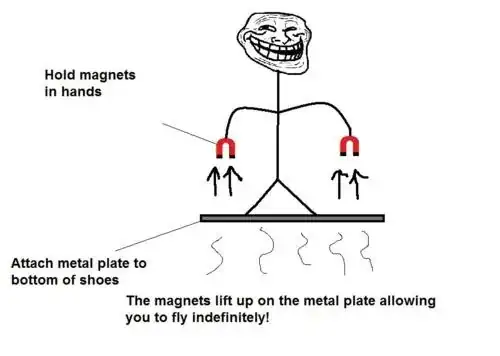
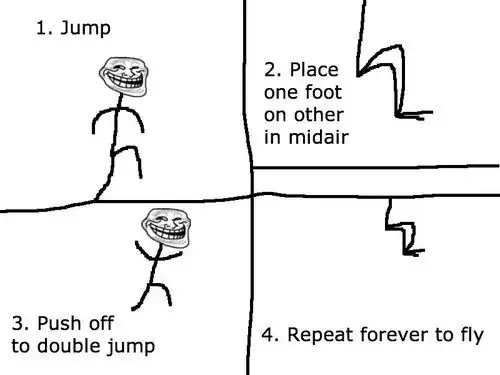
If you are willing to change laws of physics, the answer is quite obvious.

Negate the law that says every force has an equal opposite force. No the character can pull themselves up by the bootstraps or something similar. They are actual a couple ways this could be realized, from tag teaming to magnetism. I provide a gallery of different demonstrations of the principle.

enter image description here

enter image description here

enter image description here

enter image description here

Christopher King
  • 12,822
  • 6
  • 47
  • 89
0

If it's a matter of a manipulation of rules of physics, how about having someone with the ability to stretch out their arms and use material of some sort (or if you'd like to be somewhat disturbing, their arms themselves) to generate a 'Magnus Effect'[1]?

TesseractE
  • 101
  • 1
0

Why not manipulate gravity so that it pulls in a different direction, so that you could fall in the direction you want to go?

The speed of the gravitational pull could be slowed by an opposing gravitational pull in the opposite direction.

Secespitus
  • 17,743
  • 9
  • 75
  • 111
0

A sufficiently powerful electromagnetic force would do the trick, such as magnetic levitation.

All you'd then need to do is alter the strength of the magnetic field in the direction you intend to travel.

HDE 226868
  • 101,188
  • 25
  • 303
  • 542
Raisus
  • 1,513
  • 11
  • 17