A zeppelin is floating like a boat is floating. Engineless boats can be propelled by sails or oars.
Sails would be possible for the zeppelin and it would need a long keel below it to allow tacking.
Oars or paddles which must be lifted out of the water on the forward stroke would not work; there is not an air/water interface.
- Oars that stay in the water and propel via a lateral motion would work fine. This is sculling.
https://en.wikipedia.org/wiki/Sculling#Single-oar_sculling
Single-oar sculling is the process of propelling a watercraft by
moving a single, stern-mounted oar from side to side while changing
the angle of the blade so as to generate forward thrust on both
strokes... In single-oar sculling, the oar pivots on the boat's stern,
and the inboard end is pushed to one side with the blade turned so
that it generates forward thrust; it is then twisted so that when
pulled back on the return stroke, the blade also produces forward
thrust. Backward thrust can also be generated by twisting the oar in
the other direction and rowing. Steering, as in moving coxless
sculling shells in crew, is accomplished by directing the thrust.
The pictures I found do not do it justice. My favorite sculling is the little tub-boat Lin is in in the movie Spirited Away.
As regards landing, you would land the inflated zeppelin in the same way people moor barges and boats. Someone jumps off to the land, attaches a line and then the crew use the line to pull the boat in.
For your zeppelin a crewman would be lowered on an anchor. He would make the anchor fast to something sturdy on the ground (or perhaps the anchor is a screw and he screws it into the ground) then the crewmen still aboard the airship use the anchor line to pull themselves down to the ground - either with manpower or with a winch.
ADDENDUM
I take it the anchor thing is self explanatory. Here is more on single oar sculling.
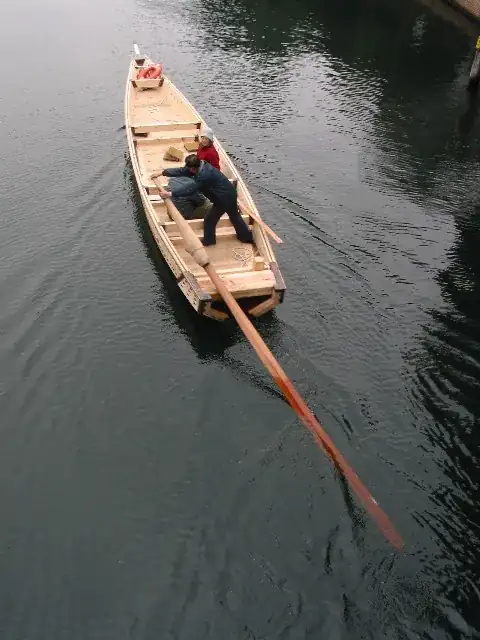
The single oar is swept back and forth. You can use a regular oar this way (for example your other oar breaks). Some boats have a mooring point in the back of the boat to allow this. The pictured boat has a long oar purposefully for sculling.
The sculling oar is pushed back and forth. It is turned as it moves from side to side, so a component of the motion is forward in both ways.
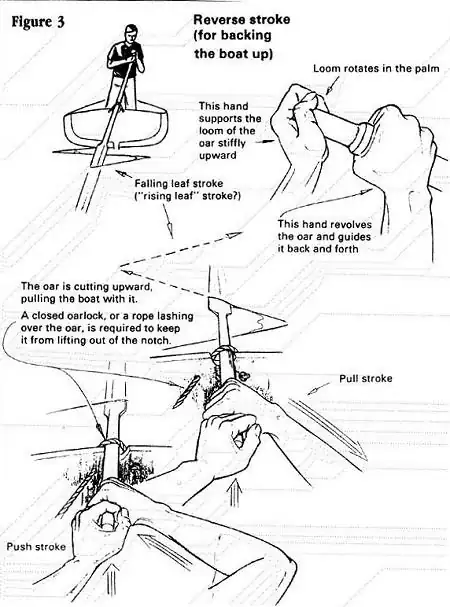 http://archive.is/pJOua
If it is still not making sense watch some youtube videos.
So your single oar sculling airship: it would have a giant fanlike sculling air-oar off the back. This would be pulled back and forth - maybe by a team of slaves or maybe by draft animals in the ship working a wheel with mechanisms to translate rotary into lateral motion.
Alternatively you could have a row of individual air-oars set up like a Roman galley, but the oar stroke would be flat against the wind on the backstroke and then blade forward (to minimize air resistance) on the return stroke.
Of course the fans would be painted with patterns specific to the allegiance of the ship, or maybe with a decoration particular to that ship.


