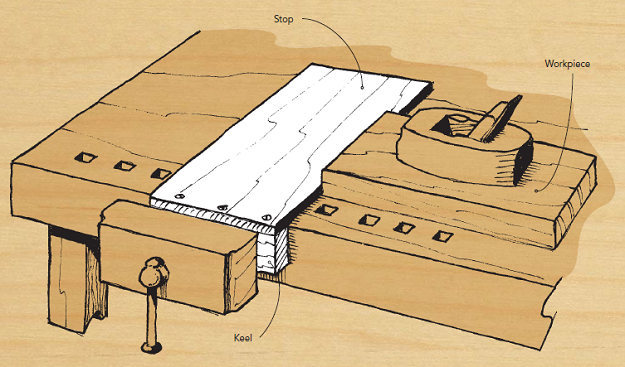
In some respects end stops (as seen on most planing boards and as built into many good benches) are the ideal for planing thinner stock. You can use dogs as these stops of course, they just need to be a raised to be a hair lower than the surface of the board you're working on. And ideally made of wood or plastic, definitely not metal!
But there tends to be a limit to how thin the material can be and for planing stops to still work well and unfortunately that limit seems to be just around 1/8" (3mm) — the workpiece can flex as it's being worked and sometimes simply jumps over the stop which is all kinds of bad. In addition the force exerted on the edges can slightly damage them, and plywood's edges aren't noted for being resilient.
Instead of individual stops like dogs or short rising stops create you can use a wide stop built into the end of the bench or clamped vertically in an end vice, clamped in a face vice (example on Pop Woodworking1), or a continuous strip2. But regardless of the stop type a thin workpiece can still want to jump across it and significant damage to it can result, from the plane itself, from the workpiece hitting anything beyond (including a smooth wall) or from falling to the floor where corner damage is almost inevitable.
So, I think the ideal solution is not to try to have the whole surface available to work on at one time.
Instead clamp the piece firmly down to the benchtop using one or more clamps, a holdfast (or equivalent) and just work around it/them. This is the conclusion I came to from working the surface of a lot of recovered hardboard and soiled plywood which I needed to scrape clean. In addition to being sure the workpiece will never jump over a stop it keeps it flatter, which will certainly help when planing thin plywood which is prone to flexing.
There is one further possibility you might want to try and that's to place the plywood onto a sheet of the non-slip rubberised stuff sold for lining drawers3. This is now widely used to hold workpieces in place during sanding and routing operations. I'm doubtful it will work well for planing very thin material (because of the flexibility of the material and how you have to press down on a plane) but you might want to try it for yourself before you rule it out.
1 I believe this style is based on one published by Robert Wearing in his excellent book, The Resourceful Woodworker.
2 When planing thin material I've rigged up temporary stops that span the bench using a strip of the same thin material I was working on, clamped firmly at each end.
3 Note this same stuff (it appears to be exactly the same) is sold by some woodworking suppliers, but at hugely inflated prices.