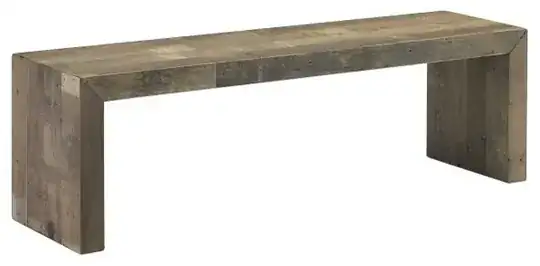
Is it possible to get this look by artificially distressing lumber and if so how would this be accomplished?
Yes, and depending on exactly the character you're after it can actually be quite straightforward, although involved. What I mean is the techniques are individually very simple but there may be quite a number of them used in sequence (and the sequence is very important — changing it can dramatically change the effect, and this is something you may want to do deliberately for variety).
Texture
Starting with wood that is not smoothly milled already can be very advantageous here, but it's possible to add certain textures to wood that is completely smooth, e.g. by sanding, brushing with a wire brush, tapping with wire brushes and generally bashing the wood to make it look old.
Species of wood matters here. Softwoods, which their notable hardness difference between earlywood and latewood, respond in a specific way to some abrasion techniques and that look is not really replicable using a smooth-grained hardwood. So to a degree the species you can use may be dictated by the exact look you're aiming to replicate.
Marks from a mill's circular saw blade can also be mimicked using the tablesaw or a circular saw but there is great potential for personal injury, anyone taking that on does so at their own risk. Careful sanding with coarse paper (60 grit or lower) is a much more advisable method to simulate this texture.
Colour
On to the colouring, just focussing on the overall look it's obviously fairly grey. So getting the wood grey by some means is the first thing to aim for. This can be done using nothing more sophisticated than a wash of heavily thinned paint, either oil-based (including artists' oil paints) or waterbase (including craft acrylics). The colouring possible with both types of paint is very similar, but because of their differences certain specific variations are easier or faster in one or the other, e.g. taking advantage of the paint being wet for a long time for easy blending or feathering, or relying on a paint's fast drying to overlay effects quickly.
There are also a number of commercial stains specifically intended to give these sorts of colours.
In addition to introducing a colour to the wood the wood can itself be coloured, for example using the vinegar + steel technique very commonly seen online for artificially ageing wood (see Note bottom for more on this).
After a base grey colour is achieved a second slightly different colour can be applied in more than one way to introduce some variation (note: because wood is inherently variable some variation will occur naturally anyway). Examples of how you might apply this 'character' paint layer, using paint that has been heavily thinned to a creamy or milky consistency:
- Brushed liberally over the wood, allowed to soak in for a short while then a damp cloth is wiped over the surface in the direction of the grain.
- Same as the above except that the wiping is done at an angle. This can simulate saw marks to a degree.
- Either of the above except that a dry cloth is used. This will give a subtly different effect, usually more hard-edged.
- The dilute paint is applied by a foam roller or by dabbing with a sponge and is allowed to dry, then worn down selectively with either a nylon mesh adhesive (e.g. Scotchbrite), steel wool or fine abrasive paper.
In addition to these sorts of techniques the wood prepared with the base colouring can be used both as-is or sealed, with a dilute coating of waterbase poly, blonde shellac or even thinned PVA glue. In all cases the seal coat should be allowed to dry thoroughly (overnight ideally) before progressing to the next step.
Note: the vinegar + steel wool technique is often poorly described in online guides. To begin with steel wool is not the only thing that can be used, old rusty nails or really any small pieces of iron or steel will work here as long as enough time is given for the vinegar to react with the metal. What this is doing is creating iron acetate, which is what then reacts chemically in the surface wood fibres to produce colour.
This reaction is with tannins in the wood, which some species (notably oak) are high in and give the most pronounced effect usually. This creates iron tannate which is black so the more tannic acid present in the wood the darker the colour. Obviously testing is important with this to gauge effect! If the colour achieved is a little darker than desired a portion of the vinegar solution can be diluted with water and tried again.
Where you're using a species that does not naturally contain much or any tannic acid (particularly softwoods) it can be introduced to the surface of the wood. While tannic acid can be bought online to make a very concentrated tannic acid solution, a strongly brewed tea can work quite well. And for the true DIY devotees a 'tannin tea' can be made using oak leaves, bark and particularly oak galls if you can find any