Druzhina
| Part of a series on |
| Imperial, royal, noble, gentry and chivalric ranks in Europe |
|---|
.svg.png) |
|
|
|
|
|
|
|
|
|
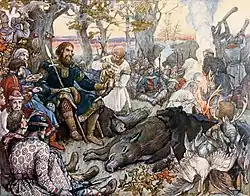
In the medieval history of Kievan Rus' and Early Poland, a druzhina, drużyna, or družyna (Slovak and Czech: družina; Polish: drużyna; Russian: дружина, romanized: druzhina; Ukrainian: дружи́на, romanized: druzhýna, lit. 'fellowship') was a retinue in service of a Slavic chieftain, also called knyaz. The name is derived from the Slavic word drug (друг) with the meaning of "companion, friend".[1][2]
 |
| Knyaz (sovereign) |
| Boyar / Szlachta (noble) |
| Druzhinnik (retainer) |
| Smerd (free tenant) |
| Kholop (slave) |
Poland
Ibrahim ibn Yaqub, who traveled in 961–62 in Central Europe, mentions that the drużyna of Duke Mieszko I of Poland had 3000 men, paid by the duke.[3] Unlike his predecessors, Casimir I the Restorer promoted landed gentry over the drużyna as his base of power.
See also
- Housecarl
- Leidang
- Hird
- Voluntary People's Druzhina, a civilian organization in the Soviet Union
- There was a military unit in Russia, called the "Czech Companions" (Česká družina or Družina), see "Czechoslovak Legion"
References
- ↑ "Online Etymology Dictionary". www.etymonline.com. Retrieved 13 May 2017.
- ↑ Zeno. "Drushine". www.zeno.org. Retrieved 13 May 2017.
- ↑ "Ibrāhīm ibn Ya‛qūb al-Isrā’īlī al-Ṭurṭūshī," by Lutz Richter-Bernburg, in: The Oxford Companion to World Exploration, David Buisseret, editor-in-chief, 2 vols., Oxford UP 2007, I:402b-403b
Bibliography
This article incorporates text from a publication now in the public domain: . Brockhaus and Efron Encyclopedic Dictionary (in Russian). 1906.
External links
 Media related to Druzhina at Wikimedia Commons
Garðaríki | ||
|---|---|---|
Names in italics are settlements whose Norse names are not recorded | ||
| Volkhov-Volga trade route |
|  |
| Dvina-Dnieper trade route |
| |
| Other locations |
| |
| ||