WARS (gene)
| WARS1 | |||||||||||||||||||||||||||||||||||||||||||||||||||
|---|---|---|---|---|---|---|---|---|---|---|---|---|---|---|---|---|---|---|---|---|---|---|---|---|---|---|---|---|---|---|---|---|---|---|---|---|---|---|---|---|---|---|---|---|---|---|---|---|---|---|---|
 | |||||||||||||||||||||||||||||||||||||||||||||||||||
| Identifiers | |||||||||||||||||||||||||||||||||||||||||||||||||||
| Aliases | WARS1, Tryptophanyl-tRNA synthetase, cytoplasmic, GAMMA-2, IFI53, IFP53, tryptophanyl-tRNA synthetase, HMN9, tryptophanyl-tRNA synthetase 1, WARS | ||||||||||||||||||||||||||||||||||||||||||||||||||
| External IDs | OMIM: 191050; MGI: 104630; HomoloGene: 3084; GeneCards: WARS1; OMA:WARS1 - orthologs | ||||||||||||||||||||||||||||||||||||||||||||||||||
| |||||||||||||||||||||||||||||||||||||||||||||||||||
| |||||||||||||||||||||||||||||||||||||||||||||||||||
| |||||||||||||||||||||||||||||||||||||||||||||||||||
| |||||||||||||||||||||||||||||||||||||||||||||||||||
| Wikidata | |||||||||||||||||||||||||||||||||||||||||||||||||||
| |||||||||||||||||||||||||||||||||||||||||||||||||||
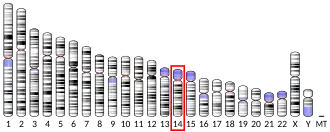



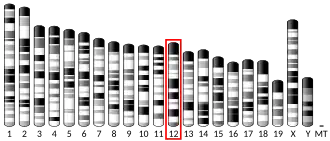

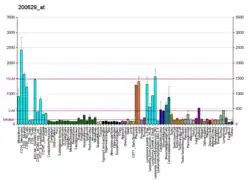
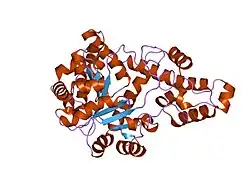
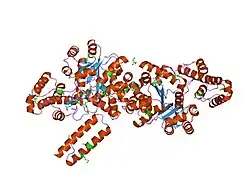
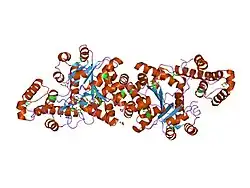
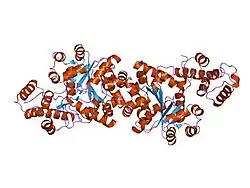
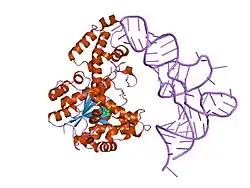
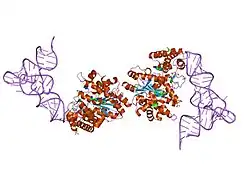
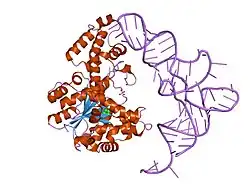
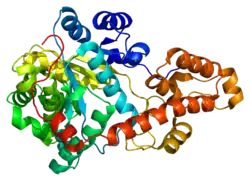
Tryptophanyl-tRNA synthetase, cytoplasmic is an aminoacyl-tRNA synthetase enzyme that attaches the amino acid tryptophan to its cognate tRNA. In humans, it is encoded by the WARS gene.[5][6][7]
Two forms of tryptophanyl-tRNA synthetase exist, a cytoplasmic form, named WARS, and a mitochondrial form, named WARS2. Tryptophanyl-tRNA synthetase (WARS) catalyzes the aminoacylation of tRNA(trp) with tryptophan and is induced by interferon. Tryptophanyl-tRNA synthetase belongs to the class I tRNA synthetase family. Four transcript variants encoding two different isoforms have been found for this gene.[7]
Phenylalanine Incorporation
Although WARS1 classically aminoacylates tryptophan, during states tryptophan depeletion, this enzyme has been observed to activate both tryptophan and phenylalanine.[8]
References
- 1 2 3 GRCh38: Ensembl release 89: ENSG00000140105 – Ensembl, May 2017
- 1 2 3 GRCm38: Ensembl release 89: ENSMUSG00000021266 – Ensembl, May 2017
- ↑ "Human PubMed Reference:". National Center for Biotechnology Information, U.S. National Library of Medicine.
- ↑ "Mouse PubMed Reference:". National Center for Biotechnology Information, U.S. National Library of Medicine.
- ↑ Buwitt U, Flohr T, Böttger EC (February 1992). "Molecular cloning and characterization of an interferon induced human cDNA with sequence homology to a mammalian peptide chain release factor". The EMBO Journal. 11 (2): 489–496. doi:10.1002/j.1460-2075.1992.tb05079.x. PMC 556479. PMID 1537332.
- ↑ Fleckner J, Rasmussen HH, Justesen J (December 1991). "Human interferon gamma potently induces the synthesis of a 55-kDa protein (gamma 2) highly homologous to rabbit peptide chain release factor and bovine tryptophanyl-tRNA synthetase". Proceedings of the National Academy of Sciences of the United States of America. 88 (24): 11520–11524. Bibcode:1991PNAS...8811520F. doi:10.1073/pnas.88.24.11520. PMC 53167. PMID 1763065.
- 1 2 "Entrez Gene: WARS tryptophanyl-tRNA synthetase".
- ↑ Pataskar A, Champagne J, Nagel R, Kenski J, Laos M, Michaux J, et al. (March 2022). "Tryptophan depletion results in tryptophan-to-phenylalanine substitutants". Nature. 603 (7902): 721–727. Bibcode:2022Natur.603..721P. doi:10.1038/s41586-022-04499-2. PMC 8942854. PMID 35264796.
Further reading
- Ewalt KL, Schimmel P (November 2002). "Activation of angiogenic signaling pathways by two human tRNA synthetases". Biochemistry. 41 (45): 13344–13349. doi:10.1021/bi020537k. PMID 12416978.
- Rasmussen HH, van Damme J, Puype M, Gesser B, Celis JE, Vandekerckhove J (December 1992). "Microsequences of 145 proteins recorded in the two-dimensional gel protein database of normal human epidermal keratinocytes". Electrophoresis. 13 (12): 960–969. doi:10.1002/elps.11501301199. PMID 1286667. S2CID 41855774.
- Bange FC, Flohr T, Buwitt U, Böttger EC (March 1992). "An interferon-induced protein with release factor activity is a tryptophanyl-tRNA synthetase". FEBS Letters. 300 (2): 162–166. doi:10.1016/0014-5793(92)80187-L. PMID 1373391. S2CID 35675265.
- Rubin BY, Anderson SL, Xing L, Powell RJ, Tate WP (December 1991). "Interferon induces tryptophanyl-tRNA synthetase expression in human fibroblasts". The Journal of Biological Chemistry. 266 (36): 24245–24248. doi:10.1016/S0021-9258(18)54219-8. PMID 1761529.
- Sudomoina MA, Zinovieva OL, Kisselev LL (December 1991). "Cloning and nucleotide sequence of the structural gene encoding for human tryptophanyl-tRNA synthetase". Gene. 109 (2): 291–296. doi:10.1016/0378-1119(91)90624-K. PMID 1765274.
- Frolova LY, Grigorieva AY, Sudomoina MA, Kisselev LL (June 1993). "The human gene encoding tryptophanyl-tRNA synthetase: interferon-response elements and exon-intron organization". Gene. 128 (2): 237–245. doi:10.1016/0378-1119(93)90568-N. PMID 7685728.
- Popenko VI, Cherny NE, Beresten SF, Ivanova JL, Filonenko VV, Kisselev LL (December 1993). "Immunoelectron microscopic location of tryptophanyl-tRNA synthetase in mammalian, prokaryotic and archaebacterial cells". European Journal of Cell Biology. 62 (2): 248–258. PMID 7925483.
- Børglum AD, Flint T, Tommerup N, Fleckner J, Justesen J, Kruse TA (1996). "Assignment of the human tryptophanyl-tRNA synthetase gene (WARS) to chromosome 14q32.2 --> q32.32". Cytogenetics and Cell Genetics. 73 (1–2): 99–103. doi:10.1159/000134317. PMID 8646895.
- Sokolova IV, Narovlianskiĭ AN, Amchenkova AM, Turpaev KT (1996). "[Alternative splicing of 5'-terminal exons of the human tryptophanyl-tRNA synthetase gene]". Molekuliarnaia Biologiia. 30 (2): 319–329. PMID 8724762.
- Krause SW, Rehli M, Kreutz M, Schwarzfischer L, Paulauskis JD, Andreesen R (October 1996). "Differential screening identifies genetic markers of monocyte to macrophage maturation". Journal of Leukocyte Biology. 60 (4): 540–545. doi:10.1002/jlb.60.4.540. PMID 8864140. S2CID 24891320.
- Yuan W, Collado-Hidalgo A, Yufit T, Taylor M, Varga J (October 1998). "Modulation of cellular tryptophan metabolism in human fibroblasts by transforming growth factor-beta: selective inhibition of indoleamine 2,3-dioxygenase and tryptophanyl-tRNA synthetase gene expression". Journal of Cellular Physiology. 177 (1): 174–186. doi:10.1002/(SICI)1097-4652(199810)177:1<174::AID-JCP18>3.0.CO;2-D. PMID 9731757. S2CID 20056701.
- Jensen LL, Nielsen MM, Justesen J, Hansen LL (2001). "Assignment of human NADH dehydrogenase (ubiquinone) 1 beta subcomplex 3 (NDUFB3) and of its four pseudogenes to human chromosomes 2q31.3, 1p13.3-->p13.1, 9q32-->q34.1, 14q22.3-->q23.1 and 14q32.2 by radiation hybrid mapping". Cytogenetics and Cell Genetics. 93 (1–2): 147–150. doi:10.1159/000056973. PMID 11474204. S2CID 2435568.
- Otani A, Slike BM, Dorrell MI, Hood J, Kinder K, Ewalt KL, et al. (January 2002). "A fragment of human TrpRS as a potent antagonist of ocular angiogenesis". Proceedings of the National Academy of Sciences of the United States of America. 99 (1): 178–183. Bibcode:2002PNAS...99..178O. doi:10.1073/pnas.012601899. PMC 117535. PMID 11773625.
- Wakasugi K, Slike BM, Hood J, Otani A, Ewalt KL, Friedlander M, et al. (January 2002). "A human aminoacyl-tRNA synthetase as a regulator of angiogenesis". Proceedings of the National Academy of Sciences of the United States of America. 99 (1): 173–177. Bibcode:2002PNAS...99..173W. doi:10.1073/pnas.012602099. PMC 117534. PMID 11773626.
- Sang Lee J, Gyu Park S, Park H, Seol W, Lee S, Kim S (February 2002). "Interaction network of human aminoacyl-tRNA synthetases and subunits of elongation factor 1 complex". Biochemical and Biophysical Research Communications. 291 (1): 158–164. doi:10.1006/bbrc.2002.6398. PMID 11829477.
- Guo Q, Gong Q, Tong KL, Vestergaard B, Costa A, Desgres J, et al. (April 2002). "Recognition by tryptophanyl-tRNA synthetases of discriminator base on tRNATrp from three biological domains". The Journal of Biological Chemistry. 277 (16): 14343–14349. doi:10.1074/jbc.M111745200. PMID 11834741.
PDB gallery | |
|---|---|
|