QSOX1
| QSOX1 | |||||||||||||||||||||||||||||||||||||||||||||||||||
|---|---|---|---|---|---|---|---|---|---|---|---|---|---|---|---|---|---|---|---|---|---|---|---|---|---|---|---|---|---|---|---|---|---|---|---|---|---|---|---|---|---|---|---|---|---|---|---|---|---|---|---|
 | |||||||||||||||||||||||||||||||||||||||||||||||||||
| Identifiers | |||||||||||||||||||||||||||||||||||||||||||||||||||
| Aliases | QSOX1, Q6, QSCN6, quiescin sulfhydryl oxidase 1 | ||||||||||||||||||||||||||||||||||||||||||||||||||
| External IDs | OMIM: 603120; MGI: 1330818; HomoloGene: 37690; GeneCards: QSOX1; OMA:QSOX1 - orthologs | ||||||||||||||||||||||||||||||||||||||||||||||||||
| |||||||||||||||||||||||||||||||||||||||||||||||||||
| |||||||||||||||||||||||||||||||||||||||||||||||||||
| |||||||||||||||||||||||||||||||||||||||||||||||||||
| |||||||||||||||||||||||||||||||||||||||||||||||||||
| Wikidata | |||||||||||||||||||||||||||||||||||||||||||||||||||
| |||||||||||||||||||||||||||||||||||||||||||||||||||
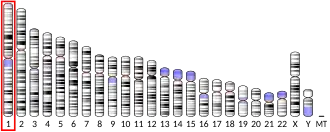



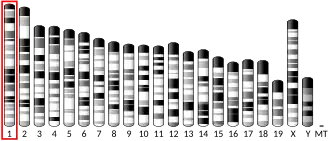

Quiescin sulfhydryl oxidase 1 is an enzyme that in humans is encoded by the QSOX1 gene.[5][6][7]
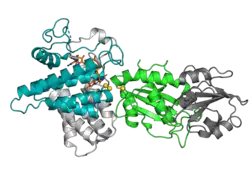
This gene encodes an enzyme that is localized primarily to the Golgi apparatus and secreted fluids.[8] QSOX1 is a multi-domain disulfide catalyst. Unlike other disulfide catalysts, QSOX1 can both generate disulfides de novo and catalyze dithiol/disulfide exchange. The de novo disulfide bond formation is catalyzed by the ERV1 domain that contains a FAD co-factor that allows depositions of electrons onto the terminal electron acceptor, typically molecular oxygen. The dithiol/disulfide exchange is catalyzed by the thioredoxin domain. The two domains are linked together by a flexible linker that allows the thioredoxin domain to first interact with the substrate protein and then regenerate by ERV1 domain.[9]
QSOX1 gene expression is induced as fibroblasts begin to exit the proliferative cycle and enter quiescence,[10][11] suggesting that this gene plays an important role in growth regulation. In fibroblasts QSOX1 is required for normal incorporation of laminin into the extracellular matrix, and thereby for normal cell-cell adhesion and cell migration.[12]
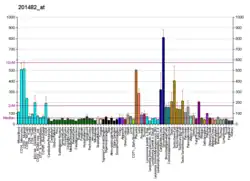
Two transcript variants encoding two different isoforms have been found for this gene.[13][7] The two isoforms have different tissue distribution and in addition isoform 1 has a transmembrane helix in the carboxy terminal while isoform 2 is a secreted soluble protein.
References
- 1 2 3 GRCh38: Ensembl release 89: ENSG00000116260 – Ensembl, May 2017
- 1 2 3 GRCm38: Ensembl release 89: ENSMUSG00000033684 – Ensembl, May 2017
- ↑ "Human PubMed Reference:". National Center for Biotechnology Information, U.S. National Library of Medicine.
- ↑ "Mouse PubMed Reference:". National Center for Biotechnology Information, U.S. National Library of Medicine.
- ↑ Coppock DL, Cina-Poppe D, Gilleran S (December 1998). "The quiescin Q6 gene (QSCN6) is a fusion of two ancient gene families: thioredoxin and ERV1". Genomics. 54 (3): 460–468. doi:10.1006/geno.1998.5605. PMID 9878249.
- ↑ Coppock DL, Kopman C, Scandalis S, Gilleran S (June 1993). "Preferential gene expression in quiescent human lung fibroblasts". Cell Growth & Differentiation. 4 (6): 483–493. PMID 8396966.
- 1 2 "Entrez Gene: QSCN6 quiescin Q6".
- ↑ Kodali VK, Thorpe C (October 2010). "Oxidative protein folding and the Quiescin-sulfhydryl oxidase family of flavoproteins". Antioxidants & Redox Signaling. 13 (8): 1217–1230. doi:10.1089/ars.2010.3098. PMC 2959182. PMID 20136510.
- ↑ Alon A, Grossman I, Gat Y, Kodali VK, DiMaio F, Mehlman T, et al. (August 2012). "The dynamic disulphide relay of quiescin sulphydryl oxidase". Nature. 488 (7411): 414–418. doi:10.1038/nature11267. PMC 3521037. PMID 22801504.
- ↑ Coppock DL, Cina-Poppe D, Gilleran S (December 1998). "The quiescin Q6 gene (QSCN6) is a fusion of two ancient gene families: thioredoxin and ERV1". Genomics. 54 (3): 460–468. doi:10.1006/geno.1998.5605. PMID 9878249.
- ↑ Coppock DL, Kopman C, Scandalis S, Gilleran S (June 1993). "Preferential gene expression in quiescent human lung fibroblasts". Cell Growth & Differentiation. 4 (6): 483–493. PMID 8396966.
- ↑ Ilani T, Alon A, Grossman I, Horowitz B, Kartvelishvily E, Cohen SR, et al. (July 2013). "A secreted disulfide catalyst controls extracellular matrix composition and function". Science. 341 (6141): 74–76. doi:10.1126/science.1238279. PMID 23704371.
- ↑
- Radom J, Colin D, Thiebault F, Dognin-Bergeret M, Mairet-Coello G, Esnard-Feve A, et al. (May 2006). "Identification and expression of a new splicing variant of FAD-sulfhydryl oxidase in adult rat brain". Biochimica et Biophysica Acta. 1759 (5): 225–233. doi:10.1016/j.bbaexp.2006.04.008. PMID 16806532.
Further reading
- Thorpe C, Hoober KL, Raje S, Glynn NM, Burnside J, Turi GK, et al. (September 2002). "Sulfhydryl oxidases: emerging catalysts of protein disulfide bond formation in eukaryotes". Archives of Biochemistry and Biophysics. 405 (1): 1–12. doi:10.1016/S0003-9861(02)00337-5. PMID 12176051.
- Hoober KL, Glynn NM, Burnside J, Coppock DL, Thorpe C (November 1999). "Homology between egg white sulfhydryl oxidase and quiescin Q6 defines a new class of flavin-linked sulfhydryl oxidases". The Journal of Biological Chemistry. 274 (45): 31759–31762. doi:10.1074/jbc.274.45.31759. PMID 10542195.
- Coppock D, Kopman C, Gudas J, Cina-Poppe DA (March 2000). "Regulation of the quiescence-induced genes: quiescin Q6, decorin, and ribosomal protein S29". Biochemical and Biophysical Research Communications. 269 (2): 604–610. doi:10.1006/bbrc.2000.2324. PMID 10708601.
- Clark HF, Gurney AL, Abaya E, Baker K, Baldwin D, Brush J, et al. (October 2003). "The secreted protein discovery initiative (SPDI), a large-scale effort to identify novel human secreted and transmembrane proteins: a bioinformatics assessment". Genome Research. 13 (10): 2265–2270. doi:10.1101/gr.1293003. PMC 403697. PMID 12975309.
]* Beausoleil SA, Jedrychowski M, Schwartz D, Elias JE, Villén J, Li J, et al. (August 2004). "Large-scale characterization of HeLa cell nuclear phosphoproteins". Proceedings of the National Academy of Sciences of the United States of America. 101 (33): 12130–12135. Bibcode:2004PNAS..10112130B. doi:10.1073/pnas.0404720101. PMC 514446. PMID 15302935.
- Liu T, Qian WJ, Gritsenko MA, Camp DG, Monroe ME, Moore RJ, et al. (2006). "Human plasma N-glycoproteome analysis by immunoaffinity subtraction, hydrazide chemistry, and mass spectrometry". Journal of Proteome Research. 4 (6): 2070–2080. doi:10.1021/pr0502065. PMC 1850943. PMID 16335952.
- Lim J, Hao T, Shaw C, Patel AJ, Szabó G, Rual JF, et al. (May 2006). "A protein-protein interaction network for human inherited ataxias and disorders of Purkinje cell degeneration". Cell. 125 (4): 801–814. doi:10.1016/j.cell.2006.03.032. PMID 16713569. S2CID 13709685.
- Chakravarthi S, Jessop CE, Willer M, Stirling CJ, Bulleid NJ (June 2007). "Intracellular catalysis of disulfide bond formation by the human sulfhydryl oxidase, QSOX1". The Biochemical Journal. 404 (3): 403–411. doi:10.1042/BJ20061510. PMC 1896280. PMID 17331072.
- Jaje J, Wolcott HN, Fadugba O, Cripps D, Yang AJ, Mather IH, et al. (November 2007). "A flavin-dependent sulfhydryl oxidase in bovine milk". Biochemistry. 46 (45): 13031–13040. doi:10.1021/bi7016975. PMC 2518652. PMID 17944490.