OR1A1
| OR1A1 | |||||||||||||||||||||||||||||||||||||||||||||||||||
|---|---|---|---|---|---|---|---|---|---|---|---|---|---|---|---|---|---|---|---|---|---|---|---|---|---|---|---|---|---|---|---|---|---|---|---|---|---|---|---|---|---|---|---|---|---|---|---|---|---|---|---|
| Identifiers | |||||||||||||||||||||||||||||||||||||||||||||||||||
| Aliases | OR1A1, OR17-7, olfactory receptor family 1 subfamily A member 1, olfactory receptor family 1 subfamily A member 1 (gene/pseudogene) | ||||||||||||||||||||||||||||||||||||||||||||||||||
| External IDs | OMIM: 618046; MGI: 1333770; HomoloGene: 8219; GeneCards: OR1A1; OMA:OR1A1 - orthologs | ||||||||||||||||||||||||||||||||||||||||||||||||||
| |||||||||||||||||||||||||||||||||||||||||||||||||||
| |||||||||||||||||||||||||||||||||||||||||||||||||||
| |||||||||||||||||||||||||||||||||||||||||||||||||||
| |||||||||||||||||||||||||||||||||||||||||||||||||||
| |||||||||||||||||||||||||||||||||||||||||||||||||||
| Wikidata | |||||||||||||||||||||||||||||||||||||||||||||||||||
| |||||||||||||||||||||||||||||||||||||||||||||||||||
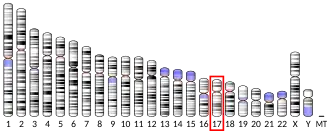



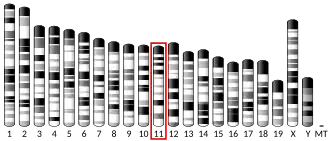

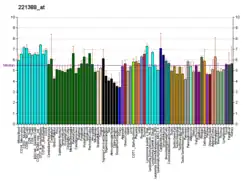
Olfactory receptor 1A1 is a protein that in humans is encoded by the OR1A1 gene.[5][6]
Olfactory receptors interact with odorant molecules in the nose, to initiate a neuronal response that triggers the perception of a smell. The olfactory receptor proteins are members of a large family of G-protein-coupled receptors (GPCR) arising from single coding-exon genes. Olfactory receptors share a 7-transmembrane domain structure with many neurotransmitter and hormone receptors and are responsible for the recognition and G protein-mediated transduction of odorant signals. The olfactory receptor gene family is the largest in the genome.[6]
Ligands
OR1A1 is relatively broadly tuned, meaning it responds to a relatively wide variety of different odor molecules.[7][8] Examples of known ligands, most of which have citrus or fruity smells:[9][10]
See also
References
- 1 2 3 GRCh38: Ensembl release 89: ENSG00000172146 – Ensembl, May 2017
- 1 2 3 GRCm38: Ensembl release 89: ENSMUSG00000070377 – Ensembl, May 2017
- ↑ "Human PubMed Reference:". National Center for Biotechnology Information, U.S. National Library of Medicine.
- ↑ "Mouse PubMed Reference:". National Center for Biotechnology Information, U.S. National Library of Medicine.
- ↑ Glusman G, Sosinsky A, Ben-Asher E, Avidan N, Sonkin D, Bahar A, et al. (January 2000). "Sequence, structure, and evolution of a complete human olfactory receptor gene cluster". Genomics. 63 (2): 227–45. doi:10.1006/geno.1999.6030. PMID 10673334. S2CID 23416814.
- 1 2 "Entrez Gene: OR1A1 olfactory receptor, family 1, subfamily A, member 1".
- 1 2 Saito H, Chi Q, Zhuang H, Matsunami H, Mainland JD (March 2009). "Odor coding by a Mammalian receptor repertoire". Science Signaling. 2 (60): ra9. doi:10.1126/scisignal.2000016. PMC 2774247. PMID 19261596.
- 1 2 Block E, Batista VS, Matsunami H, Zhuang H, Ahmed L (May 2017). "The role of metals in mammalian olfaction of low molecular weight organosulfur compounds". Natural Product Reports. 34 (5): 529–557. doi:10.1039/c7np00016b. PMC 5542778. PMID 28471462.
- 1 2 3 Schmiedeberg K, Shirokova E, Weber HP, Schilling B, Meyerhof W, Krautwurst D (September 2007). "Structural determinants of odorant recognition by the human olfactory receptors OR1A1 and OR1A2". Journal of Structural Biology. 159 (3): 400–12. doi:10.1016/j.jsb.2007.04.013. PMID 17601748.
- ↑ Audouze K, Tromelin A, Le Bon AM, Belloir C, Petersen RK, Kristiansen K, et al. (2014). "Identification of odorant-receptor interactions by global mapping of the human odorome". PLOS ONE. 9 (4): e93037. Bibcode:2014PLoSO...993037A. doi:10.1371/journal.pone.0093037. PMC 3973694. PMID 24695519.
Further reading
- Fuchs T, Malecova B, Linhart C, Sharan R, Khen M, Herwig R, et al. (September 2002). "DEFOG: a practical scheme for deciphering families of genes". Genomics. 80 (3): 295–302. CiteSeerX 10.1.1.135.3652. doi:10.1006/geno.2002.6830. PMID 12213199.
- Malnic B, Godfrey PA, Buck LB (February 2004). "The human olfactory receptor gene family". Proceedings of the National Academy of Sciences of the United States of America. 101 (8): 2584–9. Bibcode:2004PNAS..101.2584M. doi:10.1073/pnas.0307882100. PMC 356993. PMID 14983052.
External links
- OR1A1+protein,+human at the U.S. National Library of Medicine Medical Subject Headings (MeSH)
This article incorporates text from the United States National Library of Medicine, which is in the public domain.