CD180
| CD180 | |||||||||||||||||||||||||||||||||||||||||||||||||||
|---|---|---|---|---|---|---|---|---|---|---|---|---|---|---|---|---|---|---|---|---|---|---|---|---|---|---|---|---|---|---|---|---|---|---|---|---|---|---|---|---|---|---|---|---|---|---|---|---|---|---|---|
| |||||||||||||||||||||||||||||||||||||||||||||||||||
| Identifiers | |||||||||||||||||||||||||||||||||||||||||||||||||||
| Aliases | CD180, LY64, Ly78, RP105, CD180 molecule | ||||||||||||||||||||||||||||||||||||||||||||||||||
| External IDs | OMIM: 602226; MGI: 1194924; HomoloGene: 4077; GeneCards: CD180; OMA:CD180 - orthologs | ||||||||||||||||||||||||||||||||||||||||||||||||||
| |||||||||||||||||||||||||||||||||||||||||||||||||||
| |||||||||||||||||||||||||||||||||||||||||||||||||||
| |||||||||||||||||||||||||||||||||||||||||||||||||||
| |||||||||||||||||||||||||||||||||||||||||||||||||||
| |||||||||||||||||||||||||||||||||||||||||||||||||||
| Wikidata | |||||||||||||||||||||||||||||||||||||||||||||||||||
| |||||||||||||||||||||||||||||||||||||||||||||||||||
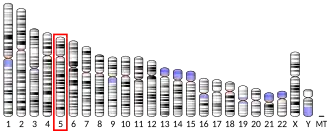



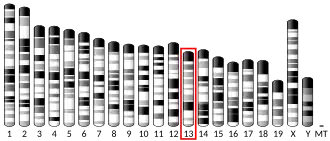

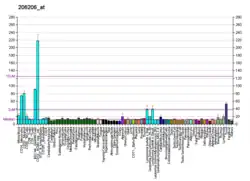
CD180 antigen is a protein that in humans is encoded by the CD180 gene.[5][6][7][8]
CD180 is a cell surface molecule consisting of extracellular leucine-rich repeats (LRR) and a short cytoplasmic tail. It is also known by the archaic terms Bgp-95 and RP105, for the founding designations following discovery in humans (1988) and mice (1994), respectively. CD180 is expressed on antigen presenting cells including B cells and dendritic cells. The extracellular LRR is associated with a molecule called MD-1 and form the cell surface receptor complex, CD180/MD-1. It belongs to the family of pathogen receptors, Toll-like receptors (TLR). CD180/MD-1, by working in concert with TLR4, controls B cell recognition and signaling of lipopolysaccharide (LPS), a membrane constituent of Gram-negative bacteria.[7]
Recently, CD180 has been demonstrated to be involved in the survival and prognosis of B-cell chronic lymphocytic leukemia.[9][10]
References
- 1 2 3 GRCh38: Ensembl release 89: ENSG00000134061 – Ensembl, May 2017
- 1 2 3 GRCm38: Ensembl release 89: ENSMUSG00000021624 – Ensembl, May 2017
- ↑ "Human PubMed Reference:". National Center for Biotechnology Information, U.S. National Library of Medicine.
- ↑ "Mouse PubMed Reference:". National Center for Biotechnology Information, U.S. National Library of Medicine.
- ↑ Miura Y, Shimazu R, Miyake K, Akashi S, Ogata H, Yamashita Y, et al. (Nov 1998). "RP105 is associated with MD-1 and transmits an activation signal in human B cells". Blood. 92 (8): 2815–2822. doi:10.1182/blood.V92.8.2815. PMID 9763566.
- ↑ Miura Y, Miyake K, Yamashita Y, Shimazu R, Copeland NG, Gilbert DJ, et al. (Mar 1997). "Molecular cloning of a human RP105 homologue and chromosomal localization of the mouse and human RP105 genes (Ly64 and LY64)". Genomics. 38 (3): 299–304. doi:10.1006/geno.1996.0632. PMID 8975706.
- 1 2 "Entrez Gene: CD180 CD180 molecule".
- ↑ [4]
- ↑ Porakishvili N, Memon A, Vispute K, Kulikova N, Clark EA, Rai KR, et al. (May 2011). "CD180 functions in activation, survival and cycling of B chronic lymphocytic leukaemia cells". British Journal of Haematology. 153 (4): 486–498. doi:10.1111/j.1365-2141.2011.08605.x. ISSN 0007-1048. PMID 21443749. S2CID 13360804.
- ↑ Gordiienko I, Shlapatska L, Kholodniuk V, Sklyarenko L, Gluzman DF, Clark EA, et al. (2017-10-05). "The interplay of CD150 and CD180 receptor pathways contribute to the pathobiology of chronic lymphocytic leukemia B cells by selective inhibition of Akt and MAPK signaling". PLOS ONE. 12 (10): e0185940. Bibcode:2017PLoSO..1285940G. doi:10.1371/journal.pone.0185940. ISSN 1932-6203. PMC 5628907. PMID 28982149.
Further reading
- Honda Y, Yamagiwa S, Matsuda Y, et al. (2007). "Altered expression of TLR homolog RP105 on monocytes hypersensitive to LPS in patients with primary biliary cirrhosis". J. Hepatol. 47 (3): 404–411. doi:10.1016/j.jhep.2007.03.012. PMID 17448566.
- Divanovic S, Trompette A, Atabani SF, et al. (2005). "Negative Regulation of TLR4 Signaling by RP105". Nat. Immunol. 6 (6): 571–578. doi:10.1038/ni1198. PMC 2144914. PMID 15852007.
- Gerhard DS, Wagner L, Feingold EA, et al. (2004). "The Status, Quality, and Expansion of the NIH Full-Length cDNA Project: The Mammalian Gene Collection (MGC)". Genome Res. 14 (10B): 2121–2127. doi:10.1101/gr.2596504. PMC 528928. PMID 15489334.
- Suzuki Y, Yamashita R, Shirota M, et al. (2004). "Sequence Comparison of Human and Mouse Genes Reveals a Homologous Block Structure in the Promoter Regions". Genome Res. 14 (9): 1711–1718. doi:10.1101/gr.2435604. PMC 515316. PMID 15342556.
- Zhang Z, Henzel WJ (2005). "Signal peptide prediction based on analysis of experimentally verified cleavage sites". Protein Sci. 13 (10): 2819–2824. doi:10.1110/ps.04682504. PMC 2286551. PMID 15340161.
- Izmailova E, Bertley FM, Huang Q, et al. (2003). "HIV-1 Tat reprograms immature dendritic cells to express chemoattractants for activated T cells and macrophages". Nat. Med. 9 (2): 191–197. doi:10.1038/nm822. PMID 12539042. S2CID 26145639.
- Strausberg RL, Feingold EA, Grouse LH, et al. (2003). "Generation and initial analysis of more than 15,000 full-length human and mouse cDNA sequences". Proc. Natl. Acad. Sci. U.S.A. 99 (26): 16899–16903. Bibcode:2002PNAS...9916899M. doi:10.1073/pnas.242603899. PMC 139241. PMID 12477932.
- Miyake K, Shimazu R, Kondo J, et al. (1998). "Mouse MD-1, a molecule that is physically associated with RP105 and positively regulates its expression". J. Immunol. 161 (3): 1348–1353. doi:10.4049/jimmunol.161.3.1348. PMID 9686597.
External links
- Human CD180 genome location and CD180 gene details page in the UCSC Genome Browser.
- Overview of all the structural information available in the PDB for UniProt: Q99467 (Human CD180 antigen) at the PDBe-KB.
- Overview of all the structural information available in the PDB for UniProt: Q62192 (Mouse CD180 antigen) at the PDBe-KB.