Oxiconazole
 | |
| Clinical data | |
|---|---|
| Trade names | Oxistat, Oxizole |
| AHFS/Drugs.com | Monograph |
| MedlinePlus | a689004 |
| ATC code | |
| Identifiers | |
IUPAC name
| |
| CAS Number | |
| PubChem CID | |
| DrugBank | |
| ChemSpider | |
| UNII | |
| KEGG | |
| ChEBI | |
| ChEMBL | |
| CompTox Dashboard (EPA) | |
| Chemical and physical data | |
| Formula | C18H13Cl4N3O |
| Molar mass | 429.12 g·mol−1 |
| 3D model (JSmol) | |
SMILES
| |
InChI
| |


Oxiconazole (trade names Oxistat in the US, Oxizole in Canada) is an antifungal medication typically administered in a cream or lotion to treat skin infections, such as athlete's foot, jock itch and ringworm. It can also be prescribed to treat the skin rash known as tinea versicolor, caused by systemic yeast overgrowth (Candida spp.).
It was patented in 1975 and approved for medical use in 1983.[1]
Synthesis
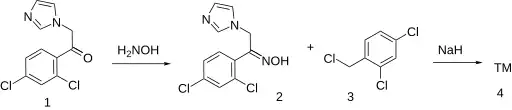
Treatment of the ketone (1) with hydroxylamine gives the oxime (2), which is alkylated with 2,4-dichlorobenzyl chloride (3) in the presence of the strong base sodium hydride to give oxiconazole.[2][3]
See also
References
- ↑ Fischer J, Ganellin CR (2006). Analogue-based Drug Discovery. John Wiley & Sons. p. 503. ISBN 9783527607495.
- ↑ Georg Mixich, Kurt Thiele, U.S. patent 4,550,175 (1985 to Siegfried Aktiengesellschaft).
- ↑ "Oxiconazole". Thieme. Retrieved 2024-06-30.
External links
- MedlinePlus - Oxiconazole
This article is issued from Wikipedia. The text is licensed under Creative Commons - Attribution - Sharealike. Additional terms may apply for the media files.