Nasal bridge
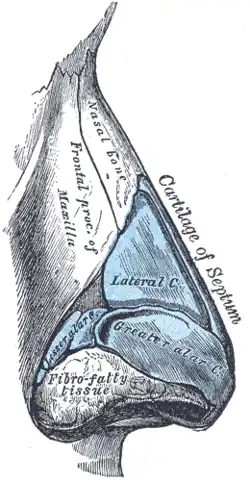

The nasal bridge is the upper, bony part of the nose, which overlies the nasal bones.
Association with epicanthic folds
Low-rooted nasal bridges are closely associated with epicanthic folds. A lower nasal bridge is more likely to cause an epicanthic fold, and vice versa.[1]
Dysmorphology
A lower or higher than average nasal bridge can be a sign of various genetic disorders, such as fetal alcohol syndrome. A flat nasal bridge can be a sign of Down syndrome (Trisomy 21), Fragile X syndrome, 48,XXXY variant Klinefelter syndrome,[2] or Bartarlla-Scott syndrome. A broad nasal bridge can be a sign of Snijders Blok–Campeau syndrome.[3]
An appearance of a widened nasal bridge can be seen with dystopia canthorum, which is a lateral displacement of the inner canthi of the eyes.[4] Dystopia canthorum is associated with Waardenburg syndrome.[5]
See also
- Aquiline nose – Human nose with a prominent bridge
- Bridge piercing – Facial piercing through the skin on the nasal bridge
References
- ↑ Montagu, A. (1989) Growing Young N.Y.: McGraw Hill pp. 40
- ↑ Klinefelter Syndrome Clinical Presentation
- ↑ Drivas, Theodore G.; Li, Dong; Nair, Divya; Alaimo, Joseph T.; Alders, Mariëlle; Altmüller, Janine; Barakat, Tahsin Stefan; Bebin, E. Martina; Bertsch, Nicole L.; Blackburn, Patrick R.; Blesson, Alyssa (October 2020). "A second cohort of CHD3 patients expands the molecular mechanisms known to cause Snijders Blok-Campeau syndrome". European Journal of Human Genetics. 28 (10): 1422–1431. doi:10.1038/s41431-020-0654-4. ISSN 1476-5438. PMC 7608102. PMID 32483341.
- ↑ Genetic Hearing Loss Archived 2013-02-17 at the Wayback Machine from UTMB, Dept. of Otolaryngology. DATE: March 17, 2004. RESIDENT PHYSICIAN: Jing Shen. FACULTY PHYSICIAN: Ronald W. Deskin, MD. SERIES EDITORS: Francis B. Quinn, Jr., MD and Matthew W. Ryan, MD.
- ↑ Tagra S, Talwar AK, Walia RL, Sidhu P (2006). "Waardenburg syndrome". Indian J Dermatol Venereol Leprol. 72 (4): 326. doi:10.4103/0378-6323.26718. PMID 16880590.